



NEWYou can now listen to Fox News articles!
The Trump administration’s new National Security Strategy marks a sweeping shift in America’s defense priorities, downplaying Islamic terrorism and decades of Middle East–centric policymaking in favor of asserting U.S. dominance in the Western Hemisphere and treating mass migration as the top national security threat.
In language that departs from every post-9/11 strategy document, the White House argues that the Middle East is no longer the primary driver of global instability and says the “era of mass migration must end,” elevating border security and counter-cartel operations to core national defense missions.
“The days in which the Middle East dominated American foreign policy in both long-term planning and day-to-day execution are thankfully over — not because the Middle East no longer matters, but because it is no longer the constant irritant, and potential source of imminent catastrophe, that it once was,” the document says.
“It is rather emerging as a place of partnership, friendship, and investment — a trend that should be welcomed and encouraged.”
AS TRUMP’S STANDOFF WITH MADURO DEEPENS, EXPERTS WARN THE NEXT MOVE MAY FORCE A SHOWDOWN
The strategy introduces a “Trump Corollary” to the Monroe Doctrine to block foreign powers from gaining influence in the Americas and calls for shifting military resources away from long-standing theaters abroad. The original Monroe Doctrine warned European powers against interfering in the Western Hemisphere; its revival — and expansion — signals one of the clearest hemispheric doctrines in modern U.S. foreign policy.
Alex Plitsas, a former Army intelligence officer, Pentagon official and current senior fellow at the Atlantic Council, questioned the strategy’s emphasis on hemispheric threats over global ones.
“The most significant threats to the United States — whether terrorism or near-peer adversaries — are not in the Western Hemisphere, but in Africa, the Middle East, Eurasia, and Eastern Asia,” he said. He pointed to Russia’s posture in Europe and rising tensions with China, warning that “we have attempted to hide behind our oceans before. It has yet to work as a strategy.”
The move reflects a broader effort to redefine U.S. national security around hemispheric threats, migration pressures and great-power competition instead of Islamist extremism, either at home or abroad.
The document argues that instability in Latin America — from record migration flows to cartel violence to expanding Chinese and Russian influence — now poses more direct risks to the U.S. homeland than conflicts in the Middle East. Administration officials have increasingly described the Western Hemisphere as the “front line” of border security, supply chain reliability and geopolitical rivalry.
Emily Harding, a senior fellow at the Center for Strategic and International Studies (CSIS), said the shift reflects the relative quiet in the Middle East today but compared the region to a famous line from “The Godfather Part III”: “You try to get out, and then it sucks you back in,” she said.
“Islamic terrorism does seem more contained than at any point in the last 20 years, but the Middle East has a way of pulling the United States back in,” she told Fox News Digital, noting that regional crises have repeatedly derailed attempts by past administrations to pivot elsewhere.
AMERICANS WANT US TO LEAD GLOBALLY BUT DOUBT MILITARY CAN WIN MAJOR WARS OVERSEAS, SURVEY FINDS
The document, which every new White House releases to outline its thinking around security strategy, was released less than two weeks after the shooting of two National Guard members in Washington, D.C. by an Afghan national in what’s being investigated as a terror attack. On Thursday, Immigration and Customs Enforcement (ICE) officials arrested another Afghan national who came to the U.S. after the 2021 withdrawal and who they say was providing support to ISIS-K. On October 31, two men were arrested for allegedly plotting an ISIS-inspired Halloween attack in Michigan.
Terrorism is no longer a standalone pillar of the strategy: instead, it’s lumped in with threats associated with migration. The administration argues that such cases reflect failures in border security and vetting rather than evidence that Islamist terrorism remains a leading global danger.
“We want to protect this country, its people, its territory, its economy, and its way of life from military attack and hostile foreign influence, whether espionage, predatory trade practices, drug and human trafficking, destructive propaganda and influence operations, cultural subversion, or any other threat to our nation,” the document states. “We must protect our country from invasion, not just from unchecked migration but from cross-border threats such as terrorism, drugs, espionage, and human trafficking,” it goes on.
The document does mention Islamic terrorism once: “We must remain wary of resurgent Islamist terrorist activity in parts of Africa while avoiding any long-term American presence or commitments.”
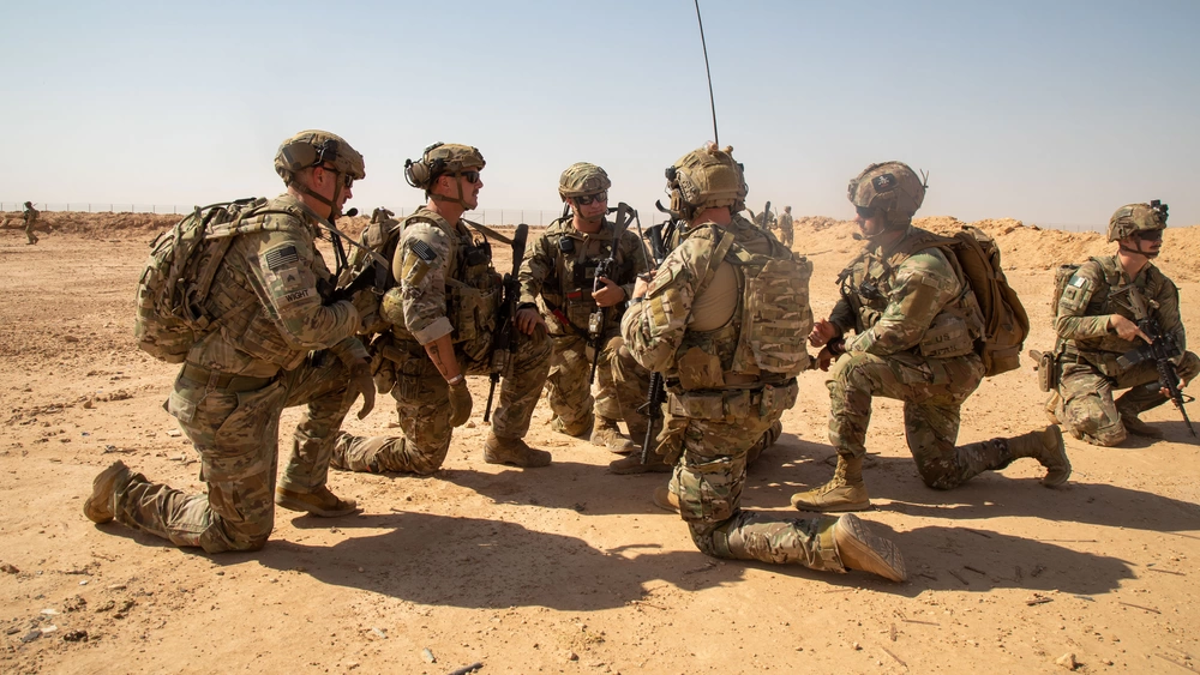
It calls for “targeted deployments to secure the border and defeat cartels, including where necessary the use of lethal force.” The Pentagon has launched over 20 maritime strikes on alleged drug traffickers, and President Donald Trump is considering launching strikes on Venezuelan territory.
Plitsas warned that the shift away from terrorism could carry risks. “The terrorist threat to the U.S. homeland remains — the groups and locations posing the most significant threats have simply shifted,” he said. He pointed to ISIS-Khorasan in Central Asia and a vast Sahel region in Africa “half the size of the United States” where ISIS and al-Qaeda affiliates “operate with relative impunity.”
Read the White House National Security Strategy document below. App users: Click here
Plitsas noted that while policymakers may want to pivot away from the Middle East, reality often intervenes. “The United States may be done with the Middle East and terrorism, but terrorism and the Middle East are not done with us,” he said. “The U.S. has tried to pivot away several times, only to be pulled back in by the rise of ISIS or by Hamas’s attack on October 7. The enemy has a say.”
Coordination with the Taliban has done a “decent job of forcing al-Qaeda and ISIS-K out of Afghanistan,” but Plitsas echoed concerns that may arise among Middle Eastern allies: does U.S. withdrawal create a vacuum for terrorist groups and adversaries to exploit?
“Withdrawing U.S. forces would mean breaking security commitments, and adversaries like Iran will absolutely fill the vacuum,” he said.
Whether the administration will translate the document’s rhetoric into policy remains uncertain; previous presidents have struggled to align national security strategies with real-world deployments. The document does not offer any specific insight into force posture changes.
CLICK HERE TO DOWNLOAD THE FOX NEWS APP
Even as the strategy emphasizes the Western Hemisphere, it dedicates several pages to China and the Indo-Pacific and the importance of domestic supply chains and strengthening military deterrence in the South China Sea.
Harding said one of its most striking components is its treatment of China’s expanding footprint in Latin America. “It essentially puts China on notice. They’re saying partners who choose the U.S. will be rewarded, and those who pick China are going to feel consequences.”
Read the full article here

![Mass Elementary School Teacher Arrested After ‘Thrusting’ with Student on Lap [WATCH]](https://www.lifezette.com/wp-content/uploads/2025/12/2025.12.05-09.29-lifezette-6932a5f3b5dc3.jpg "Mass Elementary School Teacher Arrested After ‘Thrusting’ with Student on Lap [WATCH]")