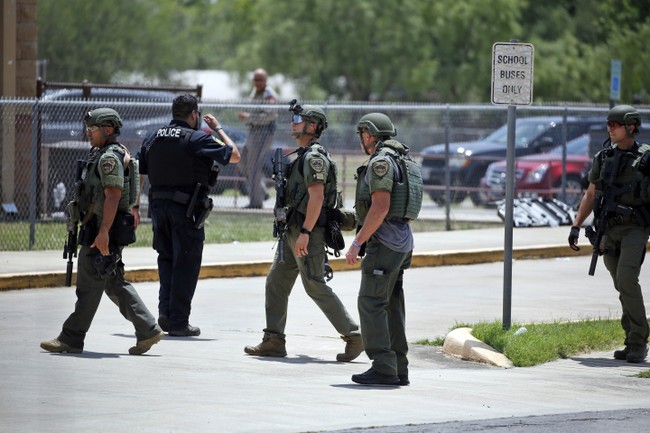

The first trial of a police officer who was present at the Uvalde school shooting began last Monday. Former officer Adrian Gonzales was the first officer to arrive on the scene that day and the only one who was present before the shooter entered the building. He is being charged with 29 counts of child abandonment or endangerment.
The prosecution case got off to a bad start last week when one of the witnesses, Stephanie Hale, testified she had seen the shooter before he entered the building. That testimony appeared to contradict a statement she had given to law enforcement four days after the shooting in which she never mentioned seeing the shooter. The defense claimed that the change in Hale’s testimony had never been revealed to the defense (a possible Brady violation) and requested a mistrial.
Judge Harle denied that request for a mistrial but by the next day he decided that, in order to be fair to the defense, he would as the jury to disregard all of Hale’s testimony. Families of the victims who were in court witnessing this setback were frustrated. One said the prosecutors appeared “incompetent.”
This week the prosecutors seem to have gotten their case back on track thanks to testimony from a key witness. Melodye Flores was a teacher’s aid at Robb Elementary. When she heard there was a man with a gun seen outside over her radio, she rushed out to make sure there were no children playing in the area.
While she was outside, she was the shooter approaching the building. She ran away and tripped. For a moment she thought she had been shot. Seconds later, officer Gonzales pulled up in his car and got out. Flores immediately told him she’d seen the shooter and that he was headed for the building.
“I told him that [the shooter] needed to get stopped before he went into the fourth-grade building,” she testified.
“And what did he say?” prosecutor Bill Turner asked.
“He, just, nothing,” Flores said.
“Did you say it more than once?” Turner asked.
“I did,” Flores said, telling jurors she urged Gonzales to intervene two or three times…
“I just kept pointing. ‘He’s going in there, he’s going to the fourth-grade building,'” she told jurors…
“When you told the officer to go in, did he go in?” Turner asked.
“No,” she said.
“What did he do?” Turner asked.
“He just stayed there,” she said.
Gonzales’ response, according to him, was to put out a warning over the radio and to call for backup. But it would be another 5-6 minutes before he and three other officers would go inside and attempt to engage the shooter. By that point the shooter had already shot his way inside a classroom and when he fired at the approaching police, they withdrew and didn’t try again for another 75 minutes.
Police officers get standard training on how to deal with active shooters. The gist of that training is to engage the shooter immediately and attempt to neutralize him. Officer Gonzales not only had received this training but he had taught it to others including just a couple months before the shooting at Robb Elementary.
Two months before the shooting, Gonzales taught a course about responding to active shooters, according to testimony from Teresa Zamarripa, the officer manager at Southwest Texas College Law Enforcement Agency.
So Gonzales knew what he was supposed to do but when confronted with actually doing it against an active shooter he froze up and resorted to asking for help on his radio.
That wasn’t the only bad decision made that day but it was certainly one of the most consequential. Had he moved quickly, he might have been able to engage the shooter before he entered the building or at least before he made his way into a classroom full of kids. By waiting, he gave time for the shooter to find victims and to hide himself behind a door.
Even if he’d engaged the shooter it’s possible Gonzales would have been shot and not been able to stop what happened next. No doubt that’s what made him hesitate. He was outgunned in a 1 on 1 shootout. The shooter had an AR-15 and Gonzales only had a handgun. On the other hand, the shooter did not have body armor that day (he wore a vest but it didn’t have any plates in it). So it’s possible Gonzales could have seriously injured the shooter with his weapon, ending the conflict before anyone had been killed. But he would have had to follow his training and engage for that to happen. Instead he “just stayed there.”
Editor’s Note: Do you enjoy Hot Air’s conservative reporting that takes on the radical left and woke media? Support our work so that we can continue to bring you the truth.
Join Hot Air VIP and use promo code FIGHT to receive 60% off your membership.
Read the full article here

![Anti-ICE Karen Gets Dragged Out of Her Car as Tensions Escalate in Minneapolis [WATCH]](https://www.lifezette.com/wp-content/uploads/2026/01/2026.01.14-09.43-lifezette-69676550aff02.jpg "Anti-ICE Karen Gets Dragged Out of Her Car as Tensions Escalate in Minneapolis [WATCH]")
![Lionel Richie, 77, Suddenly Falls Ill Onstage Halts Tour Kickoff In St. Paul, Minnesota [WATCH]](https://www.boredtrashpanda.com/wp-content/uploads/2026/06/2026.06.25-17.09-boredtrashpanda-6a3d60ac0ab9b.jpg "Lionel Richie, 77, Suddenly Falls Ill Onstage Halts Tour Kickoff In St. Paul, Minnesota [WATCH]")