
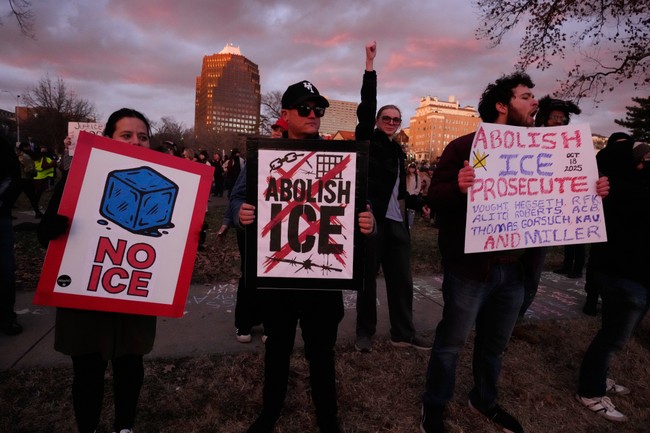

White some news outlets are still doing resistance journalism, the NY Times has published a story that takes a more even-handed look at the odds Jonathan Ross, the ICE agent who shot and killed Renee Good, could be prosecuted. The short answer is maybe, but it probably won’t be easy.
There would be many obstacles for any prosecutors trying to bring a case against the Immigration and Customs Enforcement agent who fatally shot a woman in Minneapolis last week.
If the state were to charge the agent, the U.S. Constitution makes it difficult for state authorities to prosecute federal officers for actions taken while on duty.
Even if the state cleared that hurdle, it is difficult to convict law enforcement officers in any circumstances, let alone those as contentious as the shooting of the woman, Renee Nicole Good.
The FBI is currently handling the investigation and the assumption is that the feds will not be brining any charges against Ross. That leaves a possible prosecution by the state but, at present, state officials aren’t even being read in on the FBI investigation. Even if that changes, state charges against a federal agent may not go very far.
That would leave any prosecution of Mr. Ross in the hands of state authorities, who might have jurisdiction to charge the agent but would have to fight for the ability to do so. The Constitution’s Supremacy Clause bars state prosecution of federal officers in a broad range of circumstances.
That clause does not definitively prevent federal officers from ever facing criminal charges. To avoid prosecution, the federal officer must have been performing an act he was “authorized to do by the law of the United States” and have done “no more than what was necessary and proper,” according to a recent judicial opinion.
The burden is on the state to show that an officer overstepped those bounds.
So it’s not impossible that the state could bring a case but it’s unlikely. But even if they get that far, the case still turns on the issue of whether or not the shooting itself was reasonable.
In order to convict Mr. Ross, prosecutors would have to persuade a judge or jury that a reasonable officer, facing the same situation as Mr. Ross, would not have shot Ms. Good.
A court may be asked to weigh evidence such as which direction the car’s wheels were facing when the agent fired and where exactly he was standing. But “what matters is what he perceived,” said Ed Obayashi, a California sheriff’s deputy who is also a special prosecutor in use-of-force cases. “I don’t want to get hit by a 5,000-pound moving object, even if it is going slow.”
Ashley Heiberger, a retired police captain and use of force expert, noted that an officer’s actions are supposed to be weighed without the benefit of hindsight.
In other words, Ross didn’t know at the moment the car was moving at him that it would continue swerving to the right and he would only be sideswiped, not run over.
However, there is one other wrinkle here, one that I’ve brought up before. If the case made it to trial, Ross’s defense would be asked to justify each shot he fired, not just the first one. His first shot happened as he was being struck by the car and went through the front windshield. However, he fired two more shots which apparently entered the side window.
Paul Butler, an expert on police use of force who teaches at Georgetown’s law school, noted that the sequence of the shots and the position from which they were fired would be relevant.
“If Bullet One were fired right before or at the moment where the car hit him or grazed him, and Bullets Two and Three were fired shortly after that, under the law, he would still have to demonstrate that he reasonably feared for his life” when he fired each shot, Mr. Butler said.
I think this is where Ross’s defense could fall apart. His initial actions look legally justifiable to me, but It could depend on which shots hit Good and which ones are deemed to have killed her, i.e. the autopsy findings. If the first shot through the windshield struck her and constituted a deadly injury, then I think the shooting would likely be deemed justified. If however the 2nd or 3rd shot which struck her in the head and killed her, the case for self-defense looks pretty weak at that instant.
Hopefully we’ll get answers to some of these questions as the investigation continues. But the bottom line is that none of this is a slam dunk as some on the left are claiming. This case many never go to trial and even if it does it could turn out to be a close call.
Editor’s Note: Do you enjoy Hot Air’s conservative reporting that takes on the radical left and woke media? Support our work so that we can continue to bring you the truth.
Join Hot Air VIP and use promo code FIGHT to receive 60% off your membership.
Read the full article here

![OnlyFans Models Arrested After Dispute on Flight Gets Crazy [WATCH]](https://www.rvmnews.com/wp-content/uploads/2025/08/2025.08.04-08.30-rvmnews-6891187c13b53.jpg "OnlyFans Models Arrested After Dispute on Flight Gets Crazy [WATCH]")



![Clive Davis, Legendary Music Visionary Behind Whitney Houston, Carrie Underwood, Dies at 94 [WATCH]](https://www.boredtrashpanda.com/wp-content/uploads/2026/06/2026.06.23-14.11-boredtrashpanda-6a3a941405e2a.jpg "Clive Davis, Legendary Music Visionary Behind Whitney Houston, Carrie Underwood, Dies at 94 [WATCH]")