Years ago, I worked in a large office building with a woman who walked with a terrible limp. Not a slight hitch, but a pronounced, jarring gait caused by a car accident that left her with significant bone loss in one leg. She was a delightful person, but no one could ignore the limp. It shaped how she moved through the world and, at times, how the world responded to her.
She lived that way for more than 25 years.
Liberation may begin with a D-Day assault or a precision, middle-of-the-night special-forces strike, but rehabilitation always moves slower.
Then one morning, everything changed.
She walked into the office upright and steady. No limp. No sway. Her posture looked different. Her face looked different. The transformation was so striking, people stopped what they were doing just to stare.
An orthotist had fitted her with a lift for her shoe. For the first time in decades, her body was aligned.
It felt dramatic. It felt hopeful.
Three weeks later, she showed up at work limping again.
When I asked what happened, she looked down and said quietly, “It was too painful.”
For years, that story stayed with me. I assumed she should have pushed through the discomfort. If she really wanted to walk straight, I thought, she would have endured the pain. I put the burden on her.
Decades later, while talking with the man who makes my wife’s prosthetic legs — who is also a certified orthotist — I mentioned the story. He didn’t hesitate.
“That was the orthotist’s fault.”
With that degree of limb difference, he explained, correction must happen in small increments over time. You do not force a body that has adapted to damage for decades into alignment overnight. The shock alone can undo the good you intend. Pain, in that case, isn’t weakness. It’s warning.
The problem was never the goal of walking straight. It was the pace. The change looked impressive, but it couldn’t last.
Had she been guided wisely, she might still be walking straight today.
That realization reshaped how I think about far more than posture and gait.
RELATED: Do not pass the plow: The danger of declaring a golden age without repentance
Photo by Philippe LOPEZ / AFP via Getty Images
We talk a lot about sustainability, but the word often gets treated as corporate jargon. In real life, it means something simpler: Can you keep going without being damaged by the very solution meant to help you?
The question isn’t whether disruption can be endured for a season. The question is what happens when it lasts long enough to reshape the body, the household, or even a culture itself.
The longer misalignment persists, the more people adjust to it. Not because it’s right, but because it becomes familiar.
I think of family caregivers who, like that woman, adapt to dysfunction. They normalize exhaustion. They compensate for imbalance. What once felt untenable becomes routine. The standard slowly drops, and despair and resentment find room to grow.
This pattern doesn’t stop with individuals.
It shows up in institutions and nations, especially those emerging from long seasons of corruption, fear, or misrule. The fraud being uncovered in Minnesota will not be corrected quickly. Venezuela didn’t unravel overnight, and it won’t be restored all at once. Iran won’t shed decades of tyranny through slogans or spectacle. Systems deformed over time don’t heal on announcement alone.
Liberation may begin with a D-Day assault or a precision, middle-of-the-night special-forces strike, but rehabilitation always moves slower. Hard ground is taken a little at a time. Institutions get rebuilt inch by inch. The work costs money. It lacks glamour. No one escapes it.
Trying to fix everything at once is like forcing a damaged body into alignment without preparation. The result may look decisive, but it often collapses under its own weight.
This is where leadership gets tested.
Not by how loudly change is declared, but by whether it can be endured.
RELATED: When human worth becomes conditional, caregiving becomes impossible
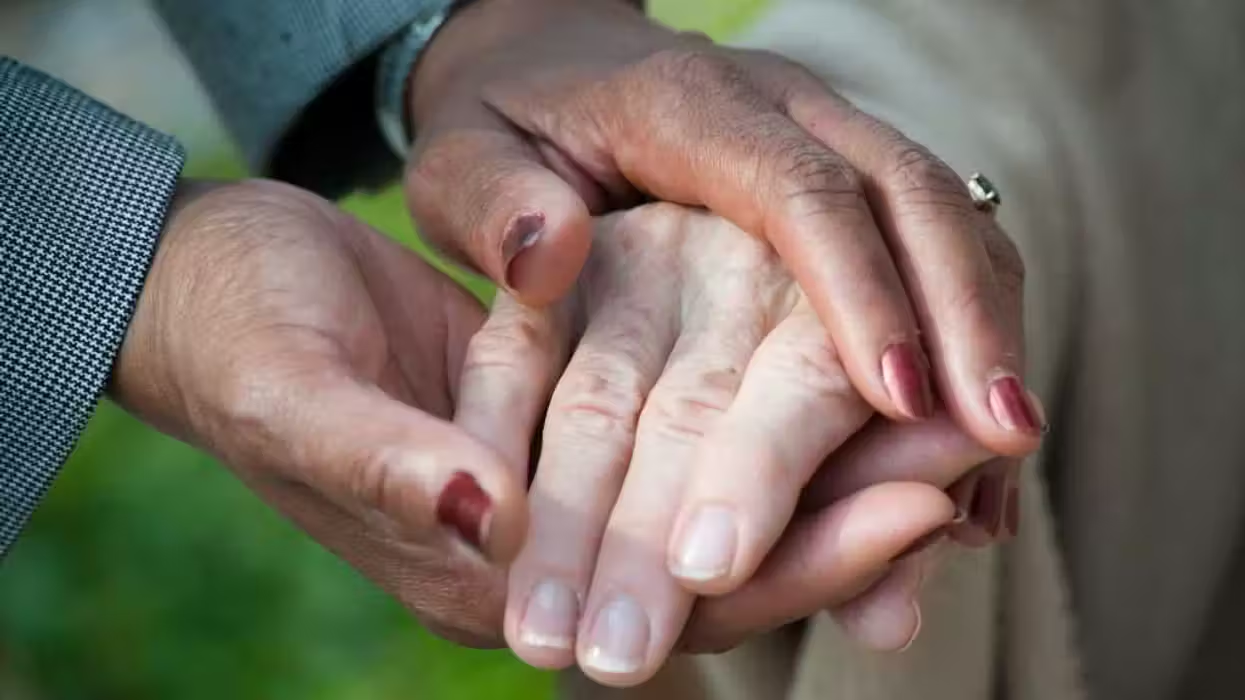 Photo by: Edwin Remsburg/VW Pics via Getty Images
Real leadership doesn’t just name what’s wrong. It requires patience and competence. It understands limits. It moves deliberately. It produces progress people can live with — and live inside — over time.
People can endure difficult change when it leads somewhere stable. What they can’t endure is repeated pain with no lasting gain.
A deliberate pace doesn’t mean abandoning the goal. Real leadership — whether for a caregiver or a nation — recognizes the trauma that brought us here. It refuses to confuse speed with progress. It commits instead to patient steps that straighten what has been bent without breaking what remains.
That kind of leadership doesn’t rush healing. It makes healing possible.
For caregivers, for communities, and for nations, alignment imposed too quickly can injure the very people it claims to help. Alignment applied with patience, competence, and resolve can change a life permanently.
That woman wanted to walk straight. She simply needed someone wise enough to guide her there.
Read the full article here