



Ed covered the news this morning about the layoffs at the Washington Post. As expected, the cuts are significant with somewhere around a third of the staff being fired today. The NY Times points out the irony that Jeff Bezos, of all people, is struggling to sell his paper online.
The company is laying off about 30 percent of all its employees, according to two people with knowledge of the decision. That includes people on the business side and more than 300 of the roughly 800 journalists in the newsroom, the people said.
The cuts are a sign that Jeff Bezos, who became one of the world’s richest people by selling things on the internet, has not yet figured out how to build and maintain a profitable publication on the internet.
The reference to Bezos is appropriate in more than one way. Bezos made his fortune by creating an online marketplace for books. Over time, Amazon started to sell just about everything else. As it did, it began to cut into sales at smaller brick and mortar stores around the country.
As the company spread and promised overnight delivery (or even same-day in some cases) some people stopped shopping at small local stores. It was simply more convenient to place an order for everything you wanted at Amazon and let them bring it to you. Amazon now makes up about 40% of all online shopping and something like 6-10% of all retail shopping in the US. In essence, Amazon took business that used to go to individual shops in every town and moved it online under one corporate roof.
There are plenty of people out there who will tell you Amazon is bad for doing this. But what I always point out to these people is that Amazon won because it offered people something they wanted: convenience. It’s a lot of effort to get in your car and drive 15 minutes to the store for that one thing you need, not sure if they’ll even have it on hand. It’s a lot easier to click a few buttons on your computer and have that item delivered to your door. It also turns out to be cheaper in most cases. People who think Amazon is evil often overlook the fact that Amazon succeeded because millions of people decided it was better. We, collectively, chose this.
Amazon ultimately works because it’s efficient. Instead of 30 small stores run by 30 separate people in every town, you have one big warehouse on the edge of town. That means items can be cheaper and you’re not paying for the overhead of 20 brick and mortar stores trying to compete for pedestrian foot traffic downtown.
The point I’m getting to here is that it seems to me something similar has been happening to the news business. A few decades ago, before the internet changed everything, every decent sized town had its own local paper and big cities had two or three. Many of the smaller papers have faded away over time. Just last year another 136 shut down.
Some 136 newspapers in the United States have closed in the past year, news deserts are expanding and web traffic to the nation’s top newspapers has dropped markedly this decade, according to a report issued Monday that struggles to find hope for the beleaguered news industry…
Taking a step back for an even broader look at the industry is even more troubling. Since 2005, the numbers of newspapers published in the United States has dropped from 7,325 in 2005 to 4,490 now, said the Medill State of Local News report. Daily newspaper circulation that averaged between 50 and 60 million people at the turn of the century now stands at just over 15 million.
Newspapers are closing as people get their news from other sources: TikTok, YouTube, Facebook, X and other social media sites. It turns out that you can distribute news really easily online, a lot easier than selling books and everything else on Amazon. And you can also move a lot of that expensive newsgathering under one roof or at least a low fewer roofs than you used to require. You can centralize and make things more efficient.
It seems we’re far enough in that process that now even the big papers in the big cities are struggling. The LA Times is also owned by a billionaire and has gone through layoffs in the past few years. Why? Because the paper is losing something like $20 million a year. The Washington Post has been in even worse shape, losing as much as $100 million a year in the past few years. Eventually, even Jeff Bezos gets tired of writing checks for $8 million every month with no end in sight.
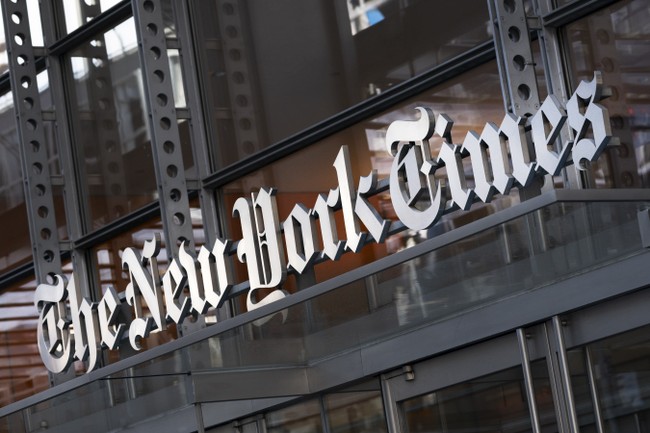
But there is one paper that seems to have figured it out. On the same day the Post was announcing layoffs of a third of its staff, the NY Times announced it gained over a million new subscribers last year.
The New York Times added 1.4 million digital-only subscribers in 2025, including about 450,000 in the last quarter of the year, the company said on Wednesday.
The Times ended the year with 12.78 million total subscribers, a jump that puts it on a pace to reach its stated goal of 15 million by the end of 2027…
Digital subscription revenue increased 13.9 percent year over year to $381.5 million for the fourth quarter, and total subscription revenue grew 9.4 percent to $510.5 million. Digital advertising revenue rose 24.9 percent year over year to $147.2 million, which the company attributed to strong marketer demand and new spots for advertising.
Notice that the growth is digital. These aren’t just people in the New York area. These are subscribers from around the country. The race to be the biggest paper in the nation isn’t even close anymore. I’m getting these numbers from Google’s AI so consider them approximate.
-
The New York Times: 10.3M+ total subscribers (dominated by digital).
-
The Wall Street Journal: 3.749M+ total subscribers (approx. 3M digital).
-
USA Today: Approx. 2.27M–2.6M (strong national digital and print presence).
-
The Washington Post: 2.2M+ subscribers (largely digital)
Like I said, it’s not even close at this point. These are the only papers in the US with more than a millions subscribers. The Post, in the wake of today’s announcement, is about to lose a bunch of those subscribers. And the NY Times is running away with the ball. For better or worse, they have become the Amazon of newspapers. And it’s still early in this process. I think it’s possible the Times could still grow another 50-100%, siphoning off the remaining subscribers from smaller papers like the Washington Post and the LA Times.
Efficiency in distributing books and toilet paper is one thing. When it comes to news, the idea of having one outlet in New York City deciding what is news for the entire country is pretty worrisome to me. I actually think the NY Times has done a decent job of trying to move beyond the demands of its left-wing New York subscriber base. They’ve published some important pieces critical of gender affirming care, for instance. Some on the right don’t seem to be aware of it, but there are lots of people on the far left who hate the Times and see it as compromised.
But it’s always been a left-wing paper and it always will be. It’s always going to default to the left-wing take on everything because everyone in that newsroom is on the left.
The Times was already the most influential paper in the country, now it’s by far the biggest as well. That’s a lot of concentrated power over what people read and ultimately think about. The temptation to abuse that power for political ends is going to be enormous. I think we’re already seeing signs of how they plan to set the agenda and then drive the outcome.
Editor’s Note: Do you enjoy Hot Air’s conservative reporting that takes on the radical left and woke media? Support our work so that we can continue to bring you the truth.
Join Hot Air VIP and use promo code FIGHT to receive 60% off your membership.
Read the full article here


![Billie Eilish’s ‘Stolen Land’ Grammy Rant Called Out by Tribe Whose Land She Lives On [WATCH]](https://www.boredtrashpanda.com/wp-content/uploads/2026/02/2026.02.04-11.14-boredtrashpanda-69832a1e818b3.jpg "Billie Eilish’s ‘Stolen Land’ Grammy Rant Called Out by Tribe Whose Land She Lives On [WATCH]")
![‘We Are Going to Beat the F**king Sh*t Out of Them’: Trump [WATCH]](https://www.lifezette.com/wp-content/uploads/2026/07/2026.07.29-18.57-lifezette-6a6a4d2dba92d.jpg "‘We Are Going to Beat the F**king Sh*t Out of Them’: Trump [WATCH]")
![DCCC Chair Dodges DSA Denunciation While Claiming Democrats Are United [WATCH]](https://www.lifezette.com/wp-content/uploads/2026/07/2026.07.29-19.01-lifezette-6a6a4e27c1758.jpg "DCCC Chair Dodges DSA Denunciation While Claiming Democrats Are United [WATCH]")


![Rand Paul Boots Fauci Lawyer From Hearing as Gallery Erupts in Applause [WATCH]](https://www.lifezette.com/wp-content/uploads/2026/07/2026.07.29-18.55-lifezette-6a6a4cb31c777.jpg "Rand Paul Boots Fauci Lawyer From Hearing as Gallery Erupts in Applause [WATCH]")
![Fauci Gets Torn a New One by Bernie Moreno [WATCH]](https://www.lifezette.com/wp-content/uploads/2026/07/2026.07.30-06.58-lifezette-6a6af62c58262.jpg "Fauci Gets Torn a New One by Bernie Moreno [WATCH]")