


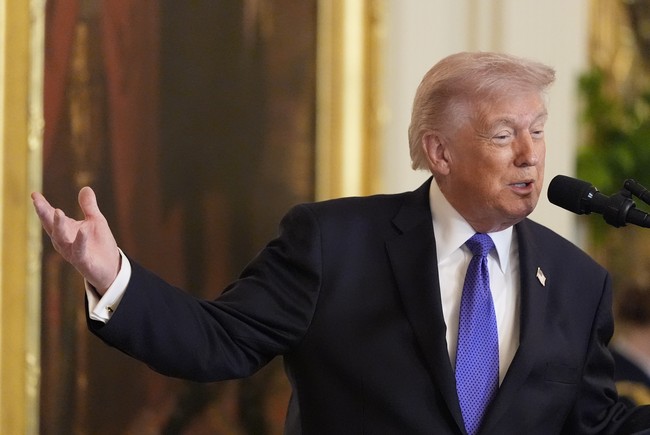

If you get a sense of déjà vu from the headline, imagine how it feels to the Kurds.
Donald Trump and Benjamin Netanyahu both want to collapse the theocratic tyrannical regime in Iran as the best outcome of the war. Neither has the political support or the logistical resources to put boots on the ground to impose that outcome. Trump wants the Iranian people to rise up again to take control of Iran, but the regime’s oppressive security forces have yet to collapse or flee. We’re only on Day 5 of the war, but Trump knows that support for this war will decrease when weeks turn into months, no matter how many times his allies point out that Barack Obama did this for seven months in Libya before Moammar Qaddafi’s military dictatorship finally disintegrated.
It will take some level of armed force to force this crisis into collapse, at least if Trump wants it to happen quickly. Therefore, Trump has turned to an ethnic minority that has a long history of military cooperation with the US, according to the Washington Post, as a way to accelerate matters:
The Trump administration, bracing for more U.S. casualties and considering whether to put troops on the ground in Iran, has begun reaching out to Tehran’s domestic opposition as potential allies to foment an uprising against the regime.
In calls this week to Kurdish minority leaders in Iran and neighboring Iraq, President Donald Trump offered “extensive U.S. aircover” and other backing for anti-regime Iranian Kurds to take over portions of western Iran, according to multiple people familiar with the effort.
“The American request to the Iraqi Kurds is to open the way and not obstruct” Iranian Kurdish groups mobilizing in Iraq, “while also providing logistical support,” said a senior official of the Patriotic Union of Kurdistan, one of two major political parties that govern Iraq’s semi-autonomous Kurdish region.
“Trump was clear in his call” Sunday to PUK leader Bafel Talabani. “He told us the Kurds must choose a side in this battle — either with America and Israel or with Iran,” said the official, one of several Kurdish and U.S. officials who discussed sensitive matters on the condition of anonymity.
The Kurds occupy the northwestern region of Iran, as well as northern Iraq, northeastern Syria, and eastern Turkey. If all of this sounds familiar, it should. The Kurds have been part of American strategy in all four countries for decades, and specifically part of our war strategy in Iraq and Syria since 1991. The Kurds keep betting on the Americans to liberate them, and that bet usually has not paid off. It did to an extent in the 2003 Iraq War, where the Kurds finally got a degree of autonomy, but not the full liberation they preferred.
The most recent use of the Kurds came in Syria. The US allied with Kurdish forces to fight ISIS and then to go after Bashar al-Assad. Turkey strenuously objected to this alliance, as they consider Kurdish military forces to be terrorist organizations, which created no small amount of problems between the US and its putative NATO ally. The Kurds helped topple Assad, but their presence in the coalition became a problem for the US and Israel not soon after:
The standard framing of Syria’s Kurdish lesson runs like this: the opposition promised Kurdish rights, then failed to deliver. The reality was worse. Syria’s Arab nationalist opposition was not merely negligent toward the Kurds — it was more hostile than the Assad regime itself. Assad maintained transactional relationships with certain Kurdish actors. The Syrian National Council and its successors could not manage even that. Kurdish demands for recognition were treated as divisive, secondary, a distraction from the real struggle.
The result was predictable. Kurdish groups built their own structures — autonomous governance in the northeast, the Syrian Democratic Forces, a parallel political and military model. That model became America’s most effective ground partner against ISIS precisely because no other opposition force had the organizational capacity to fill the vacuum.
The sequel is instructive too. Hayat Tahrir al-Sham, which emerged from an Islamist tradition with comparatively less investment in Arab nationalism, has been growing more nationalist as it governs. The Syrian government that replaced Assad launched a military campaign to push out Kurdish SDF forces. The US Special Envoy declared the alliance’s purpose had “largely expired.” Nationalism was not just an inherited ideology in Syria — it was what governance in centralized states produced. Power generated nationalism even in groups that did not start with it.
This pattern cost the Syrian revolution 10 to 15 years of cohesion — despite all the international pressure, despite all the external support, and despite facing a regime far less entrenched than the Islamic Republic.
Iran’s opposition is replicating it at a moment when it can least afford to.
Theoretically, this could provide a moment of cohesion and alliance with the dominant Persian majority. If the Kurds came to the rescue of Iranians against the regime by protecting it militarily while the Iranians take back their country, it could usher in an era of ethnic brotherhood. That would be the best-case scenario. The result could also be a heightening of ethnic conflict and a sense that the Kurds may be trying to seize power for themselves after more than a century of ambitions toward nationhood.
It’s a risk for the US and Israel, certainly. It may be a well-calculated risk, but a risk nonetheless. The Iranian people have given overwhelming celebration to American and even Israeli attacks on the regime as a liberation. Will they greet the Kurds in the same manner? TBD.
One has to wonder whether the Kurds want to take this risk, too. They will have long memories of being promised liberation from Saddam Hussein in 1991, only to see the US cut a deal with Saddam for a cease-fire that lasted twelve more years. We just pushed them out of the Syria settlement, at least to some degree, when their aspirations for autonomy after Assad’s collapse became inconvenient. We may still be their best alternative to the various status quos, but we have not been a terribly reliable ally or benefactor over the last 35 years.
Right now, though, everyone involved recognizes that the Iranian regime retaining power is the worst of all potential outcomes. Perhaps that will be enough to form effective alliances to achieve the ouster of the IRGC and the mullahs, and then everything else can be negotiated later.
Editor’s Note: Thanks to President Trump and his administration’s bold leadership, we are respected on the world stage, and our enemies are being put on notice.
Help us continue to report on the administration’s peace through strength foreign policy and its successes. Join Hot Air VIP and use promo code FIGHT to get 60% off your membership!
Read the full article here


![Demi Lovato Reflects on Teenage Relationship With Much Older Boyfriend Wilmer Valderrama [WATCH]](https://www.boredtrashpanda.com/wp-content/uploads/2026/01/2026.01.02-05.45-boredtrashpanda-6958042e43d7f.jpg "Demi Lovato Reflects on Teenage Relationship With Much Older Boyfriend Wilmer Valderrama [WATCH]")

![ICE Takes Milo Yiannopoulos Into Custody as Laura Loomer Claims Credit [WATCH]](https://www.lifezette.com/wp-content/uploads/2026/08/2026.08.28-20.31-lifezette-6a91f008289c8.jpg "ICE Takes Milo Yiannopoulos Into Custody as Laura Loomer Claims Credit [WATCH]")

![Donald Trump Honors Artemis II Crew, Announces Plans for New U.S. Space Academy [WATCH]](https://www.rvmnews.com/wp-content/uploads/2026/04/2026.04.09-11.47-rvmnews-69d791ca13b77.jpg "Donald Trump Honors Artemis II Crew, Announces Plans for New U.S. Space Academy [WATCH]")