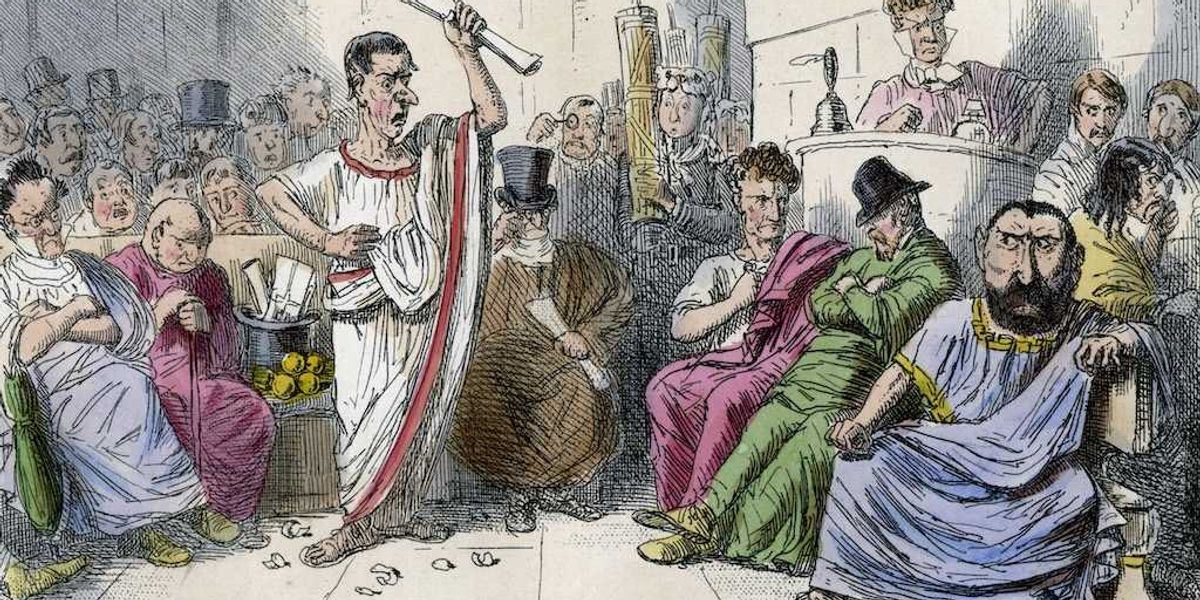

As we head into a contentious election year, campaign messages will soon flood every screen and mailbox. New technologies keep arriving, but political strategy hasn’t changed much over the past 2,000 years.
Need proof? Go back to 64 B.C., when Marcus Tullius Cicero — the Roman Republic’s great orator — ran for consul, the highest office in Rome and the closest analogue to a modern presidency. Cicero’s brother, Quintus, wrote him a blunt, practical memo on how to win. Princeton University Press published that letter in 2012 in Philip Freeman’s translation, “How to Win an Election: An Ancient Guide for Modern Politicians.” The title isn’t clever. It’s accurate.
Quintus didn’t teach Cicero to preach doctrine. He taught him to assemble a majority.
Quintus urged Cicero to treat every appearance “as if your entire future depended on that single event.” Modern technology only amplifies that warning. A bad phrase or a sour expression, caught on camera and looped endlessly, can sink a campaign.
Quintus also mapped the coalition a successful candidate must build. He told Cicero to focus on the supporters who matter most and to shore up those already on his side: “those holding public contracts,” along with “the business community.” He reminded him not to neglect “the special interest groups that back you.” He added a familiar note of retail politics: use “the young people who admire you and want to learn from you,” and rely on “the faithful friends who are daily at your side.”
Government contractors. Business leaders. Interest groups. Youth outreach. A loyal inner circle. Quintus could charge today’s consulting rates and still find clients.
He also gave Cicero the oldest instruction in politics: collect what you’re owed.
“Now is the time to call in all favors,” Quintus wrote. “Don’t miss an opportunity to remind everyone in your debt that they should repay you with their support. For those who owe you nothing, let them know that their timely help will put you in their debt.”
Anyone who has worked in politics has heard the modern version of that message, usually delivered with a smile and a firm handshake.
Quintus emphasized the need to win over the “nobility” and “men of privilege,” including former consuls. Swap “nobility” for major donors and influential business leaders — Elon Musk and Mark Zuckerberg come to mind — and swap “consuls” for ex-governors, former senators, and party grandees. Candidates still chase endorsements from yesterday’s power brokers.
RELATED: Do you want Caesar? Because this is how you get Caesar.
Blaze News Illustration
Quintus also told Cicero to exploit his opponents’ scandals. He described the corruption and sexual misconduct surrounding Cicero’s rivals, Antonius and Catiline, and urged Cicero to use it. Modern history offers obvious parallels. Gary “Monkey Business” Hart. John Edwards and his “love child” saga. Sex scandals keep happening, and campaigns keep weaponizing them.
Quintus warned Cicero about enemies and mistakes. “Since you have so many potential enemies,” he wrote, “you can’t afford to make any mistakes. You must conduct a flawless campaign with the greatest thoughtfulness, industry, and care.” Political hatreds didn’t start with cable news. Cicero faced what today might be called “Cicero derangement syndrome.”
Quintus broke campaigning into two tasks: hold your friends and persuade the public. He offered instructions for both. When it came to organizations Cicero had helped, Quintus told him to press them: “This is the occasion to pay their political debts to you if they want you to look favorably on them in the future.” He boiled down vote-getting to three levers that still move elections: “favors, hope, and personal attachment.”
Then he reached what he called the most important part of campaigning: create goodwill and kindle hope.
“Bring hope to people and a feeling of goodwill toward you,” Quintus urged. But he warned Cicero not to lock himself into specific promises. He told him to reassure each constituency in language it wanted to hear: Tell the Senate you will protect its “power and privileges.” Tell the business community and wealthy citizens you stand for “stability and peace.” Tell ordinary Romans you have always defended their interests.
Quintus didn’t teach Cicero to preach doctrine. He taught him to assemble a majority.
Cicero won, and he won big — more votes than any other candidate. Romans later called him “Father of His Country,” a title Americans associate with George Washington. Quintus became praetor two years later. Both men met violent ends in 43 B.C., as civil war consumed the republic and paved the way for empire.
Their deaths don’t diminish the point. Quintus’ advice endured because it describes permanent truths about politics: ambition, coalition-building, vanity, fear, flattery, and the eternal hunt for advantage.
Tactics and terrain may change, but the playbook didn’t. One wonders — who in our day will leave such a legacy?
Read the full article here