After a midair collision and a train derailment, Congress faces a simple test: Will it follow the evidence?
In aviation, the Senate’s ROTOR Act would mandate improved aircraft surveillance technology after last year’s deadly midair collision involving a military helicopter and a passenger jet. Yet earlier this month, the House failed to advance the bill after Pentagon opposition — sidelining broader use of Automatic Dependent Surveillance-Broadcast, a system that likely would have prevented that tragedy.
Rail risks being locked into prescriptive labor mandates, while aviation safety is undermined by incomplete adoption of proven technology. Neither sector is getting what it needs.
At the same time, a group of senators reintroduced the Railway Safety Act, branding it “data-driven” while again pushing minimum crew mandates — despite no empirical evidence that larger crews reduce accident rates — in response to the 2023 East Palestine derailment.
The impulse is understandable. When tragedy strikes, Washington acts. But acting quickly is not the same as acting on evidence.
If safety is truly the goal, Congress needs to ask a harder question: What actually reduces risk?
The data point in a clear direction. Human error dominates transportation accidents. And the most consistent safety gains in modern transport have come not from adding more people into systems but from improving system design, automation, and structured safety management.
Human error is the core problem
In 2024, roughly 40,000 Americans died in motor vehicle crashes — far outpacing most developed countries on a per-capita basis, according to the National Highway Traffic Safety Administration.
By contrast, aviation and rail — sectors that have embraced automation and safety management systems — post dramatically lower fatality rates. Commercial aviation in developed countries now experiences fatal accidents at rates below 0.1 per million departures. Federal Railroad Administration data show train accident rates have fallen 33% since 2005, with derailments down significantly and human-factor incidents continuing to decline.
The lesson is straightforward: When systems are designed to reduce human error, safety improves.
RELATED: Female Black Hawk pilot didn’t follow orders before horrific crash: Report
Photo by Jabin Botsford/The Washington Post via Getty Images
Automation works — with caveats
Fully autonomous and semi-autonomous vehicle systems have posted lower crash rates in controlled environments. These results require continued scrutiny and larger data sets, but the direction is clear: Reducing reliance on human reaction time reduces collisions.
The same logic applies in aviation and rail.
Automation now governs the vast majority of routine commercial flight operations. Positive train control has sharply reduced train-on-train collisions and overspeed derailments.
Consider last year’s midair collision. Broader, uninterrupted use of ADS-B In and Out would have provided precise real-time traffic awareness to pilots and controllers. The technology exists to prevent exactly this type of conflict, a point highlighted in the BlazeTV documentary “Countdown to the Next Aviation Disaster,” which presaged the January 2025 Reagan National Airport tragedy. Yet expanded deployment has failed to advance despite bipartisan Senate support.
In rail, meanwhile, some lawmakers are moving in the opposite direction — toward mandates for more personnel.
Symbolic safety vs. structural safety
The East Palestine derailment stemmed from a mechanical failure — an overheated bearing — not a shortage of crew members. There were three crew members on board.
Adding personnel would not have prevented a bearing from overheating. Predictive maintenance systems, sensor networks, and better data integration are the tools designed to catch precisely that kind of failure.
Yet the RSA would codify minimum crew requirements across freight rail operations, regardless of route, cargo type, or level of automation.
This isn’t primarily about risk analysis. It reflects political incentives.
Organized interests exert concentrated influence. Diffuse beneficiaries — consumers, shippers, taxpayers — do not.
Labor interests can organize to protect jobs. The Pentagon can block safety rules it opposes. But the public — which wants safer transportation — is too diffuse to mobilize around specific, technical policy choices. The result is a grab bag of special-interest “safety” measures rather than coherent, risk-targeted reform.
RELATED: Trucks destroy roads, but railroads — yes, rail! — can save taxpayers billions
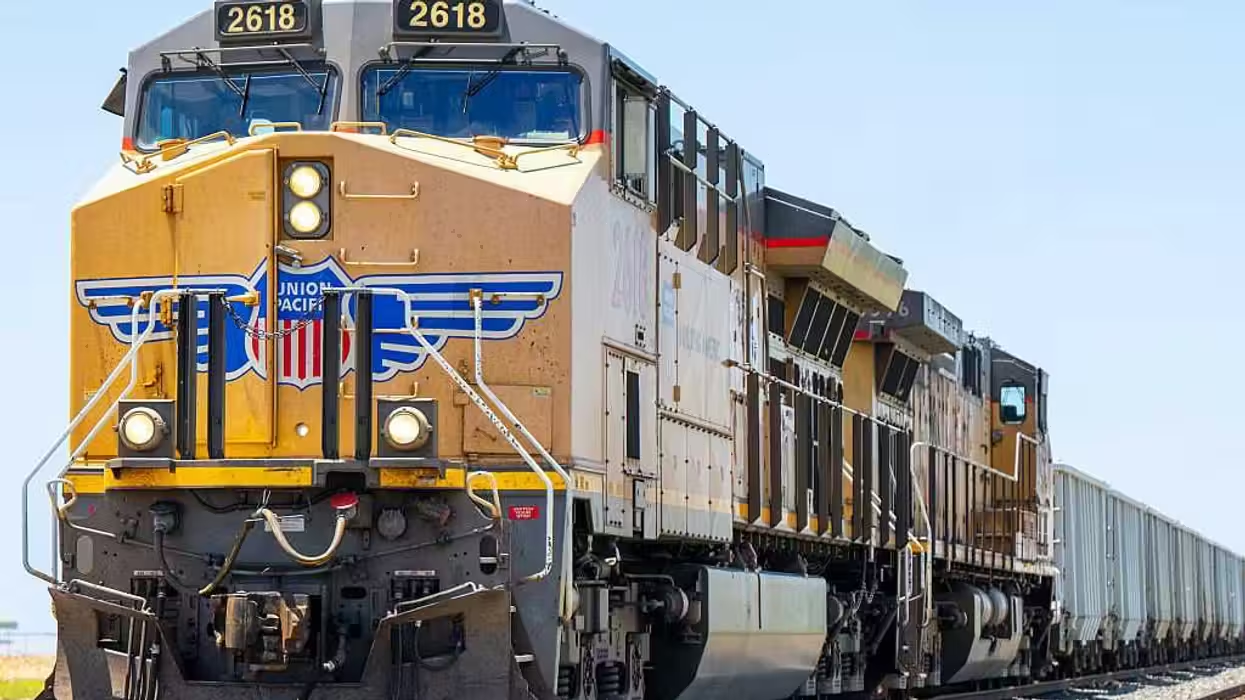 Photo by Brandon Bell/Getty Images
Focus on what works
Freight railroads in the United States are privately funded and capital intensive, investing billions annually in track upgrades, advanced detection systems, and predictive maintenance. Rail remains one of the safest ways to move goods over land because sustained technological improvement compounds over time.
By contrast, the Federal Aviation Administration — a government-run system — has struggled to modernize needed surveillance and air-traffic technologies at speed and at scale. In civil aviation, the FAA has deployed ADS-B across controlled airspace, dramatically improving traffic surveillance and situational awareness. But gaps remain where some defense aviation actors are not required to fully transmit or receive ADS-B data.
Rail now risks being locked into prescriptive labor mandates, while aviation safety is undermined by incomplete adoption of proven collision-avoidance technology. Neither sector is getting the policy it needs.
As Congress considers the RSA, lawmakers should prioritize provisions that directly reduce accident probability. Decades of transportation data point to a consistent lesson: Safety improves when systems are engineered to anticipate and correct human limitations — not when policymakers assume more humans automatically mean more safety. One-size-fits-all crew mandates don’t meet that test.
Nor should Washington abandon expansion of ADS-B and other proven collision-avoidance technologies. The system exists to prevent the very type of tragedy we witnessed. It shouldn’t take another collision for Congress to act.
The evidence isn’t ambiguous. Technology-driven risk reduction works. Symbolic mandates do not. If lawmakers are serious about safety, they need to focus on what demonstrably prevents accidents — and have the discipline to follow the data.
Read the full article here





![$10 Million to Build Up Paxton, Tear Down Talarico [WATCH]](https://www.lifezette.com/wp-content/uploads/2024/09/2024.09.03-01.03-lifezette-66d70923d08ab.jpg "$10 Million to Build Up Paxton, Tear Down Talarico [WATCH]")
![Katie Hobbs Is Trying to Run Me Off My Family Land for a Solar Scam [WATCH]](https://www.lifezette.com/wp-content/uploads/2024/11/2024.11.19-01.55-lifezette-673c98db1013d.jpg "Katie Hobbs Is Trying to Run Me Off My Family Land for a Solar Scam [WATCH]")