


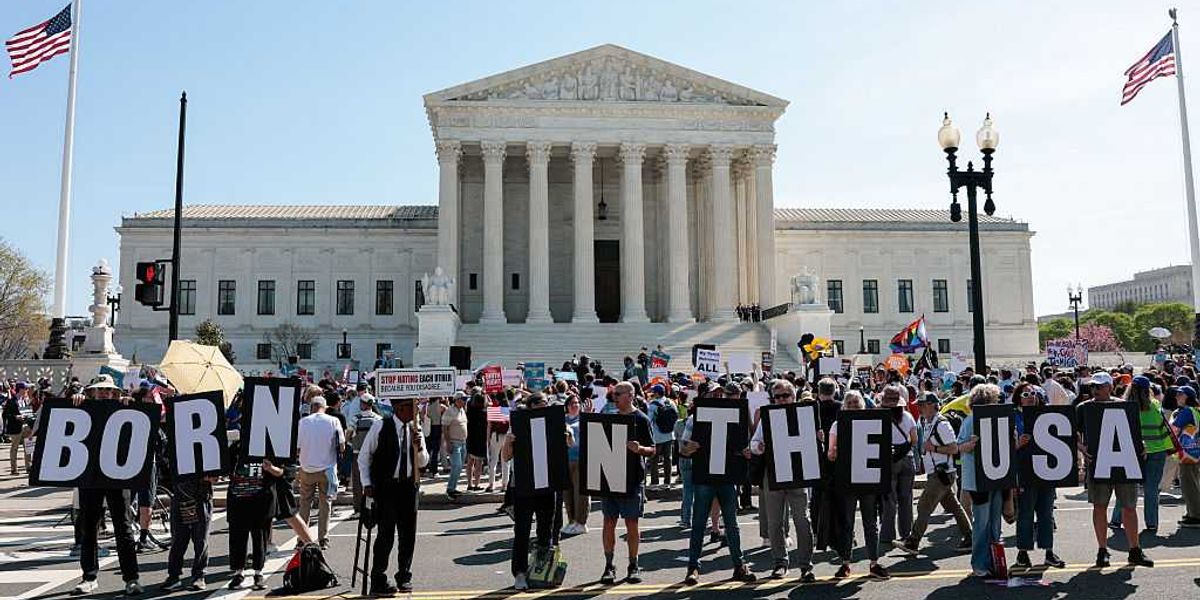

The Supreme Court recently heard more than two hours of argument in Trump v. Barbara, the case testing the constitutionality of President Donald Trump’s executive order on birthright citizenship.
Trump himself sat in the courtroom for part of the session, the first time a sitting president has done so. The moment was striking not for its symbolism alone but for what it revealed: a fundamental challenge to a 150-year-old interpretation of American identity.
The American ‘exception’ was built on a conscious break from notions of blood and soil.
The executive order, issued on Trump’s first day back in office in January 2025, directs federal agencies not to recognize automatic citizenship for children born in the United States to parents who are undocumented or present on temporary visas. It turns on the opening words of the 14th Amendment: “All persons born or naturalized in the United States, and subject to the jurisdiction thereof, are citizens of the United States.”
The administration’s core argument — one rooted in a “consensualist” theory of citizenship — is that “subject to the jurisdiction” requires more than mere presence on the soil. They argue it requires full and exclusive political allegiance, a condition that undocumented immigrants and short-term visa holders, who remain subjects of their home countries, cannot meet.
The challengers, led by the American Civil Liberties Union on behalf of a plaintiff identified as Barbara, insist the clause was meant to be a simple, sweeping geographical rule. They point to the common-law tradition of jus soli — citizenship by place of birth — that they argue the framers of the amendment endorsed.
Constitutional history, however, is rarely so settled. While the 14th Amendment was ratified in 1868 — to overturn the Dred Scott decision — scholars on the right point to the intent of the amendment’s authors, like Sen. Jacob Howard, who suggested the clause excluded those who owed allegiance to a foreign power.
While the Court applied the clause to children of legal residents in United States v. Wong Kim Ark (1898), the administration argues that case never explicitly addressed the children of those present in violation of federal law.
Lower courts have struck down the executive order, but the justices’ questions on Wednesday showed they are wrestling with the modern reality of mass migration. Several asked how a “narrow” jurisdiction rule would work in a hospital delivery room. Chief Justice John Roberts reminded the solicitor general that the Constitution is not a “living” document that changes with the wind, but conservative justices also pressed the government on whether this executive action bypasses the legislative role of Congress.
The skepticism was notable because the case arrives after the Court’s 2025 ruling that limited the scope of nationwide injunctions, ensuring the policy reached the high court on its merits.
This debate is not abstract. Birthright citizenship has long set the United States apart from the “Old World.” Most countries grant citizenship primarily by descent — jus sanguinis. In Pakistan, as in India and much of Europe, a child acquires citizenship through a parent’s nationality.
The American “exception” was built on a conscious break from notions of blood and soil, but critics argue that the exception has become an unintended magnet for illegal entry and birth tourism.
RELATED: A birthright citizenship fix is more important than the SAVE Act
PAUL J. RICHARDS/AFP/Getty Images
The executive order does not seek to formally amend the Constitution, but rather to correct what its supporters see as a century of judicial and administrative drift. It would not strip citizenship from anyone already born; it applies prospectively.
Still a decision to uphold it would effectively align the United States with the legislative models of Britain, Australia, and Ireland, all of which moved away from pure jus soli to better manage migration pressures.
The Court’s eventual ruling — expected by early summer — matters profoundly. If the justices narrow the clause, they will have restored what originalists believe was the 14th Amendment’s true meaning: that citizenship is a mutual contract between a sovereign and a subject.
If they preserve the status quo, they will affirm that the 14th Amendment’s promise remains a geographical absolute.
The hearing did not settle the question, but it forced a reckoning. In an age of porous borders, the United States must decide whether its rule of soil remains a pillar of strength or an outdated incentive that undermines the very concept of national sovereignty.
The Court’s answer will help determine the terms on which future generations enter the American story.
Read the full article here


![Carney Cranks Up Anti American Drama by Preparing for Possible US Invasion [WATCH]](https://www.rvmnews.com/wp-content/uploads/2026/09/2026.09.27-10.22-rvmnews-6ab8ee68ca869.jpg "Carney Cranks Up Anti American Drama by Preparing for Possible US Invasion [WATCH]")
