
Perhaps, and we’ll get to an answer – or at least an argument for it – shortly. The better question created by the last two pontificates is this: Has the Catholic Church abandoned St. Thomas Aquinas’ deeply considered and scripturally rooted “Just War Doctrine” in exchange for flabby and fashionable pacifism dressed up as Christianity?
We can address both questions without indulging in ad hominems and invective, I assure you, even when public officials (such as President Trump) can’t restrain their frustration enough to keep the debate on point. The second question matters more than the first, especially in a world where genocides continue to unfold in Africa targeting Christians regardless of the modern embrace of total pacifism by the Church.
We must address the second question first, for the obvious reason: if there is no such thing as a “just war” in any context, then the first question becomes moot. Pope Francis more or less dispensed with Aquinas’ Summa Theologiae doctrine (not to mention Saint Augustine, who first proposed it) in the last pontificate, writing in his 2020 encyclical Fratelli Tutti that modern warfare made any claims of justice through warfare “very difficult.” His language in paragraph 258 makes his determination to close out the Aquinas formula altogether:
258. War can easily be chosen by invoking all sorts of allegedly humanitarian, defensive or precautionary excuses, and even resorting to the manipulation of information. In recent decades, every single war has been ostensibly “justified”. The Catechism of the Catholic Church speaks of the possibility of legitimate defence by means of military force, which involves demonstrating that certain “rigorous conditions of moral legitimacy” [239] have been met. Yet it is easy to fall into an overly broad interpretation of this potential right. In this way, some would also wrongly justify even “preventive” attacks or acts of war that can hardly avoid entailing “evils and disorders graver than the evil to be eliminated”. [240] At issue is whether the development of nuclear, chemical and biological weapons, and the enormous and growing possibilities offered by new technologies, have granted war an uncontrollable destructive power over great numbers of innocent civilians. The truth is that “never has humanity had such power over itself, yet nothing ensures that it will be used wisely”. [241] We can no longer think of war as a solution, because its risks will probably always be greater than its supposed benefits. In view of this, it is very difficult nowadays to invoke the rational criteria elaborated in earlier centuries to speak of the possibility of a “just war”. Never again war! [242]
Pope Francis was correct that too many people attempt to justify aggression as “justice,” but that doesn’t negate the need for justice via force in every instance, either. “Never again war!” is a fine aspiration, but it only takes one to start a war, not two. The mechanics of war have changed since Augustine and Aquinas, but the malice and ambition of men and nations have not. Augustine and Aquinas thought deeply about those issues, reflected on scripture from both the Old and New Testaments, and posited that justice sometimes requires military action, even with the collateral damage and destruction it brings, in order to stop injustice by nations and quasi-state actors.
In the case of Iran, Fratelli Tutti actually speaks to the need for the Just War Doctrine. The regime not only has conducted war by proxies for decades against the innocent, including the massacres of October 7, but it also seeks out the nuclear weapons that Francis himself cited in the encyclical. They sought those weapons for the explicit purpose of using “an uncontrollable destructive power over great numbers of innocent civilians.” The US and other world powers have tried every other means to stop Iran’s pursuit of nuclear weapons without any success, and by last summer, the regime was days away from creating the nuclear weapons that they would have aimed at Israel in an attempt to immanentize their cultish eschaton of the Twelfth Imam. Millions, perhaps hundreds of millions, would have died had the evil lunatics of the regime in Iran achieved that capability.
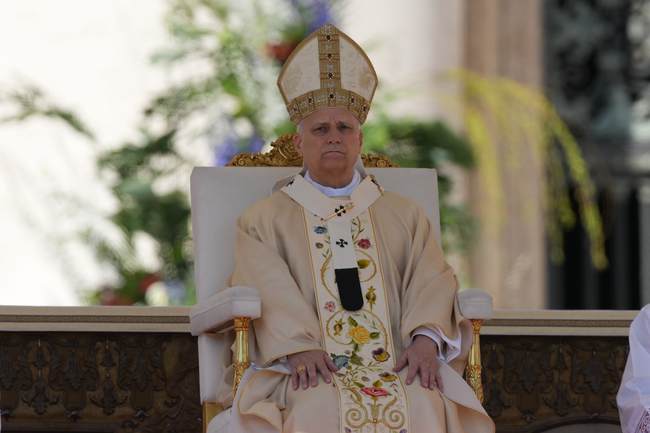
At least Francis made an argument and was careful enough to hedge it enough to allow for argument. Pope Leo XIV, whose pontificate is otherwise very promising, tossed out a glib comment that “God does not bless any conflict,” a declaration contradicted by several passages in the Old Testament and arguably one or two in the New Testament. (Not to mention the entire narrative of the Battle of Lepanto and the Rosary.) That prompted Donald Trump to lash out personally against the pope, probably to the delight of Democrats who rushed from Planned Parenthood fundraisers to the doors of the nearest cathedral to profess the Wisdom of Catholic Doctrine. Neither side had an actual argument in the classic sense, or even a point.
This is what I mean by trading well-considered doctrine for flabby and faddish thinking. Yes, it’s true that we should not want war, but the sad truth is that the world has plenty of countries and factions that do. The purpose of the nation-state, even in Christendom, is to provide security for its citizens and to ensure just relations with other nation-states. When nation-states or quasi-national factions pursue radical and extreme policies of mass murder and genocide, it is incumbent on other states, including Christian states, to end those evils by rational and just applications of power.
Neither Augustine nor Aquinas foresaw an end to war because their intellects grasped what these modern theologians have missed: man cannot be perfected except through Christ, and therefore evil would continue to exist and require remedies at the nation-state level. Both of them deeply considered the Gospels and the scriptures in identifying and then codifying the Just War Doctrine as a result. The biggest side question of this issue is when modern theologians assumed more intellectual heft and foresight than two of the greatest doctors of the Magisterium.
Having established (or re-established) the standing of Aquinas and Augustine, let us consider the Just War Doctrine as effective and turn to the specific example of the war against Iran and answer the first question. My friend Noah Rothman raises the question of what alternative was available to stop Iran’s pursuit of massively evil power:
I’m by no means qualified to opine on Catholic dogma, but it seems suboptimal that Americans or the citizens of its allies should have to meet their maker before the U.S. would act in their defense for such an action to be construed as morally righteous.
Leave aside the evils practiced by the Iranian regime. Forget that it wantonly slaughters tens of thousands of its own citizens merely for petitioning their government for redress. Ignore for now the state-sponsored practice of disfiguring and even blinding women for the offense of wearing the wrong clothes, the summary and public execution of homosexuals, the impressment of children to serve as cannon fodder in armed conflicts, and so on. Few would dispute that Iran represents not just a direct threat to American security but an ever-present threat.
The Iranian regime has killed hundreds of Americans over the decades. It executes plots on U.S. soil to kill its elected officials, civil servants, and foreign dignitaries. It sponsors Islamist terrorist activity all over the globe, the foremost design of which is to shed the blood of Americans and their allies and to undermine its geopolitical objectives (the sacrifice of which would put even more Americans at risk).
Is it inherently nobler to placidly await inevitable acts of murder before preempting the would-be murderer? Are Americans as a people immoral for demanding inquiries into the intelligence failures that lead to bloody catastrophes? Should they not accept their fates in anticipation of a belated response to their untimely deaths?
These are the types of conditions that prompted Augustine and Aquinas to develop this doctrine. That doesn’t necessarily mean it applies, but this framework from Summa Theologiae gives us the context for that debate:
War is justified (nation A wars justly against nation B) on the following conditions:
- It is called by a sovereign authority.
- It has a just cause.
- The combatants have morally right intentions (not vengeance or profit – see below).
- Qualifying Conditions (from the theory of double-effect on his justification of killing in self-defense: ST II-II, 64, 7).
- Cannot intend intrinsically evil actions.
- A good action, or at least a morally neutral action, will have two effects: a good intended, and an evil, not intended, but tolerated.
- Proportionality: the good to be achieved outweighs the evil of war.
Bear in mind that, as Pope Francis warned, it’s easier than one thinks to fit all kinds of aggression into this formula. Also, Trump made a threat that absolutely fails on points 3 and 4(1) by talking about destroying an entire civilization. That was rhetorical escalation meant to force the IRGC to talk – and it worked, briefly – but it still arguably escalates this past Aquinas’ framework if Trump actually takes that kind of action.
However, an argument can be made and supported that the war with Iran fits these requirements. Point 3 is still tricky, since one of the arguments made is that we are responding to Iran’s long history of committing acts of war against the US. (Noah mentions that in his essay.) If anything, Trump’s decision to blockade Iran rather than go for Bridge and Power Day indicates that he is acting with proportionality and avoiding “intrinsically evil actions.”
What about the necessity of a “just cause” in point 2? Aquinas Online expands on the conditions that must be met in order to claim a just cause for military action:
- Just Cause
- Thomas Aquinas addresses causes which concern the nation (nation A) itself.
a. An enemy (nation B) is attacked because they deserve it.
b. The enemy is guilty of some fault.
c. A nation may war justly
i. To avenge a wrong.
ii. Punish enemy for refusing to make amends for some past fault.
iii. To restore what was seized unjustly.- Later thinkers have expanded the notion of just cause. (See ‘The Just War’ by Jonathan Barnes in The Cambridge History of Later Medieval Philosophy (1982), pp. 771-785.)
a. Is war justified when someone other than the warring nation suffered from an enemy’s unjust aggression?
i. Friends and allies: Nation A may justly war on nation B to defend nation C. (See Thomas Aquinas, ST II-II, 188, 3 ad 1)
ii. The inhabitants of the enemy country (nation B) [a war of liberation].
a) St. Thomas More (1535) – Yes, war may be justified for humanitarian reasons.
b) Francisco Suarez (1617) – No, such a war violates the sovereignty of the other nation and will lead to international chaos.
b. There has not been any actual aggression from the enemy, but nation A has reason to fear that there is a threat of an attack from nation B [a pre-emptive war].
i. Francisco de Vitoria (1546) – No, wars are just only when redressing actual injustice.
ii. Francis Bacon (1626) – Yes, just fear is a lawful cause for war.
iii. Hugo Grotius (1645) – To threaten one’s neighbors is an actual injustice; it is aggression against peaceful order between nations.
Frankly, Iran’s actions fall into most of these points. Liberating the oppressed Iranians would certainly qualify under Catholic doctrine, as would Hugo Grotius’ condition of dealing with a nation that has continually not just threatened its neighbors but has been actively attacking them through proxies for nearly half a century. That includes the US directly but also our allies – Israel certainly, but also other Gulf nations and even countries in our hemisphere, such as the Hezbollah attack in Argentina in the 1990s.
Does this provide an ironclad “blessing” on the war from a Catholic perspective? I tend to think the argument is strong that this is indeed a “just war,” especially considering the nature of the Iranian regime and all other efforts to counter its evil. However, others could also argue against it, even while considering the Just War Doctrine as in effect. That debate would be interesting, enlightening, and fruitful in restoring dignity and justice to both the Church and global relationships.
It certainly beats the pretentious, utopian, and vapid pacifism being spouted at the moment.
Update: Pope Benedict XVI had a better sense of this, with a hat-tip to Jiminacar on Twitter:
“Let us begin by noting some basic truths. It is impossible to overcome terrorism, illegal violence detached from morality, by force alone,” he wrote. “It is indeed true that the defense of the rule of law against those who seek to destroy it must sometimes employ violence. The element of force must be precisely calculated, and its goal must be the protection of the law. An absolute pacifism that refused to grant the law any effective means for its enforcement would be a capitulation to injustice.”
Editor’s note: Normally, an essay of this length necessitating this much research would go behind the paywall. However, there is so much interest in this particular topic that I chose to keep it accessible for all readers. I hope that it will spark some spirited but respectful debate and perhaps elevate the colloquy of the last few days on all sides.
If you appreciate this approach, then please help us to keep making these arguments and analyses by supporting Hot Air. Join Hot Air VIP and use promo code FIGHT to get 60% off your membership!
Read the full article here