
The modern gun control movement in the United States has been around since the early 1960s, though it wasn’t until the Gun Control Act of 1968 was introduced in the wake of the assassinations of Martin Luther King, Jr. and Robert F. Kennedy that the movement coalesced and found its footing as a political force.
But as a new book by historian Catherine Fletcher reminds us, for as long as firearms have been around there have been forces seeking to limit their availability and place them beyond the reach of the average citizen. Fletcher’s The Firearm Revolution: From Renaissance Italy to the European Empires is a “fascinating book on the social impact of guns in Europe,” according to Reason’s J.D. Tucille, and his review of Fletcher’s material prompted me to order a copy of my own.
“Many of the arguments raised today in relation to gun control are to be found in sixteenth-century sources,” Fletcher notes. “These include calls for restrictions on the ownership of those weapons judged most dangerous, demands from users that they be allowed to keep guns for self-defence,” and so on.
Thanks to firearms, a farmer or part-time militiaman could shoot an armored knight off a horse. Fletcher quotes a 16th century critic complaining that “it is very often the case that a manly and brave hero is brought down by a pathetic little brat with a gun.”
Firearms weren’t entirely unique in this regard. Bows—especially crossbows—had long been viewed with suspicion for similar reasons. An 1139 papal decree attempted to ban them as “hateful to God.” That decree turned out to be as impotent as modern bans on “assault weapons.” And guns were even more democratizing than bows: That brat could put paid to an aristocratic hero because, as Fletcher observes, guns “may well have been cheaper than the crossbow and certainly required less physical strength to shoot than the longbow.” They also punched through expensive armor at a distance, and mastering their use required less training than did swords. Political assassins quickly adopted them as tools of the trade.
But law-abiding citizens (or serfs) also quickly realized the utility of firearms for more lawful purposes, including hunting and self-defense. And as firearms grew in popularity, the first gun controls soon followed.
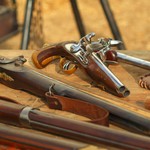
Guns with wheel locks were among the first to be restricted in Europe, according to Fletcher. The wheel lock, which some consider the grandaddy of today’s combat pistols, came into being around 1500, and just three decades later Sicily had instituted a ban on wheel lock pistols, with other Italian city-states following suit in the years to come.
Weapons control measures were not new to firearms. Even when blades dominated, many places limited where and when weapons could be carried within city walls—with the level of restriction dependent on social class. Carrying weapons of any sort often required licenses, though the frequency with which decrees were issued and reissued suggests that many people ignored such rules. Then as now, the rulers attempting to disarm members of the public were themselves well-protected by guards armed at state expense. Among those who carried weapons were people suspicious of the state, including the growing ranks of Protestants in mostly Catholic Italy.
“In 1553, the Venetian rector Cattarino Zen observed that in Gardone (among other places) ‘everyone carries an arquebus and…they’re not content with one, but even the women carry two, one in their hand and the other in their belt, both wheellocks, and they’re a bad breed, untameable overbearing Lutherans.'”
250 years later, though, the forces of gun control had won the day in Europe. As James Madison wrote in Federalist 46, “the governments [of Europe] are afraid to trust the people with arms.”
Madison believed that if the subjects of European kingdoms had access to firearms, along with “the additional advantages of local governments chosen by themselves,” then “the throne of every tyranny in Europe would be speedily overturned in spite of the legions which surround it.” As Fletcher’s book details, many powerful figures in Europe in the 1500s and 1600s would have readily agreed with Madison’s thinking, and did everything in their power to prevent gun ownership from becoming commonplace among commoners… much less a right possessed by the people.
Editor’s Note: The radical left would love to strip us of our Second Amendment rights and impose European-style gun control laws here at home.
Help us continue to report on and expose the Democrats’ gun control policies and schemes. Join Bearing Arms VIP and use promo code FIGHT to get 60% off your VIP membership.
Read the full article here