Congress created the temporary protected status program, often abbreviated TPS, in 1990 to bar the removal of foreign nationals who hail from countries roiled by civil unrest, violence, or natural disaster, regardless of their immigration status. Under the program, the secretary of the Department of Homeland Security can designate a certain country for TPS for periods of up to 18 months.
While supposedly “temporary,” these status designations — presently extended to a dozen countries and shielding millions of foreigners — have in many cases been extended for decades.
Recognizing that the conditions previously cited as justification for TPS have materially changed for the better in some countries, the Trump administration has taken steps to revoke numerous TPS designations. This initiative has, of course, enraged liberal activists and beneficiaries of the program, who have mounted various legal challenges.
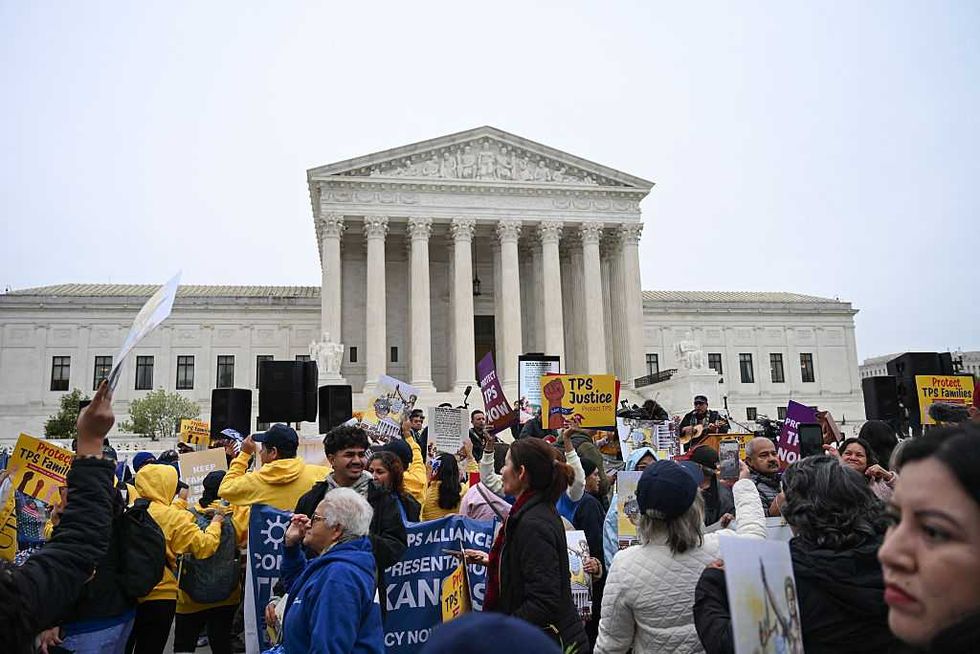
The U.S. Supreme Court — which cleared the Trump administration last year to strip Venezuelan migrants of TPS — heard oral arguments on Wednesday in the consolidated cases Mullin v. Doe and Trump v. Miot regarding the revocation of TPS for Haitians and Syrians.
Ahead of the hearing, Democratic Reps. Ayanna Pressley (Mass.) and Debbie Wasserman Schultz (Fla.) joined Democratic Sens. Edward Markey (Mass.) and Lisa Blunt Rochester (Del.) in demanding the high court defend TPS for Syrians and Haitians, stating, “Do your job, uphold the law, save lives, and protect our communities.”
Given conservative justices’ questions and remarks during the lengthy hearing, these Democrats and the hordes of foreign squatters who’ve long been shielded from removal may be headed for disappointment.
Quick background
TPS has covered Haitian migrants since January 2010 and covers nearly 350,000 citizens from the Caribbean today. Syria was designated for TPS in March 2012 and has received several extensions over the past 14 years. Roughly 6,000 Syrians presently enjoy protected status.
RELATED: SCOTUS issues shocking ruling about ‘racial gerrymander’ map
JACQUELYN MARTIN/POOL/AFP/Getty Images
Having determined that neither country still meets the conditions for special status owing largely to significant improvements in domestic safety and stability, Trump’s DHS announced the termination of Haiti’s TPS in July and the termination of Syria’s status in September.
These revocations, which were supposed to take effect months ago, have been held up in the courts.
In Washington, D.C., U.S. District Judge Ana Reyes — a foreign-born, Biden-appointed, lesbian judge who previously worked as a lawyer to fight the first Trump administration’s immigration policy and helped the U.N. secure asylum for so-called refugees — obliged her fellow immigration activists on Feb. 2, blocking the revocation of Haiti’s TPS.
‘That’s what you got?’
Reyes, a Uruguayan native, claimed that former DHS Secretary Kristi Noem not only violated the Administrative Procedure Act and the Fifth Amendment’s due process clause when terminating the TPS designation for Haiti but had likely done so “because of hostility to nonwhite immigrants.”
The U.S. Court of Appeals for the District of Columbia Circuit refused on March 6 to block Reyes’ ruling, thereby keeping the special status for Haitians in place while the litigation moved forward.
In New York, U.S. District Judge Katherine Polk Failla, an appointee of former President Barack Obama, granted an injunction in November against the government’s termination of TPS for Syrians. The U.S. Court of Appeals for the Second Circuit denied the government’s motion for a stay pending appeal on Feb. 17, prompting the Trump administration to ask the Supreme Court to weigh in.
Divided court
U.S. Solicitor General D. John Sauer, who defended the administration’s revocation of the special statuses, sparred at the outset with liberal Justices Ketanji Brown Jackson and Sonia Sotomayor over whether a TPS termination is open to judicial review, especially when the relevant statute makes expressly clear that there is to be no judicial review of any determination with respect to the TPS designation or termination or extension of a designation.
When asked by Justice Brett Kavanaugh why Congress would have barred judicial review as broadly as the administration now contends, Sauer pointed to the possible foresight that protracted legal review would inevitably undermine the temporary nature of the program and hinder the executive’s ability to conduct foreign policy in a timely and confident manner.
Sotomayor and Brown proceeded to dwell on the suggestion advanced by the plaintiffs in the Haiti case and by Judge Reyes in February that “discriminatory intent” played a role in the termination of that nation’s TPS designation, alluding to President Donald Trump’s derisive remarks about third-world nations such as Somalia, which he characterized last year as “filthy, dirty, disgusting, ridden with crime.”
While Sauer made clear that the government defended its decisions on non-discriminatory grounds, the liberal justices nevertheless appeared keen to read into extraneous comments by members of the administration, which were the primary focus of Geoffrey Pipoly, the attorney who argued on behalf of Haitian TPS beneficiaries.
RELATED: Illegal alien activists are furious at Trump administration after ‘cruel’ new ‘Dreamer’ policy drops
 Alex WROBLEWSKI/AFP/Getty Images
Neither Justice Samuel Alito nor Justice Neil Gorsuch posed questions during Sauer’s arguments, perhaps signaling understanding of or even agreement with them, but spent considerable time poking holes in those posed by the challengers.
Ahilan Arulanantham, a lawyer for Syrian TPS beneficiaries, emphasized that the issue is whether the DHS secretary adequately followed procedure when arriving at her decision to revoke TPS status, not whether her assessment was correct that the conditions previously justifying TPS had in fact changed.
Justice Alito did not appear to be buying what Arulanantham was selling. Instead, Alito echoed Sauer’s concern that if the challengers’ argument regarding the government’s supposedly insufficient level of consultation with agencies was accepted, “it will create a hole in the judicial review bar that you could drive a convoy of trucks through,” and that it will always be possible to second-guess the DHS secretary’s decisions and process.
Pipoly, who piped up after Arulanantham’s time elapsed, desperately tried to make the case that the Haitian TPS designation was based on a “sham” of a review, not grounded by empirical support but by President Donald Trump’s “racial animus towards nonwhite immigrants.”
Justice Alito countered, however, that “TPS was terminated for quite a list of countries,” many of which are home to individuals who are or could be construed as white.
“If you put Syrians, Turks, Greeks, and other people who live around the Mediterranean in a lineup, you think you could say those people are, all of them, are they all nonwhite?” Alito said, prompting an acknowledgment from Pipoly that Syrians “may be classified as white.”
After Alito nuked the notion that TPS revocation is solely bound up with race, Justice Gorsuch pressed Pipoly to disentangle the DHS secretary’s determination — which is not subject to judicial review — from the DHS’ ultimate termination of the TPS status.
“How can it not be judicial review of the determination if you’re postponing the determination?” Gorsuch asked.
“The final agency action here that was postponed is … the termination, not the determination, which is not subject to judicial review,” Pipoly responded.
Pipoly does not appear to have won over Gorsuch with his tortured attempt to strike a distinction between the two since Gorsuch replied, “That’s what you got?”
Like Blaze News? Bypass the censors, sign up for our newsletters, and get stories like this direct to your inbox. Sign up here!
Read the full article here


![“Democrats Are Freaking Out” After Supreme Court Issues ‘Voting Rights Act’ Decision [WATCH]](https://www.lifezette.com/wp-content/uploads/2025/09/2025.09.11-09.29-lifezette-68c29681a11ca.jpg "“Democrats Are Freaking Out” After Supreme Court Issues ‘Voting Rights Act’ Decision [WATCH]")