
Memorial Day means different things to different Americans. For some, especially those whose losses remain fresh, no national holiday is required to preserve memory. Grief already structures daily life; the formal rituals of remembrance — flags, ceremonies, cemetery visits — may still offer recognition, but the dead are hardly absent.
For others, the connection is more distant: a grandfather never met, a name on an old photograph, a relative spoken about only occasionally. The holiday can become less an occasion for immediate mourning than a meditation on inheritance and historical continuity.
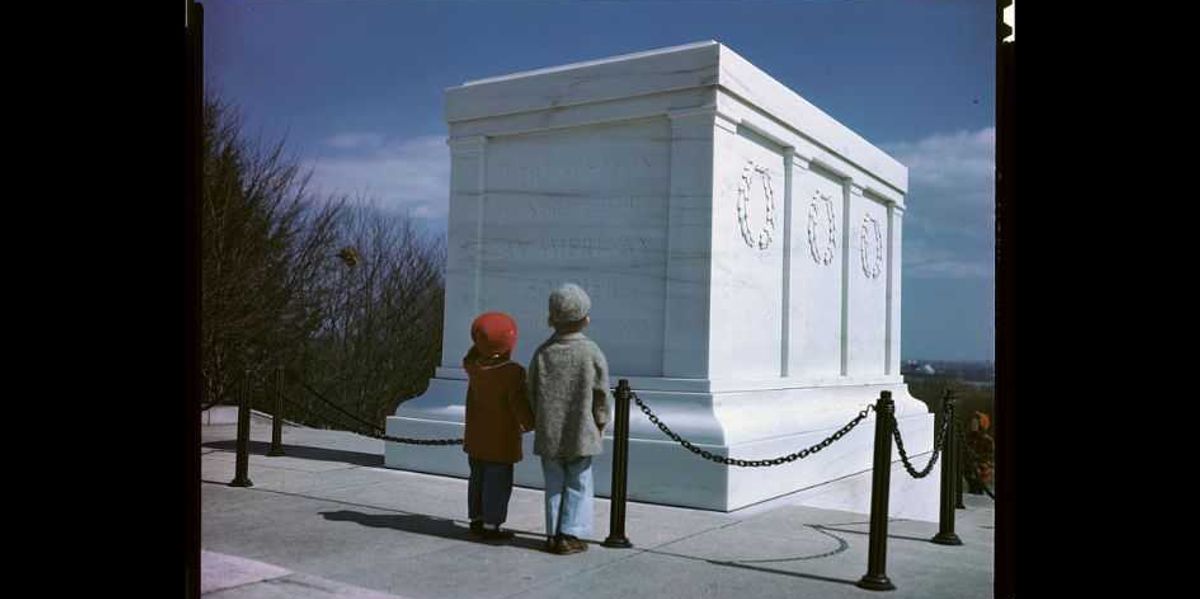
Memorial Day, like the Tomb of the Unknown Soldier, exists because modern war produces anonymity at a scale human beings struggle to comprehend.
Still other Americans may have no direct personal connection to war at all. For them, that distance is itself a kind of blessing. Memorial Day may register primarily as a feeling of generalized gratitude — gratitude for the country itself and for those who fought on its behalf.
Yet the holiday’s deeper purpose is more specific and, in some ways, more demanding. Memorial Day asks us to remember individuals whose lives were interrupted by war, individuals with whom we may have nothing in common but our shared nation.
In recent years, debates over immigration, national identity, and social cohesion have forced Americans to ask what citizenship actually means. Memorial Day offers one answer older and less ideological than many offered by contemporary politics: Citizenship implies obligations not only to the living, but to the dead. A nation becomes more than a marketplace or administrative zone when its citizens believe they owe remembrance to those whose lives became bound up with the country’s history.
Memorial Day is one of our few remaining holidays that ask us to remember strangers. Not celebrities or family members or ideological allies, but ordinary people, fellow Americans whose lives were cut short by violence that history inevitably turns abstract.
In an increasingly individualized society, that obligation can feel unfamiliar. Yet to remember our fellow citizens across distance, class, region, and even generations is to affirm that we belong to one another in ways deeper than convenience or self-interest.
These are a few of the many Americans we remember today.
James Robert Montgomery
When Drew Gilpin Faust wrote about the Civil War’s culture of mourning in “This Republic of Suffering,” she lingered over a bloodstained letter written by James Robert Montgomery, a 26-year-old Confederate signal corps soldier mortally wounded at Spotsylvania in 1864.
A former law student from Mississippi, Montgomery spent his last moments taking pen to paper and — in labored but still elegant script — composing a farewell message to his father:
“I write to you because I know you would be delighted to read a word from your dying son.”
The word “delighted” now feels shocking. Yet, as Faust observed, Civil War Americans placed immense importance on the final words of the dying. Even in agony, Montgomery worried about consoling those at home.
“I would like to rest in the grave yard with my dear mother and brothers but it’s a matter of minor importance,” he wrote, just before signing off as “your dying son.” “Let us all try to reunite in heaven.”
His final resting place remains in Virginia.
Bert Stiles
Before World War II, Bert Stiles was a Colorado college student obsessed with becoming a writer. The son of a Denver electrician and a music teacher, he spent summers working as a junior forest ranger in Estes Park, experiences that became material for his short stories. While attending Colorado College, he wrote constantly — stories, poetry, newspaper features — and briefly embraced the pacifist sentiments common on American campuses before the war.
In 1941, convinced he could become a serious writer, Stiles hitchhiked repeatedly to New York to meet literary agents who had shown interest in his work. He eventually found mentors willing to support him, and his stories soon began appearing in publications like the Saturday Evening Post.
For many celebrated American writers, war became a harsh but formative education — the crucible from which emerged figures like Ernest Hemingway, Norman Mailer, and James Jones. Looking backward, it can almost seem like a foregone conclusion that their talent would survive long enough to become literature. But for every writer history remembers, there were others swallowed by the machinery of war before their lives had fully begun. History offers no exemption for promise.
Stiles continued writing throughout his combat service, producing articles and journal entries while flying bombing missions over Germany with the Eighth Air Force. He completed a full combat tour in B-17 bombers, volunteered for a second tour flying P-51 Mustangs, and was killed in November 1944 during a dogfight south of Hanover. He was 23 years old.
Henry T. Waskow
War correspondent Ernie Pyle became famous during World War II not for writing about generals or battlefield strategy, but for documenting the emotional lives of ordinary American soldiers. His most enduring dispatch may have been his account of the death of Captain Henry T. Waskow during the Italian campaign in 1944.
Pyle wrote:
Capt. Waskow was a company commander in the 36th Division. He had led his company since long before it left the States. He was very young, only in his middle twenties, but he carried in him a sincerity and gentleness that made people want to be guided by him.
“After my own father, he came next,” a sergeant told me.
Pyle described soldiers bringing Waskow’s body down a mountain trail by mule under moonlight alongside other dead men. One by one, exhausted infantrymen approached the body, lingering beside their captain in silence.
One soldier looked down and muttered simply, “God damn it.” Another stood over him for a moment before saying, “I sure am sorry, sir.”
Then one man sat beside Waskow’s body, holding the dead captain’s hand silently for several minutes before gently straightening his shirt collar and rearranging the torn edges of his uniform around the wound.
Thomas Joseph Fox Jr.
After he was killed in action in 1970, Thomas Joseph Fox Jr. was remembered by friends as an easygoing Sacramento teenager who loved football, rock music, and cars.
One fellow artilleryman later recalled Fox borrowing his Creedence Clearwater Revival tapes at a fire base near Chu Lai. Fox talked often about home. When his tour ended, he said, he wanted to spend weekends at William Land Park waxing and polishing his car while watching girls drive by.
Another childhood friend remembered playing tackle football with Fox at East Portal Park just before he shipped out to Vietnam. After the game, Fox encouraged him to try out for the high school football team — a small moment the friend said he still carried with him more than 40 years later.
One friend who enlisted alongside him later recalled escorting his body back to Sacramento by train.
“I miss you, old friend,” he wrote decades later. “I think about you all the time.”
Marvin Winston Murray
Marvin Winston Murray had been in Vietnam less than two months when he died at 21.
A high school classmate from New York City remembered practicing relay handoffs with Murray during track practice in New York.
Years later, the memory still lingered with him. After unexpectedly encountering friends dressed for Murray’s funeral while home on military leave himself, he eventually visited the Vietnam Veterans Memorial to see Murray’s name etched into the black stone wall.
“I’m going to get a rubbing,” he wrote decades later. “So I can frame it.”
Dan Bullock
Dan Bullock was only 15 years old when he was killed in the Vietnam War in 1969, likely the youngest American serviceman to die there. He had enlisted in the Marines at 14 after altering his birth certificate to appear older.
Born in North Carolina and later raised in Brooklyn, Bullock talked about becoming a pilot, then a policeman, and finally a Marine. “Mostly he wanted to make his mark in life,” his father later said. “He wanted to be something.”
Bullock arrived in Vietnam in May 1969 and was dead just 21 days later after an attack on An Hoa Combat Base. The Marines around him did not know his real age, but many sensed something unusual about him. One recalled years later: “He was younger, and he didn’t belong.”
When a reporter visited the family’s home, they searched for his last letter home but couldn’t find it. The line his stepmother remembered poignantly captures a certain youthful bravado.
“He said he was fine,” she recalled. “He said he didn’t have any holes in him.”
Chance Phelps
Chance Phelps was funny, outdoorsy, and always on the move — “the kind of person who had to be in the thick of things,” as his mother later put it.
Raised partly in Wyoming and Colorado, Phelps loved football, hunting, fishing, and making people laugh. A former teammate remembered him as “kind of like a country boy,” always smiling and doing something goofy. Another friend later admitted that before Iraq, “I thought we were both invincible, that nothing could touch us.”
After the attacks of Sept. 11, Phelps told his mother he felt compelled to serve.
“I absolutely have to go,” he said. “I’ve got to do something.”
Phelps was 19 when he was killed near Ramadi in April 2004, barely a month after arriving in Iraq. When Marines came to inform his mother in the middle of the night, she later recalled being struck most by one detail:
“They were crying.”
Unknown
At Arlington National Cemetery, the remains of one unidentified American serviceman from World War I lies buried without a name. The tomb simply reads:
“Here rests in honored glory an American soldier known but to God.”
Memorial Day, like the Tomb of the Unknown Soldier, exists because modern war produces anonymity at a scale human beings struggle to comprehend. Each grave, each name carved into stone is an attempt to resist that anonymity, to point to an ordinary human life of infinite value.
Today is our humble opportunity to come together as a country and proclaim: These people existed. They belonged to us. They should not disappear.
Read the full article here