


There is a particular horror that attaches to threats you cannot see. In the days before Iran’s centrifuges exploded in Natanz, when they were spinning faster than their operators knew, when the gauges read normal and the logs looked clean, the malware was already there, silently acting. This condition is that of modern national security: the ambient, permanently contested digital terrain on which something is always happening, mostly out of sight.
AI accelerates this condition, introducing compression into cyber conflict, a shrinking of the intervals that give defenders room to think.
By the time anyone understood what was happening, it was over.
The interval between the disclosure of a vulnerability and its exploitation, already punishingly short, shortens further. The interval between reconnaissance and attack, between a phishing message and a compromised credential, between a software flaw and a working exploit, all contract. The U.K.’s National Cyber Security Centre judged in 2025 that AI-enabled tools would, within two years, improve adversaries’ ability to exploit known vulnerabilities. By May 2026, Google’s Threat Intelligence Group reported a transition from tentative, experimental AI use in attack workflows to industrial-scale deployment, describing what it believed to be the first observed case of a zero-day exploit developed with AI assistance, built for a mass exploitation campaign.
The current moment shares an administrative dimension with earlier military revolutions. The decisive advantage in modern conflict has repeatedly been the capacity to see, sort, prioritize, and act across complex systems faster than the enemy. What is new is the degree to which that capacity is now embedded in software owned by private firms. Sovereignty in the cyber domain is exercised not only through ministries and militaries but through cloud identity systems, software supply chains, security vendors, and the access policies of model providers. When NATO describes cyberspace as contested at all times, it is describing a condition in which the terrain is mostly private property.
The relevant change in technology is agentic AI: systems that pursue objectives, use tools, spawn sub-processes, and take actions in the world with low human involvement. In offensive terms, this architecture compresses the cost of moving through each stage of an attack. The merely competent can now operate more coherently and at greater scale. Researchers at the University of Illinois demonstrated that teams of AI agents could exploit zero-day vulnerabilities, achieving 42% with five attempts on a benchmark of recent flaws, outperforming both open-source scanners and single models working alone. Anthropic and Carnegie Mellon found that frontier models equipped with a cyber toolkit could compromise more than half of 10 simulated business-sized networks.
The barriers to relatively autonomous cyber workflows are rapidly coming down.
RELATED: Big Tech handed the keys to America’s military?
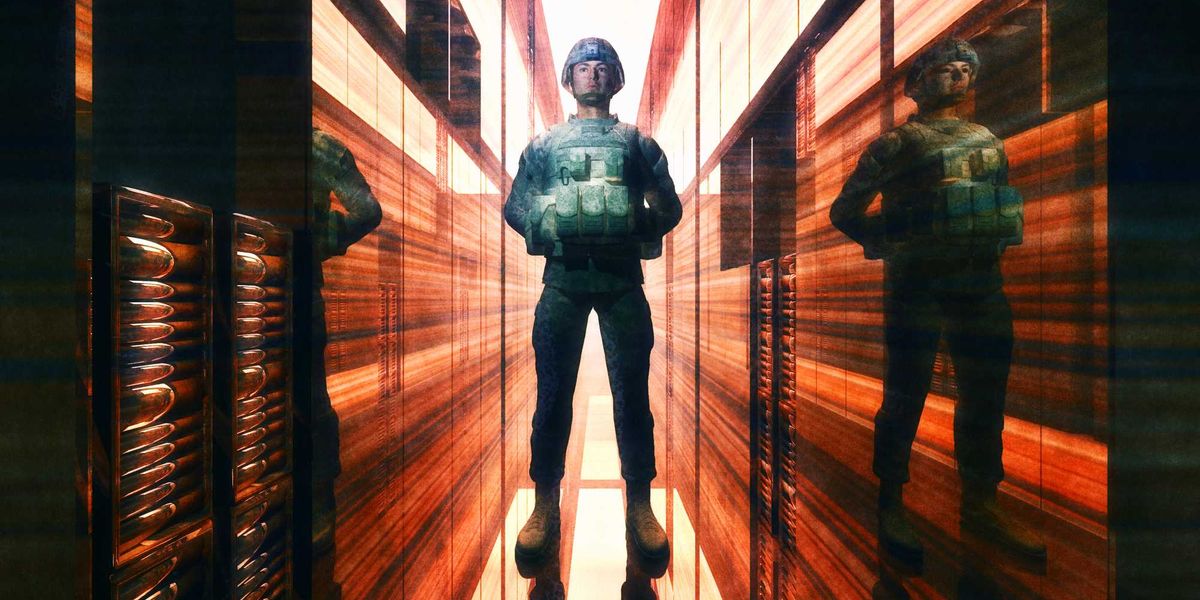
Igorodenkoff/Getty Images
A bureaucracy of bots
A great deal of tacit expertise that once lived in specialist communities, in the accumulated institutional knowledge of people who understood how systems broke, has been translated into natural language interfaces, structured workflows, and reusable tool chains. Cyber capability becomes less the possession of a rare craft elite and more the product of workflow orchestration over commodity tools. In Anthropic’s account of an alleged AI-orchestrated espionage campaign, the operation relied overwhelmingly on open-source penetration-testing utilities and custom orchestration, with novelty concentrated in integration rather than exotic malware.
The imagination of cyber warfare has long been organized around elegance, exemplified by Stuxnet’s nearly surgical precision and the operatic complexity of a state-sponsored zero-day. What is actually emerging looks more like a very fast, very patient bureaucracy. The ENISA 2025 threat landscape found that AI-supported phishing represented more than 80% of observed social-engineering activity. The FBI reported that malicious actors were using AI-generated voice messages to impersonate senior U.S. officials. The losses from AI-enabled business email compromise exceeded $30 million in the 2025 complaint data.
AI does not unilaterally favor offense or defense; it amplifies existing asymmetries. Offense gains most where systems are poorly patched, identity is weak, or social engineering can bypass procedure. Verizon’s 2025 Data Breach Investigations Report found that exploitation of vulnerabilities grew to 20% of known initial access vectors, up 34% from the prior year, with a median remediation time of 32 days and only 54% of edge-device vulnerabilities fully remediated during the year. Mandiant found that one PAN-OS vulnerability spread from disclosure to exploitation by more than a dozen groups within two weeks. However, AI-enabled defense can also make disciplined organizations faster at moving from vulnerability discovery to verified remediation, more capable of turning telemetry into action, and better at maintaining the unglamorous processes on which security relies.
Can freedom survive?
States confronted by permanent digital vulnerability can feel pressure to centralize visibility, broaden preemption, and extend exceptional controls in the name of protection. The joint guidance issued in 2026 by the Five Eyes agencies on agentic AI systems spent considerable energy on accountability: explicit human oversight, incremental deployment, strong governance, clear delineation of which agents may do what, where, and under whose authentication. This guidance presupposes institutional cultures capable of following it.
AI is already changing cyber conflict by shrinking the interval between knowledge and action, making ordinary weaknesses more dangerous, and shifting national security toward a contest over who can govern complex socio-technical systems with the greatest speed and discipline. The centrifuges in Natanz spun faster than their operators knew and then did not spin at all. The lesson was that the attacker had more time inside the system than the defenders knew, and by the time anyone understood what was happening, it was over.
Speed of interpretation determines speed of repair. The new tools available to both sides are faster, and the intervals are getting shorter. The question of whether liberal societies can build a security order that is effective without becoming opaque remains open.
Read the full article here





![Barack Obama Doesn’t Understand AI, and He’s Making Prosperity Political [WATCH]](https://www.lifezette.com/wp-content/uploads/2026/09/2026.09.26-18.17-lifezette-6ab80c24dcf39.jpg "Barack Obama Doesn’t Understand AI, and He’s Making Prosperity Political [WATCH]")