



There is a peculiar kind of intellectual cowardice that disguises itself as “skepticism.”
Instead of asking questions, engaging with evidence, or — God forbid — actually picking up the phone, it fires off a dismissive post and lets the crowd do the rest.
To Jones, it is highly possible that this anomaly indicates ‘the corridors of a ship.’
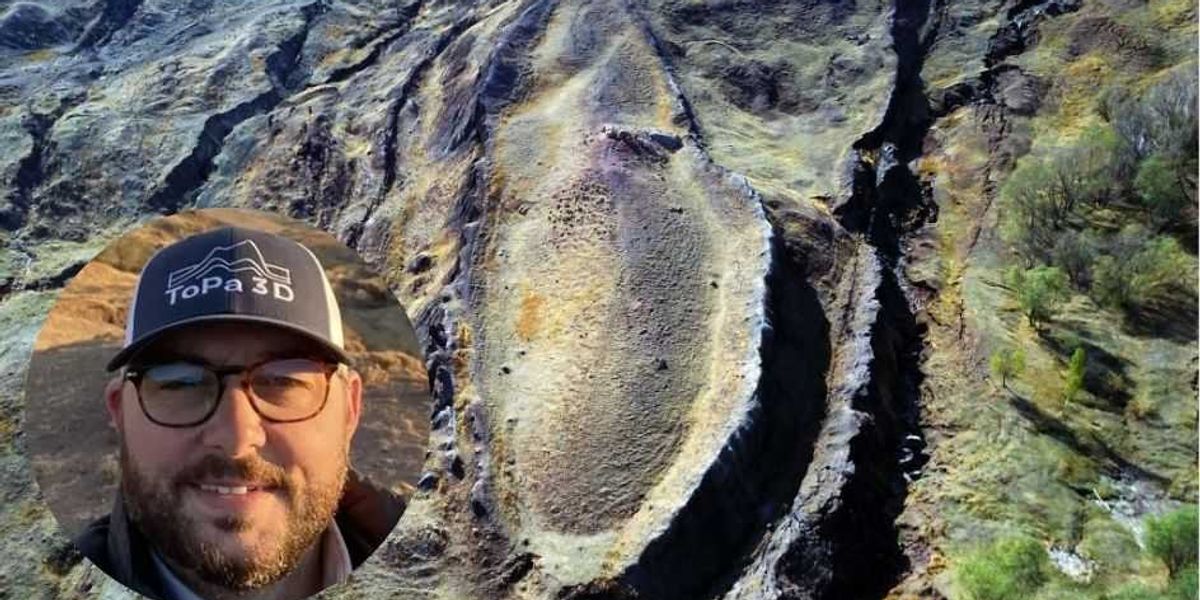
Lately, the target of this cowardice is a man named Andrew Jones. His offense? Daring to propose that a boat-shaped formation in the mountains of Eastern Turkey may just be the remains of Noah’s ark.
Jones, whom I recently interviewed over video chat, will be the first to tell you he is not an archaeologist.
What he is, however, is the project coordinator for one of the most methodical investigations of a potential archaeological site in recent memory — one being conducted by geologists, geophysicists, soil scientists, and archaeologists with decades of experience between them.
Jones has lived in Turkey since 2020, building relationships with Turkish universities, navigating government permitting processes, and assembling a team capable of doing this work the right way.
And for all that, he is being rewarded with mockery on the internet.
Wyatt’s folly
For many critics, Noah’s ark research begins and ends with one man: the late Ron Wyatt.
Wyatt, a Tennessee nurse anesthetist turned amateur biblical archaeologist, has become the universal escape hatch for anyone who doesn’t want to engage with legitimate, peer-reviewed Noah’s ark research.
Never mind that Wyatt also claimed to have found the Ten Commandments and the Ark of the Covenant. For critics, he has become a kind of all-purpose scarecrow: Invoke Ron Wyatt, roll your eyes, and the conversation is over.
One of the strangest things about the criticism is the assumption that Ron Wyatt somehow created the Durupinar story from whole cloth.
In reality, the site’s Noah’s ark connection predates Wyatt’s fame by decades.
It was discovered in 1959 by Turkish Army Captain Ilhan Durupinar during an aerial NATO mapping mission. A Turkish-American ground expedition followed in 1960, covered in a spread in Life magazine. This was documented, publicized, and treated as a legitimate subject of inquiry before Wyatt was anywhere near it.
Signs of life
The site itself is a boat-shaped impression in the earth about 18 miles south of Mount Ararat. It passes the eyeball test. It doesn’t look natural.
But more importantly, it sits in a valley loaded with Armenian and Urartu historical artifacts, such as abandoned churches and old graveyards.
Just recently, according to Jones, a Turkish archaeologist visiting the site found pottery fragments.
“Maybe 50 feet away from the site, he [found] pottery just laying on the ground where the locals are plowing,” he recalls.
The archaeologist dated the fragments to the Early Bronze Age and Late Chalcolithic. “This is the age you’re looking for for Noah’s Ark,” says Jones. “If you’re doing biblical chronology, they would place it during that time period.”
Jones is careful not to overstate the significance of these finds, noting only that they demonstrate human activity during the same time period as Noah’s ark.
These aren’t irrelevant, peripheral details. They’re central to the flood story. Because if the biblical account places Noah’s landing in the region of Ararat, which it does, then the valley floor below Durupinar is precisely where you would expect civilization’s earliest post-flood fingerprints to be.
Which brings us to the first target of the critics: the site’s location.
The Ararat question
Wes Huff, a Christian apologist with a significant online following, recently posted a lengthy critique of the Durupinar project.
He claims that “the modern site of Mount Ararat has only been called that since the 13th century” and that “the broader issue is that the precise location of Ararat remains unknown.”
This is the kind of claim that sounds clever and smart if you don’t actually know anything about the subject.
When the Bible says Noah’s ark came to rest in the “mountains of Ararat,” it is describing a region: the Armenian Highlands. And the Durupinar site is squarely inside the highlands. This is not a fringe interpretation. It’s basic historical geography.
The word “Ararat” in the biblical text is not a reference to a single volcanic mountaintop. It is a transliteration of Urartu, the ancient kingdom that spanned what is now Eastern Turkey, Armenia, and Northern Iran.
“If you look [at] the Bible, it says Urartu, which is Ararat,” says Jones.
The Urartu people were the predecessors of the Armenians. Their capital sat at what is today the city of Van in Eastern Turkey, on the shore of Lake Van. Their ruins, castles, and settlements are scattered throughout the entire region, including in the valley directly below the Durupinar site.
The implication of treating Ararat as fundamentally unknowable is that any candidate site can be dismissed before it is seriously investigated.
Going to ground
Huff’s second major line of attack targets the methodology, specifically ground penetrating radar. His claim is that “you simply don’t know what you’re looking at with GPR alone.”
This is technically true, which is exactly why nobody on Jones’ team has ever argued otherwise.
But Jones does challenge what he sees as a widespread assumption that GPR is used to bolster “sensational claims.”
As Jones explains, “A lot of scientists [and] archaeologists [and] geologists use GPR. … It’s not the final word, but it helps you understand what’s going on below the surface.”
GPR is not the conclusion. It is a step. It is a standard, widely used, non-destructive geophysical survey tool deployed by archaeologists across Europe and the Middle East as a matter of course before any excavation begins. Dismissing it as inconclusive is like criticizing a doctor for ordering an MRI before performing surgery. The whole point is that you look before you cut.
New angles
What the critics also won’t tell you is what the scans have actually found. Because at this point, “we don’t know what we’re looking at” is getting harder to sustain.
The 2019-2020 GPR surveys didn’t just confirm the boat outline visible from the surface. They mapped angular, right-angled internal structures, which may indicate rooms and chambers running the length of the formation.
They used modern digital equipment capable of generating three-dimensional models and sharing raw data with independent reviewers. According to Jones, unaffiliated geophysicists examined the scans and identified several features they considered noteworthy.
Among them was a linear anomaly running through the center of the formation.
Jones is again careful about the distinction between observation and interpretation: “There’s a straight line of voids,” he says. “Now I interpret that as someone who’s thinking this is possibly Noah’s ark.” To Jones, it is highly possible that this anomaly indicates “the corridors of a ship.”
Natural geological synclines don’t produce right angles. Rock doesn’t spontaneously organize itself into rectilinear geometry at depth. That’s the kind of finding that, in any other archaeological context, would generate serious professional interest rather than a dismissive podcast appearance.
What lies beneath
Or consider the 2014 electrical resistivity tomography data, collected by an independent New Zealand researcher. The ERT scans identified three distinct horizontal layers running through the formation. The Genesis account describes Noah’s ark as having three decks. Jones’ team members aren’t the ones drawing that connection loudly. They don’t need to. The data draws it.
In 2025, new analyses of the raw GPR data found what resembled a central corridor or tunnel running through the formation, flanked by side tunnels tracing the interior perimeter of the ship shape, and beyond that, a large central void extending at least 13 meters below the surface.
And then there is the soil. In 2024, Jones’ team collaborated with Australian soil scientist William Crabtree and Turkish geologist Dr. Mehmet Salih Bayraktutan to conduct a formal survey of 88 samples across 22 locations inside and outside the formation. The samples were then analyzed at Atatürk University laboratories.
They found that organic matter inside the formation runs three times higher than in the surrounding soil, with significantly elevated potassium levels consistent with the presence of decayed biological material (specifically wood) rather than the inorganic rock and mountain soil you would expect from a natural formation.
Yet critics routinely reduce years of work by multiple specialists to a single talking point: “It’s just GPR.”
RELATED: 5 reasons this ‘Noah’s ark’ discovery is harder to dismiss than skeptics admit
Heritage Images/Getty Images
Amateur hour
Dr. Jeremiah Johnston, appearing on Michael Knowles’ podcast, went farther than simply questioning the methodology. He implied that Jones and his team were amateurs chasing hype, while claiming he could conduct a proper excavation of the site himself for $500,000.
Let’s think about the claim that the current work being done at Durupinar is all for publicity for a moment.
Jones has spent years in Turkey, building working relationships with the Turkish government, navigating the permit process required for each phase of the investigation, signing formal agreements with a Turkish university whose archaeologist has over 20 years of field experience and has been covered in American newspapers for his other discoveries.
He has assembled geologists, geophysicists, soil scientists, and archaeologists across multiple countries. He has submitted proposals to government bodies and waited on approvals. He has done the slow, unglamorous infrastructure work that actual, serious science requires.
Meanwhile, Johnston went on a show talking about what he would do with half a million dollars.
Geology first
Huff’s accusation that there are no archaeologists on the team is equally misleading.
The work done to date — the GPR, soil sampling, geophysical surveys — all falls under geology, not archaeology. You don’t call an archaeologist to run a magnetometer. You call a geophysicist.
Archaeology becomes necessary when you excavate. The project simply isn’t at that phase yet. The archaeologists on staff have been consulting, reviewing, and preparing. In fact, the Turkish university archaeologist who recovered the pottery fragments from the valley floor was performing the kind of formal pedestrian survey that is the standard opening phase of any archaeological dig.
The critics want to hold Jones to archaeology’s standards while he’s still doing geology. Presumably they’ll hold him to geology’s standards when he starts doing archaeology.
Worth getting right
I am ethnically Armenian. I grew up hearing stories about Noah’s ark resting in Ararat. Until recently, Mount Ararat itself appeared on the Armenian passport. It remains one of the most important national symbols of the Armenian people because of what it represents: the place where civilization began again after the Flood.
I’m not asking anyone to accept that on faith. Neither is Andrew Jones. What Jones is asking is simply this: Let the investigation finish.
The sonic core drilling that will finally produce intact subsurface samples is pending Turkish government approval, potentially arriving this fall. That drilling will either find what Jones believes is there or it won’t. The AMT surveys will either show bedrock in the wrong place to support a natural formation theory or they won’t. The geophysical data will either hold up or it won’t.
What the critics have offered is not a counter-investigation. They have offered no alternative data, no competing site survey, no engagement with the soil samples or the GPR profiles or the pottery finds. They haven’t even picked up the phone to request the data directly from Jones.
If Durupinar is nothing, if it is a geological oddity and nothing more, the data will show that, and Jones has said as much. He follows where the data leads.
The question worth asking is why so many people with such loud opinions about this site are so determined to make sure that data is never fully collected or taken seriously.
Read the full article here


![Infant and Woman Killed in NY Harbor Capsizing as Captain Faces Charges [WATCH]](https://www.rvmnews.com/wp-content/uploads/2026/08/2026.08.10-13.42-rvmnews-6a79d55eac72f.jpg "Infant and Woman Killed in NY Harbor Capsizing as Captain Faces Charges [WATCH]")