


A federal judge dismissed a request for a temporary restraining order against the Department of Justice’s (DOJ) believed-to-be halted $1.776 billion Anti-Weaponization Fund Wednesday, perpetuating the ambiguity that surrounds the fund’s status.
U.S. District Judge Richard Leon — appointed by former President George W. Bush — rejected a nonprofit watchdog organization’s motion for a temporary restraining order against the fund, according to court documents. Citizens for Responsibility and Ethics in Washington (CREW), a left-wing lawfare group, brought a May 22 suit against the fund just days after the DOJ announced it.
During the Wednesday hearing, it became clear that while the fund is currently halted, the DOJ has not formally rescinded the order establishing it as of yet.
CREW’s lawsuit argues that Trump made a “sham settlement” with the IRS to create a “slush fund” to benefit his allies. The lawsuit further labels the fund’s creation a “jaw-dropping act of presidential corruption” that “is brazenly illegal” since it had not been authorized by Congress. The group accused the fund of violating core statutes of transparency and accountability. (RELATED: Left-Wing Groups Weaponize Bar Complaints Against Trump Admin Attorneys)
The DOJ argued that CREW’s case was moot because it “concerns an Anti-Weaponization Fund that had not been set up and is now not going forward,” according to court documents.
CREW had to speculate about the Fund’s operation precisely because “so little has happened,” the DOJ said. The department cited its own lack of action, saying no fund members had been appointed, no claim procedures had been established, no cases had been filed, and no claimant had received money.
CREW responded by asserting that the case — and restraining order request — was not moot. The nonprofit said that “if anything, [intervening events] have confirmed the need for judicial intervention” and argued that the DOJ would need to rescind its order to create the fund in writing. (RELATED: Trump To Drop DOJ’s ‘Dead’ Anti-Weaponization Fund)
US President Donald Trump signs a funding bill to end a partial government shutdown in the Oval Office of the White House in Washington, DC, on February 3, 2026. (Photo by SAUL LOEB / AFP via Getty Images)
Leon questioned DOJ Attorney Andrew Block about why the government would not rescind the order during the hearing, according to CBS News. “All I know is that the acting attorney general has said the fund is not moving forward,” Block responded.
Leon concluded that he was “not persuaded a live controversy remains.” He referenced President Donald Trump’s statements that the fund might still be approved but said that Trump “may be doing what he’s doing for political benefit,” according to CBS News. But Leon also issued a warning to Block: “Don’t play possum with this court.”
CREW has also brought a motion for a preliminary injunction, which Leon said he will adjudicate in a separate decision.
The DOJ’s Anti-Weaponization fund already faced obstacles from a previous court decision last month. Federal Judge Leonie Brinkema blocked the DOJ from considering claims or making payments from the fund on May 29, according to court documents. She also barred the Trump administration from continuing work on the creation of the fund while the case continued.
Brinkema stated at the time that her decision was necessary “to ensure that no funds are irreversibly disbursed from the Anti-Weaponization Fund … while plaintiffs’ Motion is pending.” Brinkema’s temporary injunction expires Friday, when she will hear more arguments and decide whether to extend her order to block payments.
The DOJ announced the $1.776 billion Anti-Weaponization Fund on May 18 “to provide a systematic process to hear and redress claims of others who suffered weaponization and lawfare,” according to the original press release. The fund follows historical precedent of similar government funds. While Trump announced the fund in conjunction with deciding to end his lawsuit against the IRS, the fund was not directly contingent upon that decision.
The fund met a wave of pushback from Senate Republicans, who considered supporting a Democrat-led amendment to terminate it. The conflict threatened to dismantle Republican efforts to pass a reconciliation bill to fund immigration enforcement. Acting Attorney Todd Blanche responded by telling a House Appropriations Subcommittee the DOJ would drop the fund on June 2. (RELATED: House Sends Major Immigration Enforcement Bill To Trump’s Desk After Weaponization Fund Slowed Down Process)
“We’re not moving forward with the fund, period,” Blanche stated in the hearing.
Senate Majority Leader John Thune confirmed Blanche’s announcement the same day, affirming the fund was “off the table” in a press gaggle attended by the Daily Caller News Foundation.
Blanche continued to defend the fund’s purpose.
“The reasons for the fund — it’s something that President Trump talked about for a long time, which is the fact that there were a lot of people in this country who had their government weaponized against them,” Blanche said. “The reasons for the fund … remain as important as [they] were before.”
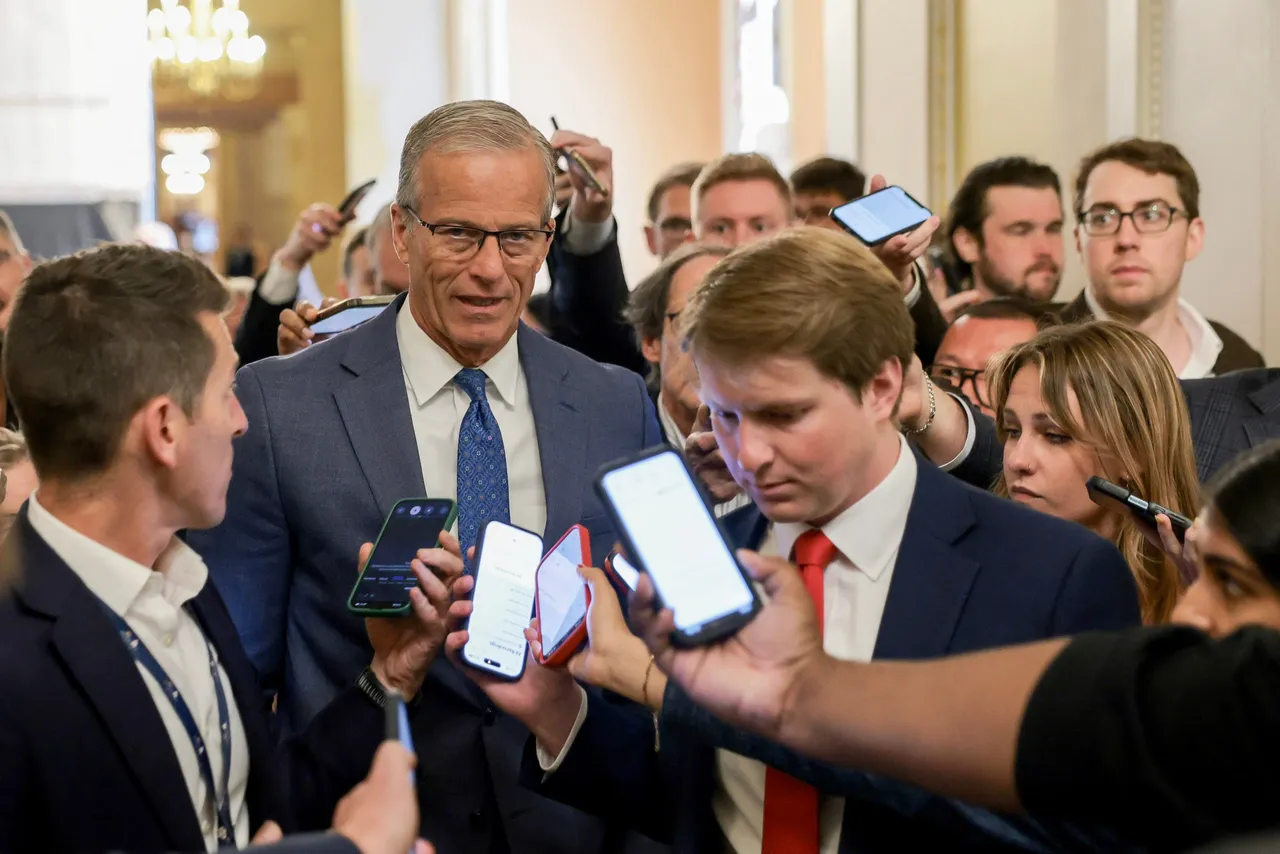
WASHINGTON, DC – JUNE 01: Senate Majority Leader John Thune (R-SD) heads to the Senate Chamber at the beginning of the work week at the U.S. Capitol on June 01, 2026 in Washington, DC. (Photo by Anna Moneymaker/Getty Images)
But Trump has continued to raise uncertainty about the fund’s death. When reporters asked him whether the fund was dead the day after Blanche’s statement, he said that “I’d have to ask the lawyers. I don’t know,” according to NBC News.
“The weaponization fund, as far as I’m concerned, was a beautiful thing,” he continued. “I love it. I think it’s so important.”
Trump continued to praise the fund in NBC’s “Meet the Press” interview Sunday.
“So me, personally, I think the weaponization fund is a great idea, and so do many other Republicans. We have to get it approved,” Trump said.
“You have to understand, people have been destroyed by crooked politicians, and they should be reimbursed for that,” he added.
The Daily Caller spoke with Oversight Project President Mike Howell, a candidate for the lead position on the fund’s board, last week. He said possible fund claimants include Christians who have been targeted by government investigations, pro-lifers prosecuted through the FACE Act, and January 6 defendants.
Read the full article here