



A group of lawyers were caught red-handed by a judge who said she is tired of the courts being burdened.
What started out as a mundane case of a lawyer claiming he was owed legal fees turned into an embarrassing ordeal for both the municipal government and the lawyer seeking remuneration.
‘A prime example of the risk associated with serving as a rubberstamp.’
Last October, a court in Aberdeen, Mississippi, awarded lawyer Tom Withers III attorney’s fees and expenses stemming from a previous case he worked on. Legal documents accessed by Blaze News stated that attorneys for the city, rather than the city itself, were held responsible for the payment of the fees.
This meant that those involved in the case included Withers, his attorneys Kathleen M. Wilson and Shauncey Hunter Ridgeway, and the city’s lawyers Kathryn Y. Williams and Mark C. McClinton.
Both parties filed submissions, and within a two-week period the legal process was ready to continue — until a review of the submitted briefs showed that both parties had submitted documents containing nonexistent citations that were hallucinated by AI.
Withers’ lawyers signed off on a filing that contained citations described as “hallucinatory,” while the city lawyers signed off on two filings that contained fake citations on behalf of the jurisdiction.
The court then asked the attorneys from both sides to show why they shouldn’t be sanctioned for their behavior.
RELATED: iPhone’s debut crushed young women’s fertility, new study says
Douglas Graham/Roll Call/Getty Images
Both parties eventually admitted that their citations resulted from unverified use of artificial intelligence.
In January, all the attorneys were in attendance for a hearing where they “expressed embarrassment and apologized to the Court,” the filing read.
Lawyer Williams admitted to using an AI tool to do legal research, while Wilson admitted to using generative AI to draft her filing. Neither verified their work before submitting it.
The other two lawyers, Ridgeway and McClinton, admitted that they did not review the filings before submitting them to the court, but signed off on them electronically anyway.
RELATED: Even if you don’t choose to use AI, you’re probably interacting with it
 Ezra Acayan/Getty Images
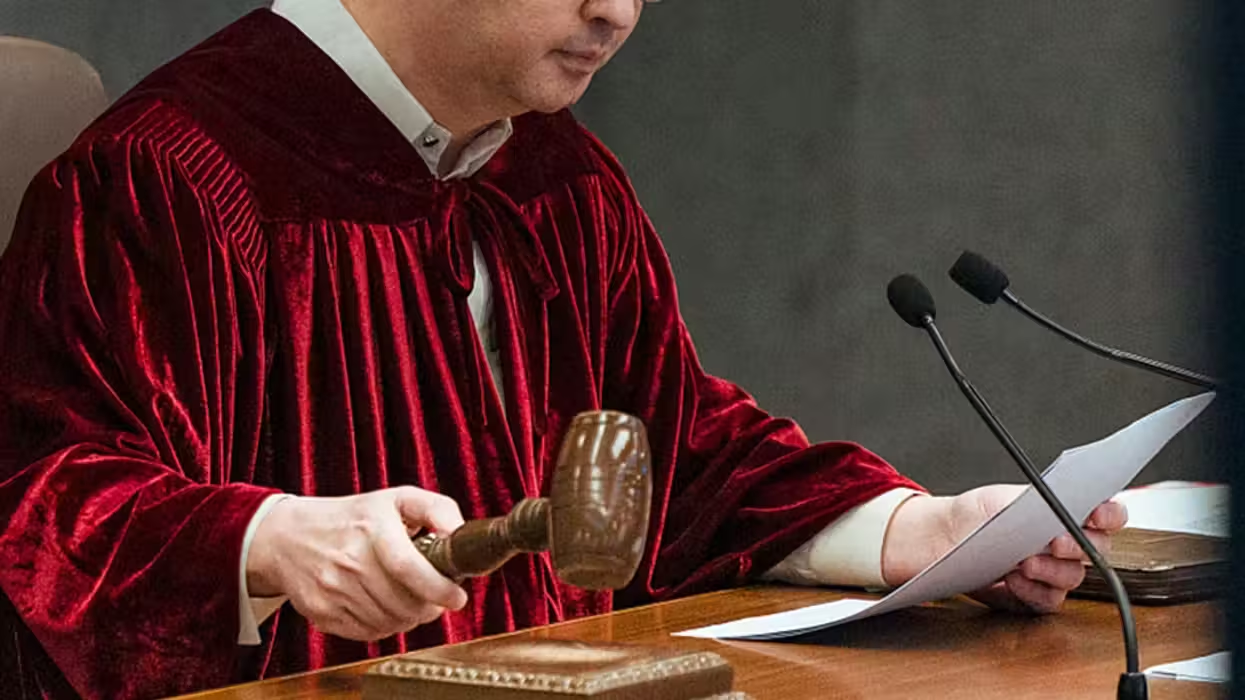
This all fell on the desk of Judge Sharion Aycock, a senior U.S. district judge for the Northern District of Mississippi, appointed by President George W. Bush in 2007.
Aycock wrote that the lawyers essentially had wasted court resources and called out the two local attorneys for their behavior.
“In an era of rampant unverified AI usage within the legal field, this case presents a prime example of the risk associated with serving as a rubberstamp when acting as local counsel.”
Additionally, Aycock described the “unusual scenario” as one in which “attorneys for both litigants engaged in similar sanctionable conduct.”
Judge Aycock added, “This Court is yet again ‘burden[ed] [with] addressing AI hallucinations in court filings.’ … While ‘[g]enerative technology can produce words,’ it cannot attach ‘… sincerity, truth, or responsibility to what it writes. That remains the sacred duty of the lawyer who signs the page.'”
On X, lawyer Rob Freund reported that among the sanctions placed on the lawyers, they were handed fines ranging from $1,000 to $3,500 and a disqualification from practicing in the district for two years.
Like Blaze News? Bypass the censors, sign up for our newsletters, and get stories like this direct to your inbox. Sign up here!
Read the full article here


![Speaker Johnson Issues Dire Warning Ahead of the Midterms [WATCH]](https://www.lifezette.com/wp-content/uploads/2025/05/2025.05.25-07.40-lifezette-6833722173116.jpg "Speaker Johnson Issues Dire Warning Ahead of the Midterms [WATCH]")
![Sophie Cunningham Belts Out Patriotic Classic in Viral Video, And Her Haters Will Absolutely Loathe It [WATCH]](https://www.boredtrashpanda.com/wp-content/uploads/2026/08/2026.08.16-08.01-boredtrashpanda-6a816e73a54e1.jpg "Sophie Cunningham Belts Out Patriotic Classic in Viral Video, And Her Haters Will Absolutely Loathe It [WATCH]")

![Minnesota Election Chief Threatens Journalists After Voter Vouching Sting Exposes Stunning Loophole [WATCH]](https://www.rvmnews.com/wp-content/uploads/2026/08/2026.08.16-08.01-rvmnews-6a816e74c79b6.jpg "Minnesota Election Chief Threatens Journalists After Voter Vouching Sting Exposes Stunning Loophole [WATCH]")
![Good Samaritans Save Woman Swept Underwater at Sabino Canyon Flooded Bridge [WATCH]](https://www.lifezette.com/wp-content/uploads/2026/08/2026.08.16-06.59-lifezette-6a815fbe6c70f.jpg "Good Samaritans Save Woman Swept Underwater at Sabino Canyon Flooded Bridge [WATCH]")