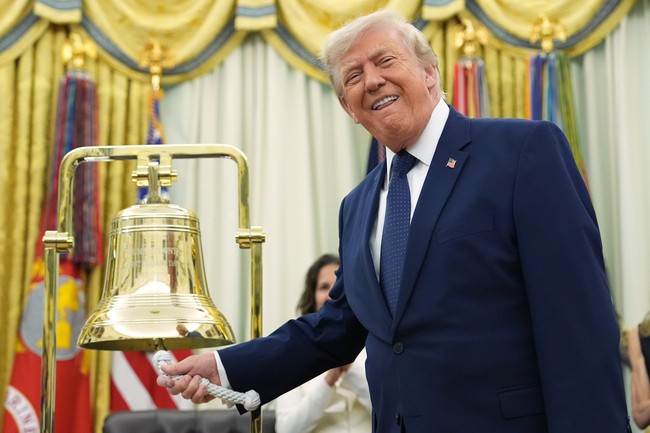

Once more unto the breach, dear friends, once more, or close up the wall with our electoral dead.
Mike Johnson will step into the role of Shakespeare’s Henry V in hopes of winning a Harfleur on the SAVE America Act when Congress resumes, on behalf of a very annoyed Donald Trump. Both the House and Senate have attempted to move this broad electoral-reform bill with little success in either chamber. Trump has blamed the filibuster for its marooned status, but the expansion of the bill’s reforms last year has lost a few Republicans in the Senate, and it’s not clear that the current version would get to fifty votes even without the filibuster.
Yesterday, Fox News Sunday host Shannon Bream asked the House Speaker about his decision to send everyone home for Independence Day celebrations rather than continue working on the bill. Johnson told Bream that he would take a new direction with the SAVE America Act by crafting a reconciliation bill to avoid the filibuster in the Senate – but also narrowing the bill to focus on its most popular elements:
🚨 BREAKING: Congress is about to reconvene and Speaker Johnson announces SAVE AMERICA ACT is PRIORITY NUMBER ONE — he’s forcing a vote to put it in reconciliation
Attach it to the NDAA, put it on EVERY must-pass bill, make clear that the Senate MUST approve voter ID and proof… pic.twitter.com/orenKrwiMK
— Eric Daugherty (@EricLDaugh) July 5, 2026
Real Clear Politics has more of the conversation in context:
BREAM: Okay, I want to talk about reconciliation, but before that, you talk about what the House has passed. So, the SAVE America Act on your side is about voter ID and proof of citizenship. What’s come together in the Senate is different. The president wants some additional things about mail-in ballots, tra ns treatment, trans — for minors and trans athletes. Will he accept the House version? You’ve had conversations with him. Is he willing to accept that version, or does he want everything else what’s packed into the Senate version?
JOHNSON: I think our version is the main, sort of, the backbone of that.
BREAM: The House version?
JOHNSON: Yes. He would like to add the prohibition of mail-in balloting, except for exceptions like if somebody’s deployed overseas or they’re ill or can’t get to the polling place. But he understands that one is a — is a bigger reach. If we can get proof of citizenship and photo ID to vote, that eliminates so much of the problem, all the fraud and everything that everybody’s concerned about in our elections, particularly, frankly, in these blue states.
The expanded version Trump demanded has created more complications in the Senate – and Trump’s electoral challenges to Bill Cassidy and John Cornyn made them worse. The first proposals for the SAVE Act focused on voter-ID proposals that are wildly popular with voters in every demographic, and a return to confirming citizenship at registration, a practice abandoned long ago in most if not all jurisdictions. With most states requiring that data now for Real ID driver’s licenses and state IDs, however, the burden on voters would be nearly indistinguishable from those processes.
At the time, Republicans were united in pushing for those reforms, but the additional demands to eliminate mail-in ballots – a very good policy, of course – made some GOP House and Senate members more uncomfortable, as mail-in voting has become popular over the past few years. The infighting in the GOP this primary season has created bitterness and a sense of retribution at a very inopportune time. Trump has blamed John Thune for not dispensing with the filibuster, but as noted above, the current SAVE America Act wouldn’t get to 50 votes, which makes the filibuster issue moot.
Johnson has apparently worked with Trump to streamline the bill back to its original core. Putting this in a reconciliation envelope would take pressure off of Thune on the filibuster too, while allowing him the best possible opportunity to get past the 49-vote threshold and into range where J.D. Vance could cast a tiebreaking vote, if necessary. A bill limited to a voter ID requirement might even get John Fetterman’s vote, as he has repeatedly said he’d support it on a standalone basis, allowing the bill to have a bipartisan character.
There is one problem with this approach, which is that reconciliation bills are limited to fiscal matters and must be deficit-neutral. Both parties have used them for larger policy goals, but this is far from the most significant; ObamaCare passed under reconciliation, as did Joe Biden’s stripped-down green bill under the title “Inflation Reduction Act.” The cost would be minimal in comparison and easily offset for deficit neutrality, but the Senate parliamentarian would have to rule on whether the bill qualifies as fiscal legislation. That would put more pressure on Thune to act if the parliamentarian rules the reconciliation bill out of order, either to fire the parliamentarian or to end the filibuster.
Nevertheless, this is still the smartest strategy to get this bill passed before the November elections. Johnson still has to succeed in getting his own caucus united when the House returns first. Maybe a stirring rendition of the St. Crispin’s Day speech will come next? Agincourt was an even bigger victory, after all.
Editor’s Note: It’s America’s 250th birthday! Help HotAir celebrate the greatest nation in history by honoring its past, defending its present, and preserving its future with reporting you can trust.
Join HotAir VIP and use promo code AMERICA250 to receive 74% off your membership.
Read the full article here

![Holiday Celebration Erupts as Milwaukee Cop Hit During Fireworks Incident [WATCH]](https://www.rvmnews.com/wp-content/uploads/2024/09/2024.09.11-02.14-rvmnews-66e1a5bd887b7.jpg "Holiday Celebration Erupts as Milwaukee Cop Hit During Fireworks Incident [WATCH]")



![Socialism 2026 Erupts with Fat Genocide Claims, Prison Abolition, and May Day Mobilization [WATCH]](https://www.lifezette.com/wp-content/uploads/2026/09/2026.09.08-07.54-lifezette-6a9fbf40d303e.jpg "Socialism 2026 Erupts with Fat Genocide Claims, Prison Abolition, and May Day Mobilization [WATCH]")