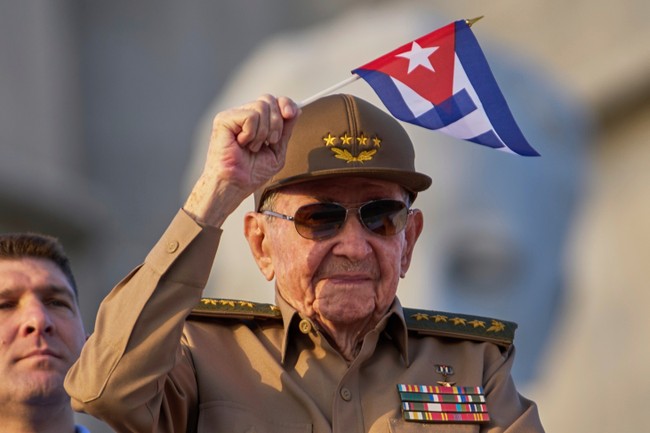

Sunday was the 73rd anniversary of the communist revolution in Cuba and the country held its annual celebration. But, surprisingly, the surviving Castro brother was not present.
Cuba held a traditional rally on Sunday to commemorate one of the revolution’s most important anniversaries, with former President Raúl Castro, 95, conspicuously absent.
It’s the first time in at least 30 years that Castro did not attend the event, and no explanation was offered.
The event was presided by President Miguel Díaz-Canel, who read a congratulatory message from Castro to his compatriots in the eastern city of Pinar del Río, where the rally was held.
Diaz-Canel gave a speech bashing the United States, of course.
“Every day they issue a threat against the revolution, and every week they announce a new punishment for Cuban companies and officials,” the president said…
“Cuba is the victim of a coldly calculated genocide,” Díaz-Canel said during his speech, in which he accused the Trump administration of imposing a policy of “maximum pressure” and intensified “economic strangulation.”
The NY Times posted a story yesterday, the point of which seems to be that Cuba is surviving despite the pressure from Trump’s oil blockade.
For months, President Trump has been predicting that Cuba is about to collapse.
“It’s just going to fall,” he told reporters on Jan. 4, a day after taking control of Venezuela’s oil, which had been Cuba’s lifeline…
Over nearly seven decades of U.S. pressure, Cuba has defied the odds and improvised to survive. Now it seems that Mr. Trump, like many U.S. presidents before him, is also finding that toppling the government founded by Fidel Castro is not so simple.
The survival of the revolution may sound great to the NY Times and its readers but the reality doesn’t sound all that pleasant.
In Havana and beyond, the crisis’s effects were clear.
We met families walking two hours for water because government pumps had run out of diesel. Women, lacking gas, cooked with firewood on the street. Powerless refrigerators became cabinets. Hitchhikers littered roadsides after the city halted public busing. And dozens of people told us they were simply exhausted after so many sleepless nights in the sweltering heat without fans or air-conditioning.
The situation is terrible but Cubans are well trained and know better than to complain. There are nightly protests in which people bang pots and pans but that’s it. No one will say what many are likely thinking about their own government.
Exhausted Cubans told us they were angry at both Havana and Washington. Yet no one said they planned to take to the streets. Aside from banging pots and pans, the Cuban people have hardly staged protests.
“You go out to express your opinion on the street, and they throw you in jail or fine you,” said David Hechavarría Gamboa, 24, standing alongside his wife on a darkened street. “I can’t put my family at risk.”
But none of the readers of this piece are complaining about the communist government. All of them blame the Trump administration and America.
The USA’s 66 year-old trade embargo has been a complete catastrophic failure. The one good thing it has showed is that the character of the Cuban is beautiful, strong and resilient. But the current Trumpian cruelty of starving these people of basic energy is a crime against humanity. Trump and his staff belong at the Hague being tried for these crimes.
On and on it goes.
We are the bad guys here! This zombie policy of embargo and control, in place for over 60 years does nothing but hold back the lives of ordinary Cubans. It makes me so sad.
You have to scroll way down to find a comment that sees things remotely clearly.
The New York Times once again frames Cuba’s misery as primarily the product of U.S. “pressure” and Trump’s oil blockade, while treating the island’s socialist system as a mere backdrop rather than the central cause. Cubans are indeed resourceful—jury-rigging solar panels, batteries, and homemade fuel—but that ingenuity is forced by decades of central planning that destroyed productive capacity long before Venezuela’s oil stopped flowing.
Cuba’s chronic blackouts, decaying grid, and dependence on foreign subsidies are not new; they predate the current crisis by years. Socialism’s incentives—state monopolies, suppressed private enterprise, and political control over resources—produced the very scarcity the article romanticizes as resilience. The embargo is real and imperfect, yet dozens of countries trade with Cuba; the deeper failure is an economic model that cannot generate reliable energy, food, or growth without external patrons.
By focusing on adaptation and American “impatience,” the piece downplays the system that made adaptation necessary in the first place. Cubans deserve better than another defense of the regime that keeps them improvising in the dark.
Cubans do deserve better but they won’t get it from the NY Times.
Editor’s Note: Do you enjoy HotAir’s conservative reporting that takes on the radical Left and woke media? Support our work so that we can continue to bring you the truth.
Join HotAir VIP and use promo code FIGHT to receive 60% off your membership.
Read the full article here

![Hegseth Unveils Major New Four Star Command for Autonomous Warfare [WATCH]](https://www.commondef.com/wp-content/uploads/2026/10/2026.10.01-15.25-commondefense-6abe7b80d9bb7.jpg "Hegseth Unveils Major New Four Star Command for Autonomous Warfare [WATCH]")