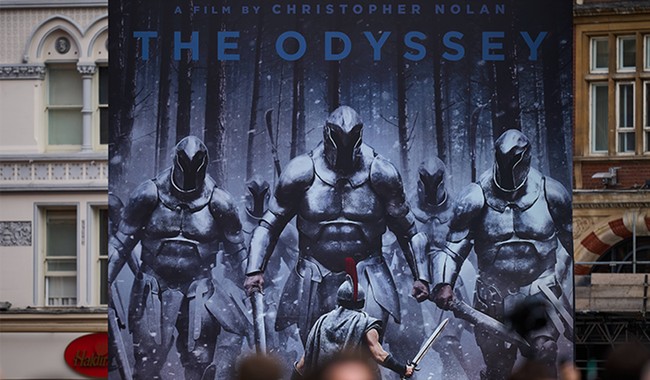

It turns out that a lot of American critics – including some of the right – are snowflakes. Many have embraced Christopher Nolan’s hit film The Odyssey like a religion, while blasting Emily Wilson, the feminist scholar whose translation of Homer’s epic was partly used by Nolan to make his film. Wilson herself has criticized the film.
It’s been a fascinating dynamic. The Odyssey was first denounced as woke, then it was defended by people like Ben Shapiro and Lara Trump. Things seem to be at a draw right now while Nolan prints money.
However, the divide with The Odyssey is not between Left and Right – and right and right -as it is between British and American sensibilities.
Simply put, the British press has always been more brave and fearless than their American counterparts. Here is NPR’s new interview with Wilson, who was born and raised in Oxford:
Christopher Nolan’s new film The Odyssey is a box-office hit. But University of Pennsylvania classics scholar Emily Wilson, who published her own translation of Homer’s epic in 2017, says Nolan’s script is poorly written and lacking in emotional depth and character development. And, she adds, there are no sex scenes — and all the food looks horrible.
“We need to have a protagonist with detailed, believable motivation,” Wilson says. “[But] these desires seem stripped from Odysseus. He doesn’t seem to want food. He doesn’t seem to want sex. What does he want?”
“He’s clever … and smart and therefore a fascinating character,” Wilson says. But, she adds, “the movie gives us a version of Matt Damon as Odysseus, who is not required to be smart, instead he’s just constantly troubled by anxiety about his role in the Trojan Horse and the Trojan War. … That’s a shame.”
Nolan wrote the script for The Odyssey himself, which Wilson feels may have been a mistake: “I do think that it would have been better if Nolan had hired a scriptwriter, because that would have solved a lot of the issues.”
Bingo. That Odyssey fanboys are flipping out about this is telling, because they are not directly addressing Wilson’s claims. One of them even wrote that Wilson and other critics “don’t know how to watch movies.” (And you, nepo baby who got the job via a family or social connection, do?) Perhaps Wilson is doing the job of the critic better than the Hollywood hacks are themselves.
One of my favorite papers in college was Britain’s Melody Maker, edited by the great Allan Jones. The weekly’s aesthetic can be summarized in a story Jones did about Lou Reed, who was then a rock superstar. “When I turn up at the offices of Arista Records to interview Lou Reed for the first time,” Jones writes, “I’m taken aside and told quite firmly that certain questions I may have for Lou are off-limits.” Reed then hits Jones with “an obligatory barrage of colorful abuse, a well-practiced nastiness that makes me laugh rather than terrorize me, which seems to be his intention. It makes for a bumpy first 20 minutes.” Then Reed “suddenly softens, offers me a drink, pouring startlingly large measures of Johnnie Walker Red into a couple of glasses and handing one to me.” Jones then makes his move: “I decide to ignore the instructions I’ve been given and ask him whatever the [expletive] I want. Which I do, Lou quickly getting into it.”
How defiant and lively this is compared to today’s American press releases – and the swarming online fans who attack at the slightest tarnishing of godlike Taylor Swift or Christopher Nolan. We’ve forgotten that criticism can itself be a creative act. In his terrific memoir Afternoons with the Blinds Drawn, Suede singer Brett Anderson recalls the power of the music press when his band was just getting going in the early 1990s. A crucial moment in the band’s early life is in 1990, when Suede is on tour opening for a popular band called Kingmaker. The gig is attended by Steve Sutherland, a writer for Melody Maker. His review praises Suede, saying that having Suede as a supporting act was putting “pearls before swine.” Sutherland says this is “us vs them,” with us being the fans of great rock and roll and them being the bland corporate types who will swallow anything – the equivalent today of the BTS army or Beyhive.
The British press is much braver than the Americans – and their independence makes artists better. Brett Anderson is spot-on here: “I think the piece was ultimately a creative act. Sutherland knew that he was doing something more important than pissing a few people off when he wrote it. He knew he was being outrageous, unpopular, unpleasant and unnecessarily vitriolic but he also knew that his goading would ultimately inspire bands to strive to improve.”
He goes on: “Nowadays, despite a few notable exceptions, most publications seem too afraid of offending their demographic to have any worthwhile opinion, apparently supporting whatever is in their best interest regardless of its artistic worth, blandly approving of marketing campaigns and fearful of their shareholders.”
Emily Wilson is right about The Odyssey. She’s making her Yankee counterparts look like lapdogs.
Editor’s Note: We now have the room to run outside commentary by some of our favorite and most provocative thinkers on the Right. That only happens because of the support of our readers, who ensure that we have the resources to keep providing an independent platform and independent voices in a sea of Protection Racket Media domination.
Help us maintain that fight! Join HotAir VIP and use promo code FIGHT to get 60% off your membership.
Read the full article here


![Shania Twain Says Parents ‘Kicked Around’ Her and Sisters in ‘Very Violent’ Childhood Home [WATCH]](https://www.boredtrashpanda.com/wp-content/uploads/2026/07/2026.07.31-16.05-boredtrashpanda-6a6cc7e21dfc5.jpg "Shania Twain Says Parents ‘Kicked Around’ Her and Sisters in ‘Very Violent’ Childhood Home [WATCH]")


![Cancel Culture Ate the Role Models and Now Kids Feel Like Nothing They Do Matters: Glenn Beck [WATCH]](https://www.talkred.com/wp-content/uploads/2026/10/2026.10.04-09.37-talkred-6ac21e6d41722.jpg "Cancel Culture Ate the Role Models and Now Kids Feel Like Nothing They Do Matters: Glenn Beck [WATCH]")
![Trump’s Treasury and IRS Unleash Education Freedom Tax Credits Tied to Nationwide School Choice [WATCH]](https://www.lifezette.com/wp-content/uploads/2025/12/2025.12.05-09.29-lifezette-6932a5f3b5dc3.jpg "Trump’s Treasury and IRS Unleash Education Freedom Tax Credits Tied to Nationwide School Choice [WATCH]")