Every August, families spend tens of thousands of dollars on college tuition, housing, meal plans, and textbooks. They compare degree requirements, graduation rates, and campus amenities. Yet many never ask the most basic consumer question: What is actually inside the classes they are buying?
Colleges already label the price. It’s time to label the product.
Americans would not buy food without reading the ingredients or take medicine without knowing something about the possible side effects. College courses, however, are often sold by title and catalog description alone. Students register for “Introduction to History,” “Ethics,” or even a science requirement with little idea of the intellectual assumptions the professor will bring into the lecture hall.
That information can be consequential. A course may pursue knowledge through evidence and argument. It may also subordinate the subject to diversity, equity, and inclusion programs, critical theory, gender ideology, Marxist assumptions, or some other political project.
Ideological activism is not confined to philosophy, literature, or religious studies. It increasingly appears across the curriculum, including in professional programs and “hard” scientific fields.
Parents and students have every right to know whether a professor intends to teach the advertised subject, examine competing arguments, and permit disagreement — or use the classroom to promote a political worldview.
The concern is especially urgent at public universities. Faculty members at state institutions are government employees paid by taxpayers. In Arizona, for example, they undertake obligations to uphold the United States and state constitutions. Taxpayers are therefore entitled to ask whether professors are educating students for citizenship in a constitutional republic or teaching theories fundamentally hostile to it.
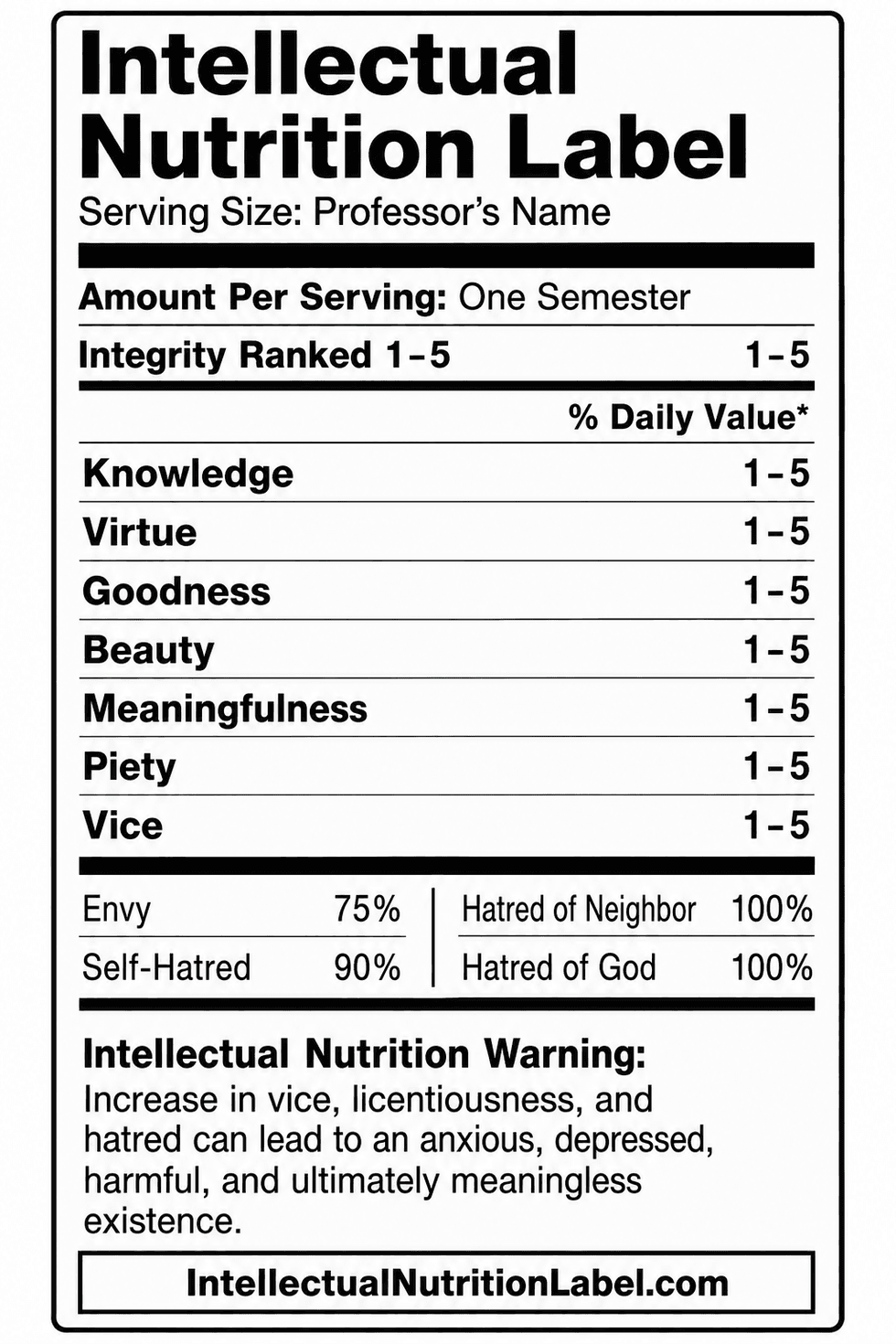
That’s why I developed what I call the “Intellectual Nutrition Label.”
The idea is simple. A nutrition label does not order shoppers to buy or reject a product. It tells them what the product contains so they can decide for themselves. The Intellectual Nutrition Label would do the same for college professors and courses.
Using public information — university biographies, curricula vitae, books, articles, interviews, lectures, and course materials — each label would summarize the intellectual content students are likely to encounter. Families should not need graduate training or weeks of research to understand what a professor openly teaches.
RELATED: Trump’s Justice Department is shining a light on woke universities — finally
Angela Lewis/Bloomberg/Getty Images
A useful label might ask:
- Does the professor encourage the pursuit of knowledge or deny that objective truth exists?
- Does the course cultivate virtue and self-command or treat desire as its own justification?
- Does it direct students toward goodness, beauty, and wisdom or toward resentment, envy, and contempt?
- Does the professor teach students how to examine arguments or tell them which political conclusions a decent person must reach?
A label could also rate qualities such as intellectual honesty, knowledge, virtue, beauty, meaningfulness, and piety. A professor might rank highly for candor and scholarship while receiving a low rating for piety because he publicly rejects belief in God. The point would not be to uncover private opinions or publish anonymous accusations. The ratings would summarize what professors already say about themselves and their work.
 Owen Anderson
That distinction is essential. An Intellectual Nutrition Label should not become a blacklist, an invitation to harassment, or a substitute for reading a professor’s work. It must rely on verifiable public evidence, represent a professor’s position fairly, and provide enough sourcing for readers to check the judgment for themselves.
The concept has predecessors. David Horowitz’s 2006 book, “The Professors: The 101 Most Dangerous Academics in America,” documented ideological activism in higher education. The David Horowitz Freedom Center continues to track left-wing activists and organizations. Turning Point USA’s Professor Watchlist sought to alert students to professors who brought political activism into the classroom and briefly maintained a list of recommended faculty.
The Intellectual Nutrition Label would have a narrower purpose: consumer disclosure. It would tell students and parents what intellectual ingredients a professor publicly advertises, in a format ordinary people can understand before registration day.
If a professor teaches that the United States is inherently oppressive, advocates Marxist critical theory, rejects biological sex as fixed, or treats Christianity principally as an instrument of domination, those positions should be documented in the professor’s own publications, biography, lectures, or course materials. An accurate summary of publicly stated beliefs is not censorship.
RELATED: Universities won’t give back the land — but they will bury history
 ROBYN BECK/AFP/Getty Images
The more serious objection may be that parents and taxpayers were never expected to notice. Academic language often conceals radical assumptions behind specialized vocabulary. Professors can signal their commitments to colleagues while students discover the course’s real content only after enrollment.
That arrangement is losing its protection. Parents increasingly ask what their children are learning. Taxpayers increasingly ask whether public universities are educating students or recruiting them into political movements. Those are legitimate questions, especially when a single semester can cost more than many families earn in months.
Throughout the coming semester, I will publish Intellectual Nutrition Labels evaluating professors from publicly available evidence. The labels will not decide which courses students may take. They will help families make that decision with their eyes open.
Readers can follow the project on my Substack and at intellectualnutritionlabel.com (coming soon).
When families spend tens of thousands of dollars on a college education, they deserve to know who is teaching, what that professor believes, and which intellectual ingredients will be placed before their children. Colleges already label the price. It’s time to label the product.
Read the full article here




![Cancel Culture Ate the Role Models and Now Kids Feel Like Nothing They Do Matters: Glenn Beck [WATCH]](https://www.talkred.com/wp-content/uploads/2026/10/2026.10.04-09.37-talkred-6ac21e6d41722.jpg "Cancel Culture Ate the Role Models and Now Kids Feel Like Nothing They Do Matters: Glenn Beck [WATCH]")
![Trump’s Treasury and IRS Unleash Education Freedom Tax Credits Tied to Nationwide School Choice [WATCH]](https://www.lifezette.com/wp-content/uploads/2025/12/2025.12.05-09.29-lifezette-6932a5f3b5dc3.jpg "Trump’s Treasury and IRS Unleash Education Freedom Tax Credits Tied to Nationwide School Choice [WATCH]")