
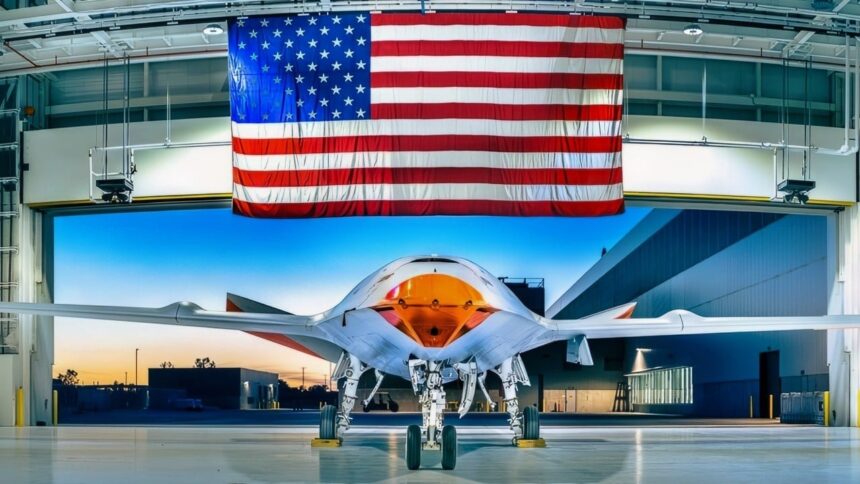

As the unmanned-platform revolution takes hold everywhere, the United States Navy is getting into the action. In fact, the Navy is doing its best to stay ahead of the curve: the maritime branch is not just building unmanned systems that can operate underwater or conduct surveillance and targeted strikes; it is also producing, in partnership with Boeing, the MQ-25A Stingray.
The U.S. Navy and Boeing conducted ground testing of the MQ-25 Stingray at Chambers Field onboard Naval Station Norfolk, Virginia. The MQ-25 Stingray is an unmanned aerial refueling aircraft. (U.S. Navy photo by Mass Communication Specialist 2nd Class Sam Jenkins)
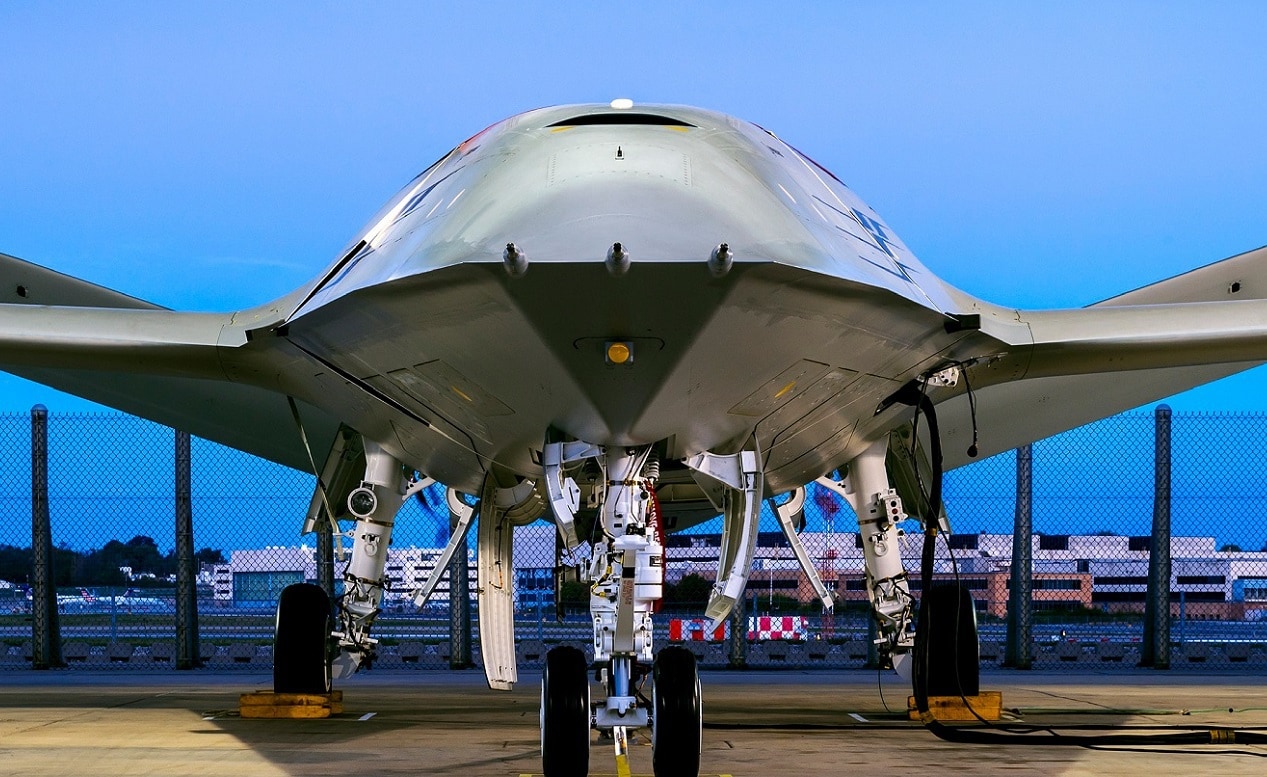
MQ-25. Image Credit – Creative Commons.
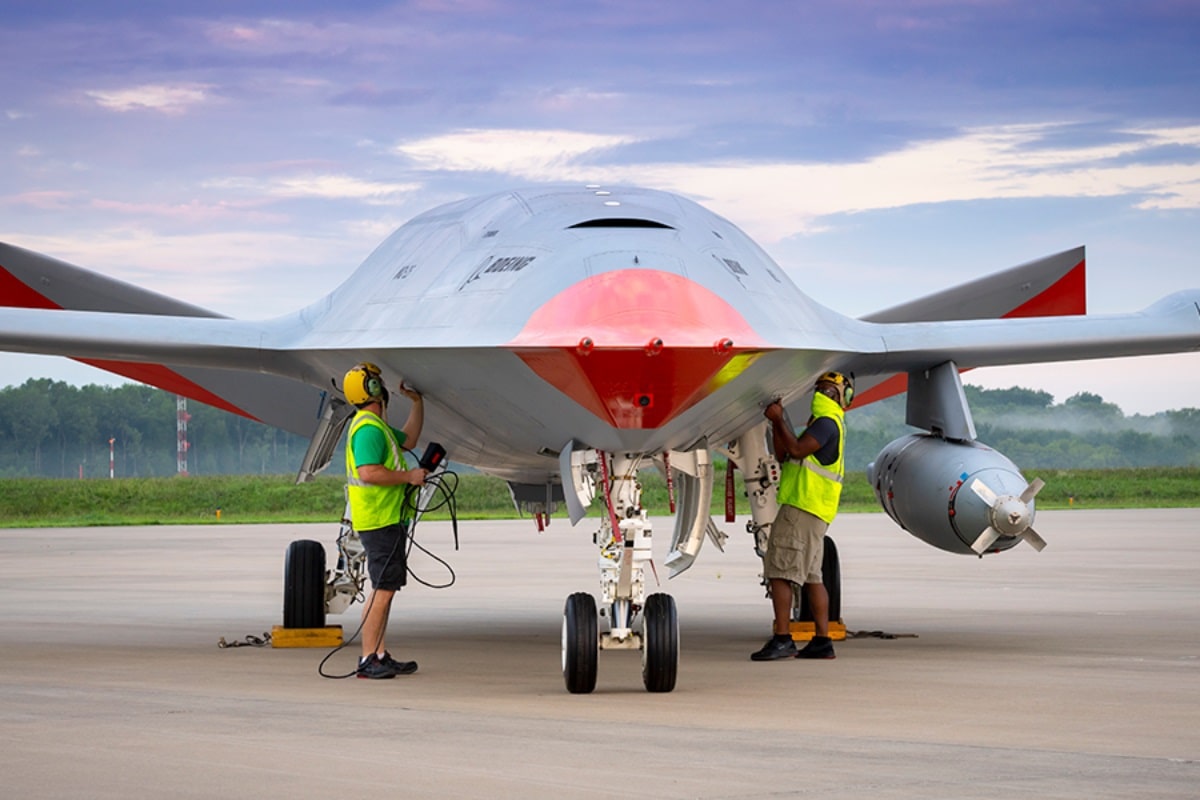
MQ-25A Stingray. Image: Creative Commons.
This unmanned platform will soon deploy from America’s nuclear-powered aircraft carriers and will serve as what many call a “flying gas station.”
The Navy’s (and Air Force’s) Midair Refueling Capabilities
Yes, of course, the United States already has a significant midair refueling capability. But as the Iran War has demonstrated, those midair refueling planes are large, slow, and easy for the enemy to detect.
What’s more, those platforms are increasingly vulnerable to attack from enemy planes, missiles, and drones.
If the United States lost these planes in combat, few spares would be available. Without a redundant capability, the US would lose its critical midair refueling capacity.
And the Navy can’t always rely on those bigger Air Force KC-135s because special modifications must be made to the Air Force system to support the Navy’s “probe-and-drogue” midair refueling system.
Thus, the Navy often has to employ its F/A-18E/F Super Hornets as aerial tankers via a process known as “buddy tanking.”
During this process, a Navy Super Hornet carrying external fuel tanks and an aerial refueling pod transfers that excess fuel to another friendly bird midflight.
But each time that a Super Hornet is used as a midair refueler, that bird is unavailable for its primary mission: combat.
Unburdening the Conventional Midair Refuelers
That’s where the unmanned, cheaper, and smaller MQ-25A Stingray comes into the picture.
The Stingray will launch from an aircraft carrier, loaded with aviation fuel, and rendezvous with other Navy planes to transfer fuel to them in flight.
If this Navy-specific system can demonstrate a consistent capacity for midair refueling, then the Navy can unburden the Air Force’s already stretched KC-135 fleet as well as its own Super Hornet fleet from the responsibility of conducting midair refueling.
The Navy can do this at a far lower cost than if it had to produce its own manned, dedicated midair refueling system.
Because of its massive responsibility, the Navy’s Stingray drone will be larger than the usual unmanned aerial vehicle (UAV) we’ve all become accustomed to seeing.
The MQ-25A comes in at 51 feet long with a 75-foot wingspan when its wings are extended.
Thus, the Navy has required Boeing to make the wings of this drone retractable, reducing that wingspan while in storage on the carrier to just 31 feet.
A single Rolls-Royce AE 3007N-series engine powers this drone.
The MQ-25 must operate in one of the most congested aviation environments imaginable: the airspace around an aircraft carrier.
So, the Navy has created the Unmanned Carrier Aviation Program, which includes an Unmanned Carrier Aviation Mission Control System (UMCS).
That system will handle command-and-control while integrating the drone into carrier flight operations–that includes deck handling, taxiing, launches, and even recoveries.
During flight, the vehicle will receive commands from human operators.
Welcome to the New Age of Drones
Boeing expects the UCMS to eventually control multiple drones deployed from the aircraft carrier, not just the midair-refueling Stingray.
In April of this year, the first operational MQ-25A completed its maiden flight from Boeing’s MidAmerica Airport facility in Mascoutah, Illinois.
The aircraft remained airborne for nearly two hours while Navy and Boeing personnel tested the system’s flight controls and engine performance and worked out its handling characteristics.
They also tested the Stingray’s automated taxiing, takeoff, flight, and landing systems while responding to commands from the ground-control network.
In May of this year, following the success of the April tests, the Navy moved the MQ-25 program to “Milestone C” of its development cycle, meaning the UAV was entering low-rate initial production.
Like all military programs these days, the Stingray has struggled with delays.
The Navy had wanted the Stingray operational by 2024. Current planning estimates it will be flying the unfriendly skies no earlier than 2029, a five-year delay.
The Navy wants 76 MQ-25 units, comprising 67 operational and 9 test aircraft. In its recent 2027 defense budget request to Congress, the Navy asked for $1.75 billion for the program.
A Unique Start for the Navy’s Drone Program
But the Navy doesn’t just want the Stingray to serve as a midair tanker.
The maritime branch also wants the Stingray to conduct surveillance missions and intelligence collection operations.
According to Boeing, the aircraft’s architecture can accommodate additional technologies as the Stingray’s requirements evolve.
Meanwhile, the Navy wants both its older Nimitz-class and newer Gerald R. Ford-class aircraft carriers to be capable of launching and recovering these systems.
Unlike other branches, which have primarily embraced drones for their offensive capabilities, the Navy is entering the age of drones by adopting an unmanned midair tanker.
But perhaps that’s the best way forward, especially since Boeing claims the Stingray can be easily adapted for other non-refueling missions.
About the Author: Brandon J. Weichert
Brandon J. Weichert is the Senior National Security Editor at 19FortyFive.com. He also manages The Weichert Brief on Substack. Weichert also hosts “National Security Talk” on Rumble. He is the author of four bestselling national security books, the most recent of which is A Disaster of Our Own Making: How the West Lost Ukraine (Encounter Books). Follow him via Twitter/X @WeTheBrandon.

![Leftist Podcaster Groans Illegal Alien Crime Stories Are Exhausting, Says Enforcement is Humiliating [WATCH]](https://www.rvmnews.com/wp-content/uploads/2026/09/2026.09.03-09.09-rvmnews-6a9939627bc86.jpg "Leftist Podcaster Groans Illegal Alien Crime Stories Are Exhausting, Says Enforcement is Humiliating [WATCH]")


![Three Quarters of DOJ Civil Rights Attorneys Bolt Rather Than Clean Voter Rolls and Kill DEI [WATCH]](https://www.rvmnews.com/wp-content/uploads/2026/09/2026.09.26-08.43-rvmnews-6ab785c38476a.jpg "Three Quarters of DOJ Civil Rights Attorneys Bolt Rather Than Clean Voter Rolls and Kill DEI [WATCH]")
![Bill Burr Rips Healthcare CEOs for Choosing Security Over Asking What Motivated Luigi Mangione [WATCH]](https://www.boredtrashpanda.com/wp-content/uploads/2026/09/2026.09.26-09.20-boredtrashpanda-6ab78e6bd8480.jpg "Bill Burr Rips Healthcare CEOs for Choosing Security Over Asking What Motivated Luigi Mangione [WATCH]")