
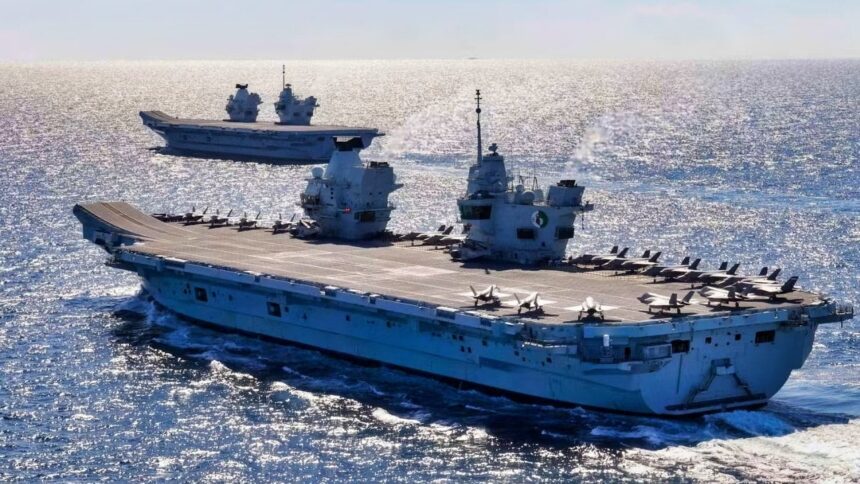

Summary and Key Points: HMS Queen Elizabeth and HMS Prince of Wales displace about 65,000 tons apiece and are the largest warships the Royal Navy has ever built. Neither has a catapult. Neither has an arresting wire. Every American fleet carrier has both, and so does the French Charles de Gaulle, which is why a US Navy flight deck can launch the F/A-18 Super Hornet, the EA-18G Growler, the E-2D Advanced Hawkeye and the F-35C. The Royal Navy’s two carriers can fly none of them. They fly the F-35B, and for the next four decades they will fly nothing else.
The Queen Elizabeth-Class Is No US Navy Aircraft Carrier
Queen Elizabeth-Class Aircraft Carrier Deck. Image Credit: Creative Commons.
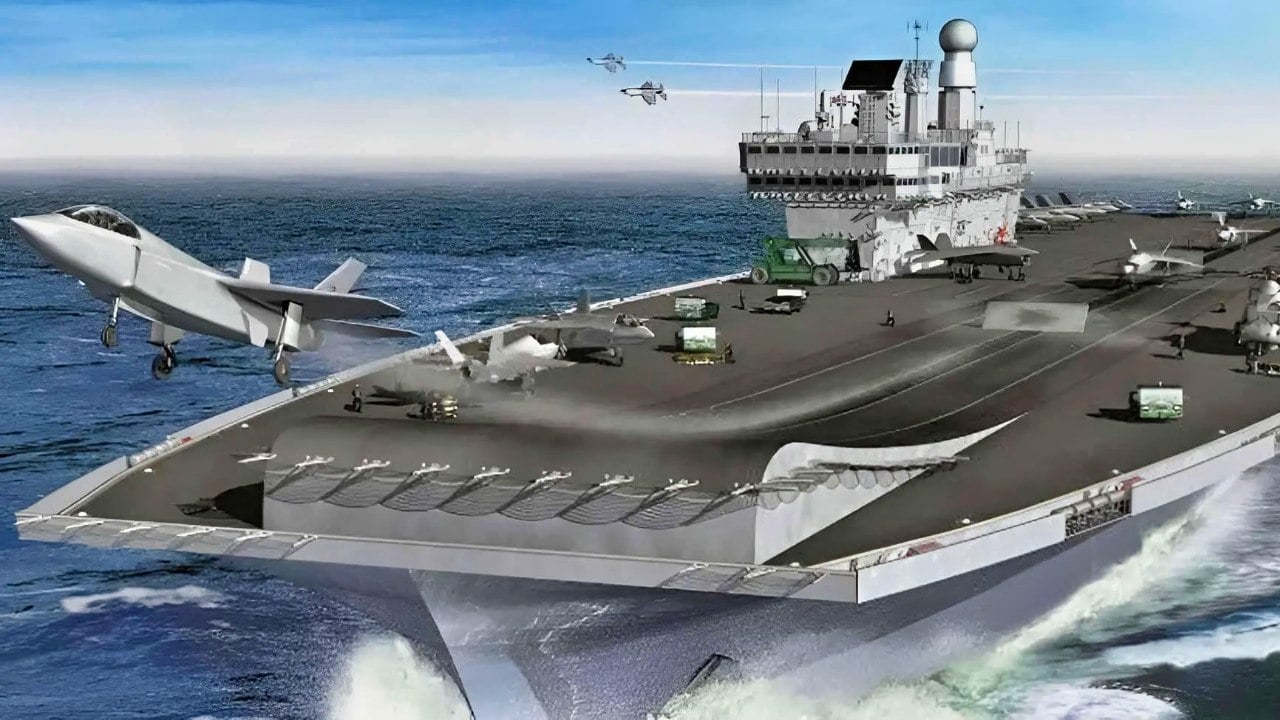
Queen Elizabeth-Class Aircraft Carrier Artist Rendering.
HMS Queen Elizabeth and HMS Prince of Wales are the largest carriers ever built for the Royal Navy. Yet they lack one of the defining technical features found aboard American and French fleet aircraft carriers: the aircraft catapult.
This means that Britain must be very intentional about what carrier aircraft it purchases and operates from these ships. Basically, the ships are built around STOVL, which limits Britain’s options to the F-35B.
The F/A-18, EA-18G, E-2D, and F-35C are all non-starters.
In choosing the STOVL system, Britain placed a hard limit on its carrier fleet capabilities, sacrificing flexibility and performance—but perhaps gaining a fleet better aligned with Britain’s ambitions.
Selecting the STOVL System
American carriers use CATOBAR systems, where an aircraft attaches to a catapult and is violently accelerated down the deck to flying speed.
On recovery, a tail hook catches one of the arresting wires and decelerates the aircraft, again violently, in just a few hundred feet. Older American carriers, including the Nimitz-class, use steam catapults.
But the Ford-class introduced the electromagnetic EMALS system.
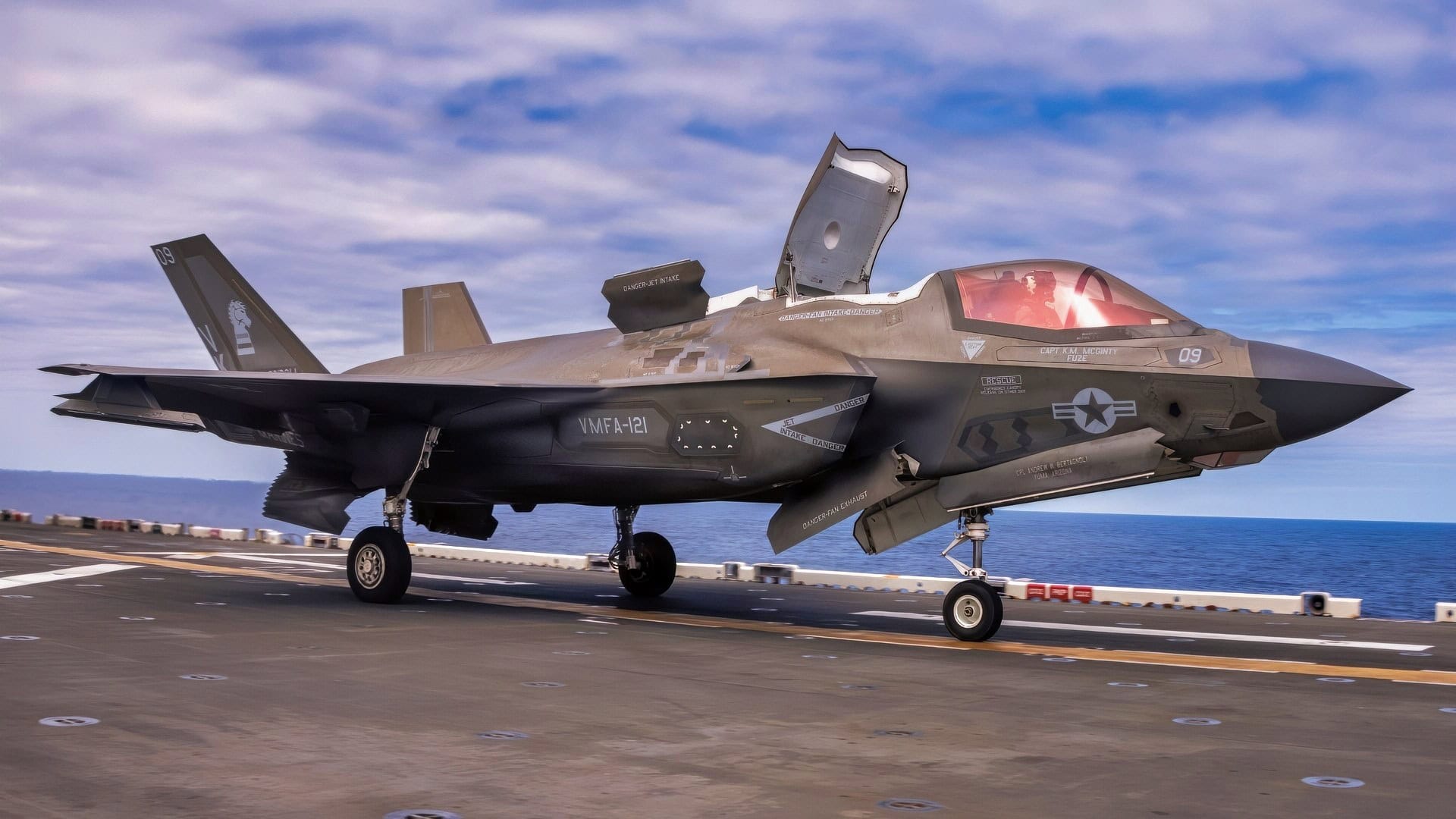
A U.S. Marine Corps F-35B Lightning II assigned to Marine Fighter Attack Squadron (VMFA) 121, 31st Marine Expeditionary Unit, takes off during a joint service flyover in the Philippine Sea, Feb. 26, 2026. Aircraft participated in a coordinated event to demonstrate joint service readiness and maritime capabilities. The 31st MEU is a persistent, combat credible force operating aboard the ships of the Tripoli Amphibious Ready Group in the U.S. 7th fleet area of operations, routinely interacting and operating with our allies and partners to contribute to deterrence, security, crisis response, and combat operations in the Indo-Pacific region. (U.S. Marine Corps photo by Lance Cpl. Victor Gurrola)
Both systems require intensive commitments and extensive infrastructure support, including catapult machinery, arresting gear, additional electrical and steam-generation capacity, maintenance personnel, reinforced deck structures, and the specialized training necessary to execute one of aviation’s most complex and demanding operations.
Britain opted not to deal with the extra hassle and infrastructure of CATOBAR operations, choosing instead to build the Queen Elizabeth-class around STOVL and eliminate catapults and arresting wires entirely.
Launching the F-35B
The Queen Elizabeth-class features a distinctive ski-jump bow. With this method, aircraft accelerate conventionally along the deck before climbing the ramp.
The ramp’s upward trajectory buys the aircraft additional time to accelerate while its wings develop lift.
The F-35B, for example, is ideal for the STOBAR system thanks to the Pratt & Whitney F135 turbofan with a swiveling rear exhaust nozzle, shaft-driven Rolls-Royce LiftSystem behind the cockpit, and roll-control ducts in the wings.
For landing, the F-35B can transition to powered lift and recover vertically, rather than having to catch a wire, as a jet landing on an American carrier would be required to do.
Britain has also developed Shipborne Rolling Vertical Landing (SRVL) techniques, allowing the aircraft to land with some forward velocity, enabling it to carry more fuel and ordnance than would be permitted with a true vertical recovery.
The Drawbacks
But STOVL exacts a performance price.
The F-35B’s lift fan, swiveling nozzle, and associated machinery occupy space and weight that the F-35A/C can devote to fuel, ordnance, or other equipment.
Consider the range of the F-35B compared to the F-35C, with the former operating within a 450 nautical mile radius and the latter operating within a 670 nautical mile radius.
This is because the F-35C has larger wings and greater internal fuel capacity. The F-35C can also carry more ordnance, meaning the F-35B’s strike capacity is reduced by comparison.
The biggest drawback, however, probably doesn’t relate to the F-35B at all, but to the fact that the British can’t launch support aircraft the way the Americans can.
The CATOBAR system permits the launch of the E-2D Advanced Hawkeye, for example, giving the Americans airborne early warning and command and control.
Similarly, the Americans enjoy use of the EA-18G Growler, a dedicated electronic-attack aircraft—and of course, the F/A-18. Britain won’t have the benefit of such versatility; its performance will be permanently capped.
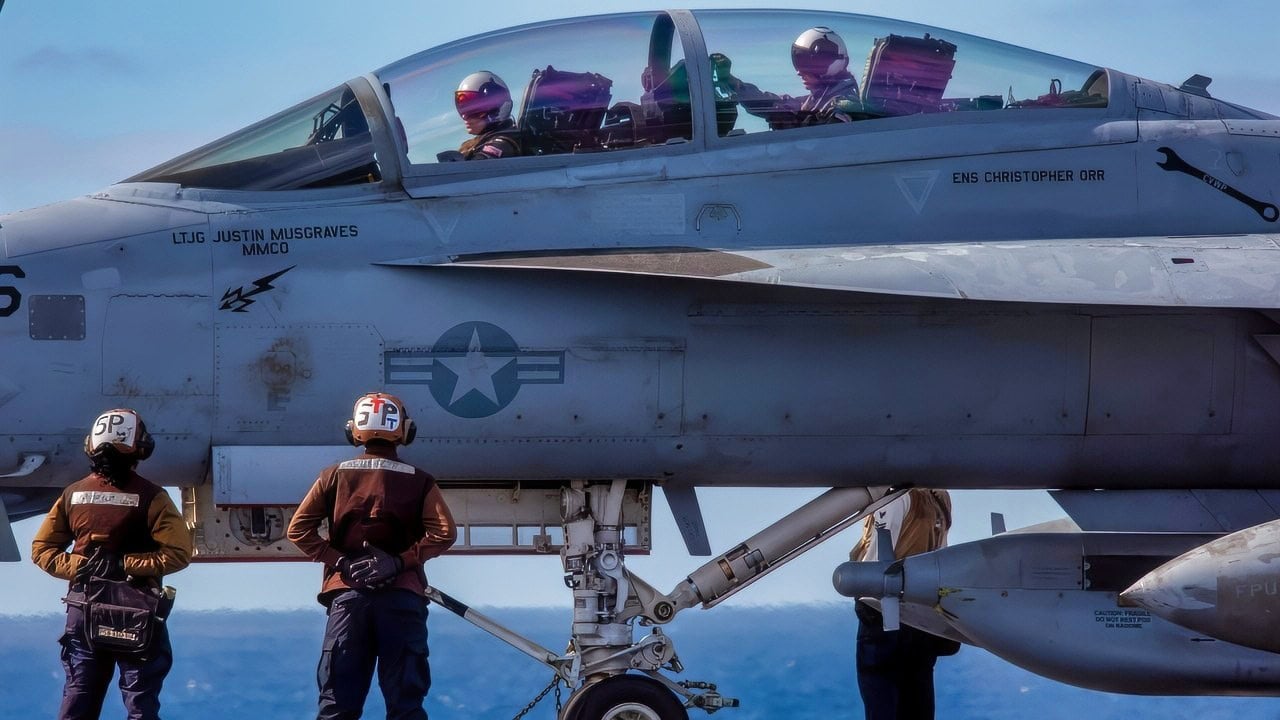
U.S. Navy Sailors prepare to taxi an EA-18G Growler, attached to Electronic Attack Squadron (VAQ) 133, on the flight deck of Nimitz-class aircraft carrier USS Abraham Lincoln (CVN 72) on Nov. 24, 2025. USS Abraham Lincoln (CVN 72), flagship of the Abraham Lincoln Carrier Strike Group, is underway conducting routine operations in the U.S. 3rd Fleet area of operations, demonstrating the U.S. Navy’s long-term commitment to a free and open Indo-Pacific. (U.S. Navy photo by Mass Communication Specialist Seaman Daniel Kimmelman)
Different Ambitions
But Britain has a different set of ambitions than the US. Britain doesn’t necessarily need the versatility or high-end performance of US carriers.
The two countries have radically different strategic requirements and thus need different military equipment. America has commitments and presence requirements throughout the Atlantic, Mediterranean, Persian Gulf, and Indo-Pacific.
A prospective war in the Pacific creates brutal range requirements, with enormous distances between bases and targets.
Britain, meanwhile, has no plans to defeat China in a carrier air war.
Britain’s obligations are limited to Europe and NATO, where geography is comparatively compact.
Britain also has the benefit of fighting alongside the US and knows that US capabilities will be available indirectly.
In short, Britain didn’t really need a CATOBAR system. The STOVL system meets Britain’s strategic requirements just fine.
About the Author: Harrison Kass
Harrison Kass is a writer and attorney focused on national security, technology, and political culture. His work has appeared in Tablet, City Journal, The Hill, The Spectator, and The Cipher Brief. He holds a JD from the University of Oregon and a master’s in Global & Joint Program Studies from NYU.






![NYPD Cops Hunt Suspect Who Hurled Furniture at 90-Year-Old Woman [WATCH]](https://www.rvmnews.com/wp-content/uploads/2024/06/2024.06.02-12.37-rvmnews-665c6798d8aa1.jpg "NYPD Cops Hunt Suspect Who Hurled Furniture at 90-Year-Old Woman [WATCH]")