


The towering figure of Anna Klobuchar Clemenc has returned to the streets of Calumet, Michigan, 70 years after she died.
Standing at 6’2″ tall, the woman known as “Big Annie” became the face of the copper miners’ strike in Copper Country, the northwestern counties of Michigan’s Upper Peninsula where copper mines sprang up in the middle of the 19th century.
On Christmas Eve 1913, the plight of the strikers turned unthinkably tragic.
The conditions in the mines were brutal. With shafts reaching more than a mile underground, the darkness was deep and thick, and the cost of miners’ equipment, including the candles for their hats, was deducted from their wages.
Shifts sometimes lasted 10 or 12 hours, six days a week, and almost always involved back-breaking physical labor. According to one report, nearly one out of every three miners suffered serious injury and one out of 200 was killed on the job.
Below are photos taken from inside Quincy Mine, located about 11 miles south of Calumet. The Quincy copper mine operated more or less continuously from 1846 until 1945, and a private organization now offers tours.
Photos taken by Blaze News
By 1913, the development of a new drill had changed the pay structure at the mines to compensate for time rather than productivity, resulting in a dramatic reduction in miner pay, according to the Daily Press. On July 23 of that year, nearly 9,000 copper miners in the region went on strike.
Big Annie, of course, was not one of them. However, she often led the way in their daily parades, carrying a giant American flag and demanding an eight-hour workday, higher wages, and better conditions.
Then the wife of a miner and the foundress of the Western Federation of Miners’ Women’s Auxiliary no. 15, Big Annie was eventually dubbed the “Heroine of the Copper Country Strike” and even an “American Joan of Arc.” She was arrested multiple times and served time in jail.
During one particularly contentious run-in with law enforcement, Big Annie reportedly shouted: “Kill me. Run your bayonets and sabres through this flag and kill me, but I won’t move. If this flag will not protect me, then I will die with it.”
The strike was at best minimally effective. The governor sent in the Michigan National Guard almost immediately, a notorious strike-breaking firm from New York arrived as well, and while the strike did disrupt operations, so-called scabs and imported foreign labor kept the copper mines going to some extent.
Then on Christmas Eve 1913, the plight of the strikers turned unthinkably tragic.
Big Annie and the rest of the Women’s Auxiliary hosted a Christmas party in the Italian Hall in Calumet for the striking miners and their families. The event was festive and even featured Santa and some gifts donated by union members and other businesses.
But at around 4:40 p.m., a man suddenly interrupted the revelry by shouting, “Fire! Fire!” His cries prompted a stampede downstairs for one exit, and 73 people were trampled to death in the stairwell, 59 of them children.
There was never any fire, and the alarmist was never identified. Folk singer Woody Guthrie memorialized the deadly incident in his song “1913 Massacre.”
Afterward, the strike limped along for another four months but officially ended without formal resolution on April 13, 1914.
Mining companies in the area did eventually implement an eight-hour workday and boosted wages, though some scholars argue that those changes were part of a larger labor reform movement throughout the country rather than the result of the strike.
Big Annie moved to Chicago shortly after the strike ended and died there in 1956 at the age of 68. While there’s no doubt she brought spirit and resolve to the strikers and their families, her legacy is a bit mixed.
Two of her three marriages ended in divorce. She divorced her first husband, miner Joseph Clemenc, just after the end of the strike and then married Frank Shaws, an editor of a socialist Slovenian newspaper.
Like Shaws, Big Annie was also a socialist. The Michigan Women’s Hall of Fame characterizes her as:
devoted to the active participation of women outside the traditional confines of the home. Having graduated from eighth grade, she was a relatively well-educated woman at that time. Clemenc was an avid follower of Eugene Debs, Mother Mary Harris Jones, and the tenets of socialism. It was her independent nature and strong-willed character that inspired many men and women to take a stand for justice.
Still, WLUC-TV recently described her as “a symbol of persistence and the mining history that built Calumet,” and residents there have never forgotten their native daughter.
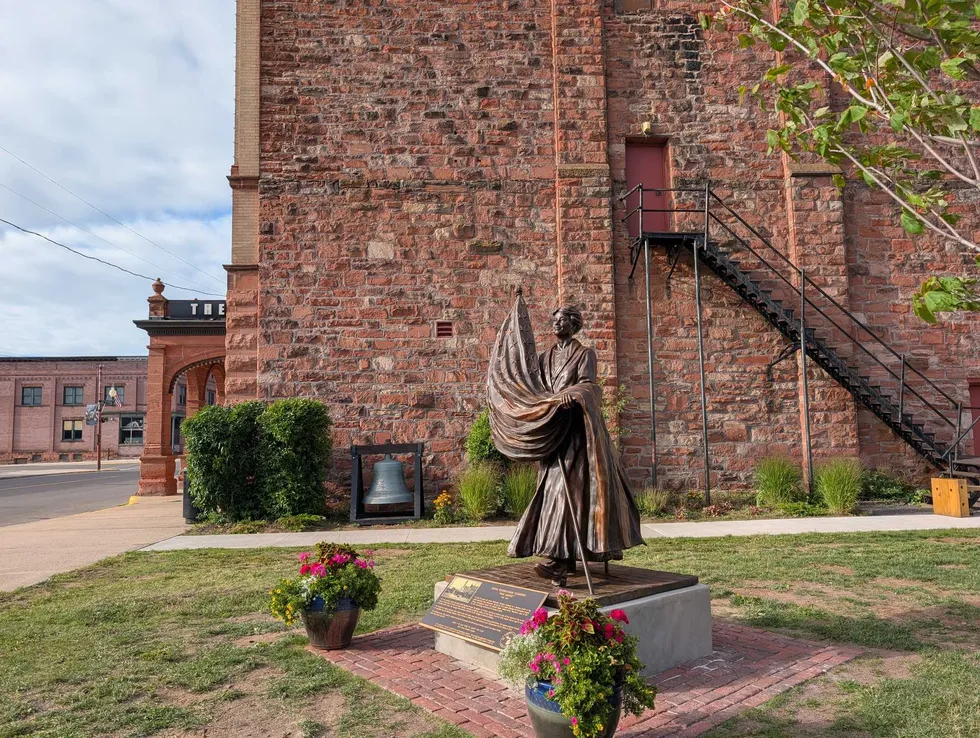
On August 22, they unveiled a life-size bronze statue of Big Annie, complete with a base made of Calumet street bricks dating back to 1913. A parade celebrating the occasion drew large crowds and included the pep band from nearby Michigan Technological University.
RELATED: First rule for surviving Michigan winter? A daily walk with my kids
 Courtesy of Visit Keweenaw
The statue project was a labor of love all its own. Locals spent years and raised over $150,000 to honor Big Annie, who was inducted into Michigan Women’s Hall of Fame in 1996 and Labor’s International Hall of Fame in 2013.
“If it wasn’t for people like Annie, who were so strong, I would have a hard time being a union member myself,” Bricklayers Union Member Adam Saari told WLUC-TV, “because the labor standards would not be the same.”
“I helped work on the statue, and I’m also someone who works in the mines,” said Bryan Latto, according to WLUC. “Our unique Upper Peninsula history is something that only we can preserve, so it’s something that we’ve got to do ourselves, otherwise nobody else is going to do it for us.”
Like Blaze News? Bypass the censors, sign up for our newsletters, and get stories like this direct to your inbox. Sign up here!
Read the full article here



![Canadian Economic Minister Admits Plot to Target United States Midterm Elections [WATCH]](https://www.lifezette.com/wp-content/uploads/2026/01/2026.01.23-11.29-lifezette-69735b8a4bbbb.jpg "Canadian Economic Minister Admits Plot to Target United States Midterm Elections [WATCH]")