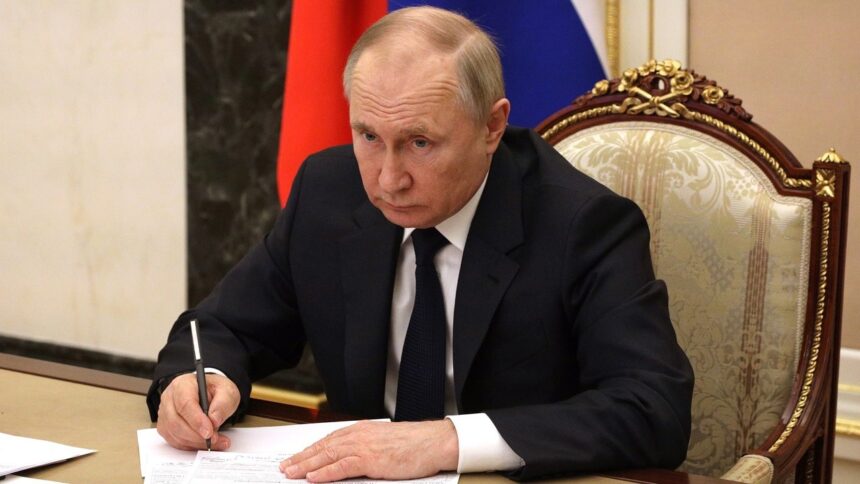

Almost every country that holds elections has a tradition of political parties convincing wartime veterans to use their status as heroes or as people who sacrificed for their country to boost their viability as candidates. But as with most of the world, Russia has taken this practice and turned it on its head. Russian President Vladimir Putin is set to hold elections for the country’s state parliament soon.
Currently, the majority of seats in this legislature are held by his United Russia party, and few observers predict that the former KGB Lt. Col. will lose that majority.
Not that it really matters.
The Duma, as it is called, plays a negligible role in making laws that meaningfully affect how the country is ruled.
It is more of a rubber-stamp parliament than a governing body.
However, Putin, in an act of supreme cynicism, is planning on using these elections as a means of recruiting more military personnel.
The Kremlin has long been rumored to be planning a major mobilization of hundreds of thousands of new recruits.
However, this call-up is reportedly being delayed until well after this 18-20 September parliamentary balloting. This delay is driven solely by Putin’s fear of a backlash at the polls in Russia.
This is especially true if the internet suddenly starts being flooded with smartphone videos of Russian youth being dragged off the street press-gang style into military vans and hauled off to an induction station.
As previously stated, no one predicts that Putin’s United Russia will lose its majority.
But there could be a loss of seats or, even more significant, a major drop-off in voter participation, both of which he wants to avoid.
The Ultimate Recruiting Poster
In an attempt to square the circle, Putin now has over 200 military personnel who have fought in Ukraine running at the top of different parties’ candidate lists.
They are also seen in television ads, campaign events, and posted advertisements.
The Russian president’s circle of spokesmen and surrogates promote them as members of Russia’s “true elite”. They are often referred to as some of the nation’s most prestigious citizen-candidates.
The intent is two-fold. One is to demonstrate to those now serving in Russia’s military and fighting in this war that they will have a special place in civilian life and will be celebrated as such.
Many do not understand the reality that any of these “revered heroes” who end up in a nice, comfortable position as an MP will have an easier-than-most existence but will enjoy little real political power.
But the other- and for now the more important – objective is that running so many veterans of the Ukraine conflict in such a high-profile campaign will convince more potential volunteers to sign up to fight.
“It is the ultimate recruiting poster – one of these ‘heroes’ of the SVO [Special Military Operation] being promoted for a parliamentary seat,” said a now-retired Soviet military officer now living in the US who spoke to 19FortyFive.
Desperately Seeking Legitimacy
The voting for the Duma, the lower house of parliament, begins Friday and is the first election of its kind since the war began.
Balloting is also going to take place in areas of Ukraine that Russia has captured and now acts as an occupation force and/or has illegally annexed – like Crimea.
The Kremlin is also doing all it can to stage-manage these elections.
T-90M. Image Credit: Creative Commons.
It is using the vote as a means to propagate the narrative that there is widespread support for the war and provide the veneer of legitimacy that Putin is always trying to manufacture in elections – including those of his own runs for the presidency.
By promoting veterans as candidates, the Kremlin wants to convince these potential recruits that they would be fighting for some greater set of values – for the future of a Russia with its greatest days still ahead, said Nikolay Petrov, senior research fellow at the NEST Centre, who spoke to the Washington Post.
His organization was founded by exiled Russian former oligarch and now-in-exile opposition figure Mikhail Khodorkovsky.
But Russia also “doesn’t know what to do” with those returning from the battlefield,” Petrov told The Associated Press, and so it offers them largely insignificant positions with little real power, while focusing on promoting those who already held public office.
Former Putin speechwriter-turned-political analyst Abbas Gallyamov was more straightforward, calling it “empty talk.”
Under these circumstances, Russians head to the polls.
How they vote, in what numbers, and for which of these military “heroes,” may significantly affect how Putin and his inner circle gauge the public’s view of the war.
About the Author: Reuben F. Johnson
Reuben F. Johnson has thirty-six years of experience analyzing and reporting on foreign weapons systems, defense technologies, and international arms export policy. Johnson is the Korea Fellow at the Casimir Pulaski Foundation. He is also a survivor of the Russian invasion of Ukraine in February 2022. He worked for years in the American defense industry as a foreign technology analyst and later as a consultant for the U.S. Department of Defense, the Departments of the Navy and Air Force, and the governments of the United Kingdom and Australia. In 2022-2023, he won two awards in a row for his defense reporting. He holds a bachelor’s degree from DePauw University and a master’s degree from Miami University in Ohio, specializing in Soviet and Russian studies. He lives in Warsaw.