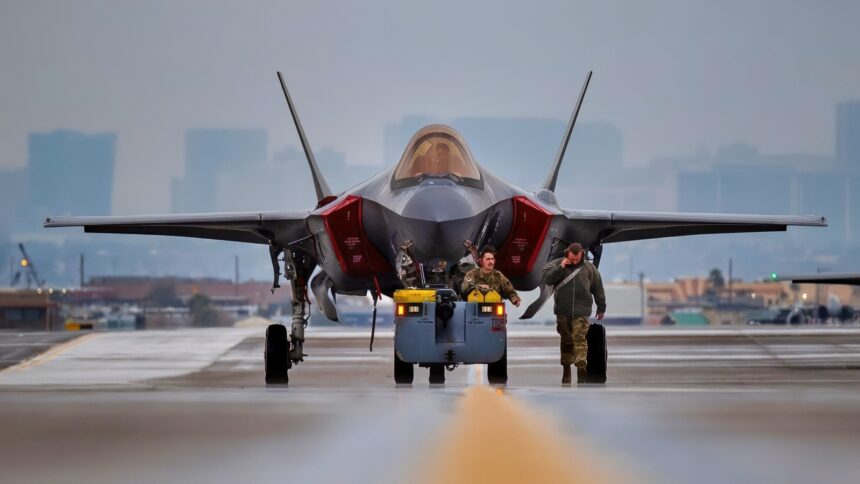

U.S. President Donald Trump’s administration has approved a $24.3 billion sale of the world’s most advanced fighter jets to Saudi Arabia.
The Saudi Kingdom will receive nearly 50 Lockheed Martin F-35 fighter jets as part of the package, which also includes Pratt & Whitney engines and other parts.
It comes amid a re-escalation by Houthi rebels in Yemen against Saudi targets in recent weeks.
48 Fighters
Announced on Thursday, the package includes 48 F-35s, widely believed to be the world’s most advanced fighters, equipped with conventional takeoff and landing.
The package also includes 49 Pratt & Whitney engines: 48 installed and 1 spare. Saudi Arabia will also receive a range of other items as part of the deal, including secure communications systems, precision navigation, and training and logistics support services.
“This proposed sale will support the foreign policy and national security objectives of the United States by improving the security of a major non-NATO ally that is a force for political stability and economic progress in the Gulf region,” the U.S. State Department said on Thursday, 17th September.
“The proposed sale will improve Saudi Arabia’s capability to deter current and future threats by strengthening its homeland defense, and improving interoperability with U.S. forces, and other regional and NATO forces,” the announcement continued, adding that the package will also “augment Saudi Arabia’s operational aircraft and enhance its air-to-air, and air-to-ground self-defense capability augment Saudi Arabia’s operational aircraft and enhance its air-to-air, and air-to-ground self-defense capability.”
F-35 at Lakeland, Florida Airshow. Photo taken by Harry J. Kazianis.
The State Department said the Kingdom “will have no difficulty absorbing this equipment and services into its armed forces.”
Saudi Arabia currently owns more than 300 fighter jets. Its stockpile largely consists of U.S.-made F-15s, of which it possesses 232, with 15 used for training.
It also has more than 150 from Europe, including 72 Eurofighter Typhoons and 81 Panavia Tornados.
A Long Process
Saudi Arabia has sought F-35s for several years as the Kingdom seeks to modernize its armed forces in the face of growing threats from Iran and the Tehran-backed Houthis in Yemen.
Then-President Joe Biden explored a deal to provide F-35s in exchange for Saudi Arabia normalizing relations with Israel, but the proposal fell through.
Since Trump returned to office, he has prioritized defense sales to the Kingdom, with a $142 billion arms deal agreed in May 2025 in what the White House described as the “largest defense sales agreement in history.”
The Saudi delight at the deal was evident on Thursday, with the Kingdom’s embassy in Washington posting on X: “The proposed F-35 sale reflects the strength and enduring nature of the Saudi-U.S. strategic partnership and the continued advancement of our defense cooperation.
For decades, Saudi-U.S. security cooperation has contributed to regional stability, strengthened our collective defense capabilities, and advanced our shared interests.”
No Impact on Israel
The U.S.-Saudi sale “will not alter the military balance in the region,” the State Department said.
This is a reference to the Qualitative Military Edge agreement with Israel, which, under U.S. law, ensures Israel maintains military and technological superiority over the potential combination of regional rivals in the Middle East.
Israel and Saudi Arabia have never shared formal diplomatic relations, and the latter does not recognize Israeli sovereignty.
Talks to normalize relations fell through at the onset of the war in Gaza in 2023.
Congressional Concerns
Congress will now review the sale before it is formalized. It has 30 days to scrutinize or block any sale before approval.
Lawmakers have previously been skeptical over increased defensive cooperation with Saudi Arabia, with questions in 2018 over a possible sale following the murder of Saudi journalist Jamal Khashoggi.
On Thursday, shortly after the sale was announced, Democrat Rep. Raja Krishnamoorthi said he opposed it because of concerns about Saudi Arabia’s relationship with China.
“The Trump Administration should not move forward with its proposed sale of F-35 fighter jets to Saudi Arabia when our own intelligence community is warning that it could put the crown jewels of American military technology within reach of the Chinese Communist Party,” said Krishnamoorthi. “Beijing has spent decades stealing American intellectual property and technology to close the gap with the United States, and we must not help them do it.
We must not sell our most advanced fighter jet anywhere the CCP may be able to get its hands on the technology inside it.”
About the Author: Shay Bottomley
Shay Bottomley is a British journalist. He has written for the Western Standard, Business Insider, Maidenhead Advertiser, Slough Express, Windsor Express, Berkshire Live and Southend Echo.