
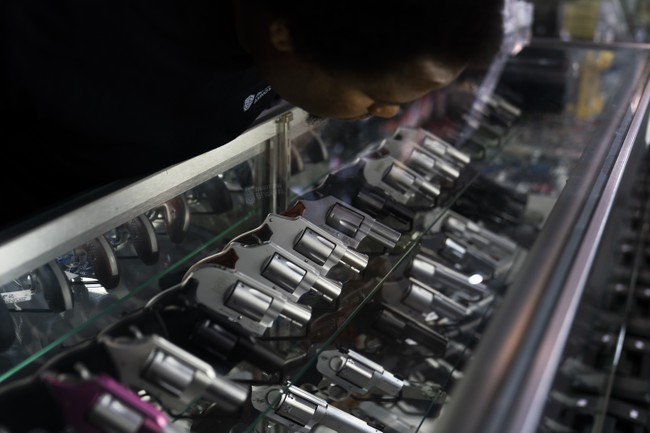

The Second Amendment Foundation and the National Rifle Association have partnered on a new amicus brief urging the Supreme Court to accept a case challenging Maine’s 72-hour waiting period.
The district court in Beckwith v. Frey granted a preliminary injunction to the plaintiffs, but the First Circuit reversed that decision while declaring that acquiring a firearm isn’t protected Second Amendment activity, so there was no need for the state to try to justify its law using historical analogues.
While the amicus brief does discuss the fact there is both a circuit court split on waiting periods and a decided lack of historic laws that would help Maine’s case, it also raises another argument in favor of the Court granting cert: to combat the “interest balancing” tests that have emerged in some courts (like the First Circuit) when it comes to Second Amendment issues that don’t directly involve keeping or bearing arms.
In this case, it’s the acquisition of a firearm that’s at stake, and as NRA’s Joseph Greenlee and SAF’s Kostas Moros point out, there’s a split among lower courts about what to do with ancillary rights like that.
According to the First Circuit, there is no explicit right to acquire a firearm at all, and lawsuits are not viable “unless plaintiffs demonstrate that the Act is abusive toward Second Amendment rights.” “In our view,” the court explained, the law is “a burden on, but not an infringement of, the Second Amendment right to keep and bear arms.” Thus, the First Circuit has ruled that judges get to determine whether the burdenimposed by a law is “abusive” enough to justify a Second Amendment claim. In other words, interest balancing is back as the governing standard for Second Amendment cases in the First Circuit, as it is elsewhere.
The amicus brief argues this is not what the Court has intended. As Justice Alito explained in Wolford, any law that implicates the plain text of the Second Amendment must be justified by historical tradition.
A waiting period implicates the right to both keep and bear, because it imposes an artificial delay in exercising those rights. Additionally, the right to keep and bear necessarily encompasses the right to acquire, even if it’s not explicitly stated in the text of the Second Amendment. If there is no right to get a firearm, how can the right to possess and carry one be guaranteed?
It might be an ancillary right, but Greenlee and Moros say those ancillary rights don’t deserve less protections.
Already, this supposed lesser protection for “ancillary” rights is being used to uphold all sorts of blatant constitutional violations. For example, a California state court recently ruled that the state’s new 11% “sin tax” on guns and ammunition does not even implicate the plain text of the Second Amendment. Bruen’s historical test is meaningless if courts can simply dodge it by declaring that the Second Amendment’s plain text is not implicated enough to trigger the historical inquiry.
We just saw this same game being played in the Ninth Circuit, where a narrow majority on an en banc panel determined that two of Hawaii’s weird gun laws are presumptively constitutional by claiming that they’re merely part of a “shall issue” licensing scheme, adding that it was actually the plaintiffs who bore the burden of proving the laws were abusive instead of putting the burden on the state to justify its laws based on historical analogues.
Maybe the justices will address this feigned confusion on the part of anti-2A judges in the Viramontes decision, but honestly they could stand to repeat themselves a time or two, and Beckwith v. Frey would be a good platform to do so.
Editor’s Note: Second Amendment groups like SAF and NRA are doing everything they can to protect our right to keep, bear, and acquire arms.
Help us continue to report on their efforts. Join Bearing Arms VIP and use promo code FIGHT to receive 60% off your membership.
Read the full article here

![Marco Rubio Takes NBC News Host to School on Trump’s ‘Media Ban’ [WATCH]](https://www.rvmnews.com/wp-content/uploads/2026/09/2026.09.23-08.21-rvmnews-6ab38c10d2068.jpg "Marco Rubio Takes NBC News Host to School on Trump’s ‘Media Ban’ [WATCH]")

![12 Democrat AGs Surrender on CNN Takeover [WATCH]](https://www.boredtrashpanda.com/wp-content/uploads/2026/09/2026.09.23-09.27-boredtrashpanda-6ab39b875c4a4.jpg "12 Democrat AGs Surrender on CNN Takeover [WATCH]")