


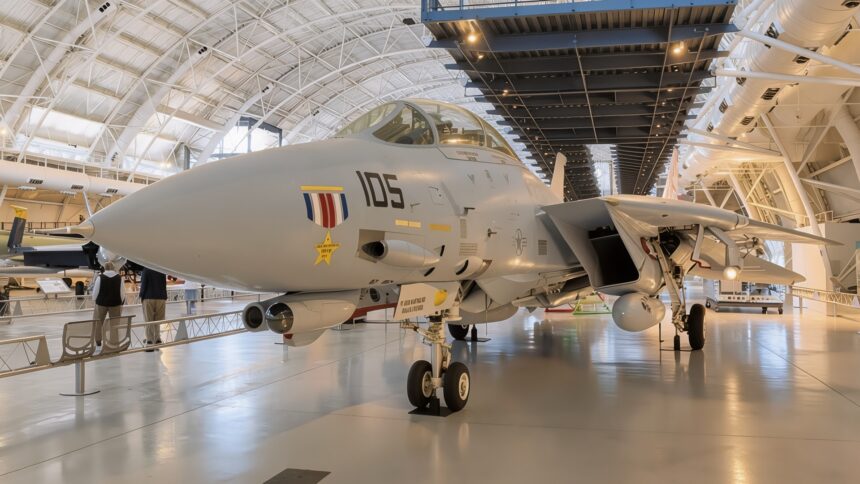

Summary and Key Points: In the early 1990s, with Top Gun still fresh and the A-12 Avenger II stealth attack jet canceled, Grumman made the Navy an offer: a Super Tomcat for the 21st century. The ST-21 would have kept the F-14’s swing wings and paired them with F110-GE-429 engines, enlarged fuel-carrying gloves, and modern sensors, aiming for Mach 1.3 supercruise.
The F-14 Super Tomcat 21 Would Have Been Epic
The F-14 Super Tomcat 21 (ST21) was a proposed, advanced upgrade for the U.S. Navy’s F-14 Tomcat in the early 1990s, intended to modernize it as a 21st-century multirole fighter with significantly improved range, avionics (such as an AESA radar), engines (F110-GE-429), and payload, including supercruise capability. Still, it was ultimately canceled in favor of the more economical F/A-18E/F Super Hornet.
However, the Super Tomcat 21 never entered service; it was a proposed upgrade that was ultimately superseded by the F/A-18E/F Super Hornet due to cost, maintenance, and evolving Navy needs.
Iran still flew a variant of the Tomcat until 2025, when Israeli airstrikes took out the last of them. Even if built, modern demands for stealth and network-centric warfare would likely lead to its retirement in favor of newer 5th-gen or next-gen aircraft like the F-35 and F/A-XX.
Key Features of the Super Tomcat 21
Enhanced performance would have been provided by more powerful engines (F110-GE-429), a larger glove (wing root) to carry more fuel, and improved aerodynamics to enable supercruise (Mach 1.3).
The F110-GE-429 is a powerful engine, enabling Mach 1.3 supercruise, a significant leap over the earlier, problematic Pratt & Whitney TF30, which was known for compressor stalls, offering better reliability, speed, and range.
With afterburners, the F110s produced over 27,000 pounds of thrust each, contributing to the F-14’s Mach 2+ speed. It featured variable geometry air intakes with movable ramps, controlled by the Air Inlet Control System (AICS), to manage airflow to the engines at different speeds and altitudes.
The ST 21 would have had an advanced avionics package. Upgraded radar (APG-71), FLIR systems, digital controls, and modern Electronic Warfare (EW) suites.
Greater range, payload, and the ability to carry advanced standoff weapons like AMRAAMs. The ST 21 was designed as a multirole aircraft. It was designed to be a potent fleet defender and strike aircraft.
Background on the F-14 Super Tomcat
The US Navy was looking for ways to extend the service life of the beloved F-14 Tomcat in the 1990s. Due to the success of the film “Top Gun,” the Tomcat was arguably the most popular aircraft in the US inventory.
The ST 21 moniker came from the Navy, specifically, a “Super Tomcat for the 21st century.” In 1988, a joint McDonnell Douglas and General Dynamics team was awarded a development contract for what would become the A-12 Avenger II, or the “Flying Dorito.”
The A-12 Avenger II would have been the first true stealth fighter; unlike the F-117, it would have had AIM-120 AMRAAM air-to-air missiles, but the project suffered from massive cost overruns and was canceled by 1991.
McDonnell Douglas designed an attack aircraft based on the more economical and successful F/A-18 Hornet. Grumman, however, opted to offer an even more heavily upgraded variant of the F-14, available as a new aircraft or through the remanufacture of existing platforms.
In place of the problematic glove vanes on the F-14, which were maintenance nightmares and, in many cases, welded shut, the ST21 incorporated enlarged aerodynamic gloves that offered significant benefits in supersonic handling and dogfighting performance. These aerodynamic gloves provided an additional 2,200 pounds of fuel storage in each wing, granting the aircraft even greater range.
Super Tomcat 21s would house navigation and attack FLIR (Forward-Looking Infrared) sensors. With upgraded computer systems and an improved Heads-Up Display, the ST-21 would take a 20-year-old fighter and outfit it with the best avionics package available.
The ST-21 would have been a formidable, bad-ass dogfighter. And it could have been continuously upgraded as well. But that wasn’t the issue.
Doomed For Failure
The F-14 Tomcat was never an economical aircraft to build and maintain. Its variable-sweep wings and the airframe that supported them were maintenance-intensive and expensive.
And at that time, the Pentagon was not in a position to spend lavishly.
While the improvements slated for the Tomcat were impressive, the advent of stealth aircraft, specifically the F-22 Raptor, initiated a shift in the US military’s combat aviation toward fifth-generation stealth fighters.
While many analysts believe that the ST-21 might still be in service today if it had been adopted, the gains of fifth-generation stealth aircraft by the US and China would have rendered it obsolete.
That’s why the F/A-18 Super Hornets are being phased out of service in favor of the F-35 and the soon-to-be-adopted F/A-XX, as the Navy transitions to a sixth-generation stealth fighter being developed in conjunction with the Air Force in the Next Generation Air Dominance (NGAD) program.
It is another of those great “what if” type of scenarios, but it was never fated to be. And it was never built. It was a drawing-board design, but it didn’t stop many aviation and Tomcat-loving enthusiasts from dreaming.
About the Author: Steve Balestrieri
Steve Balestrieri is a National Security Columnist. He served as a US Army Special Forces NCO and Warrant Officer. In addition to writing on defense, he covers the NFL for PatsFans.com and is a member of the Pro Football Writers of America (PFWA). His work was regularly featured in many military publications.








![Maintenance Man Opens Fire at South Los Angeles Senior Home, Injuring Three [WATCH]](https://www.rvmnews.com/wp-content/uploads/2026/09/2026.09.27-16.49-rvmnews-6ab9493448aea.jpg "Maintenance Man Opens Fire at South Los Angeles Senior Home, Injuring Three [WATCH]")