

Some rifles earn their reputation on the range. The HK416 earned its reputation on the far side of a compound wall. On May 2, 2011, operators from SEAL Team 6 went into Osama bin Laden’s compound in Abbottabad, Pakistan. The HK416 was widely reported to be the carbine many of them carried. American Rifleman called the raid the rifle’s “most famous appearance to date,” and almost overnight a rifle that had lived in the quiet corners of the special operations world had a household name.
However, the story of why the frogmen picked it up begins years earlier, with the Army.
The HK 416 Was Born From Delta Force’s Frustration With The M4
Heckler & Koch began work on the rifle in the 1990s, and Delta Force adopted it in 2004.
Larry Vickers, a former Delta operator who worked closely with HK on the project, has called it the proudest thing he’s done in the industry.
In his words, the very first weapons off the assembly line in Germany “went straight to Delta Force.” HK engineer Robert Hirt did much of the design work.
The problem they set out to fix was the M4’s direct impingement system.
It pipes hot propellant gas and carbon straight back into the bolt carrier group.
That works well enough on a range. Put a short barrel and a suppressor on it, run it hard in the sand, and the fouling and heat start to pile up.
HK’s answer borrowed from the G36.
The 416 uses a short-stroke gas piston that drives an operating rod into the carrier, so the dirty gas never reaches the action.
HK416. Image Credit: Creative Commons.
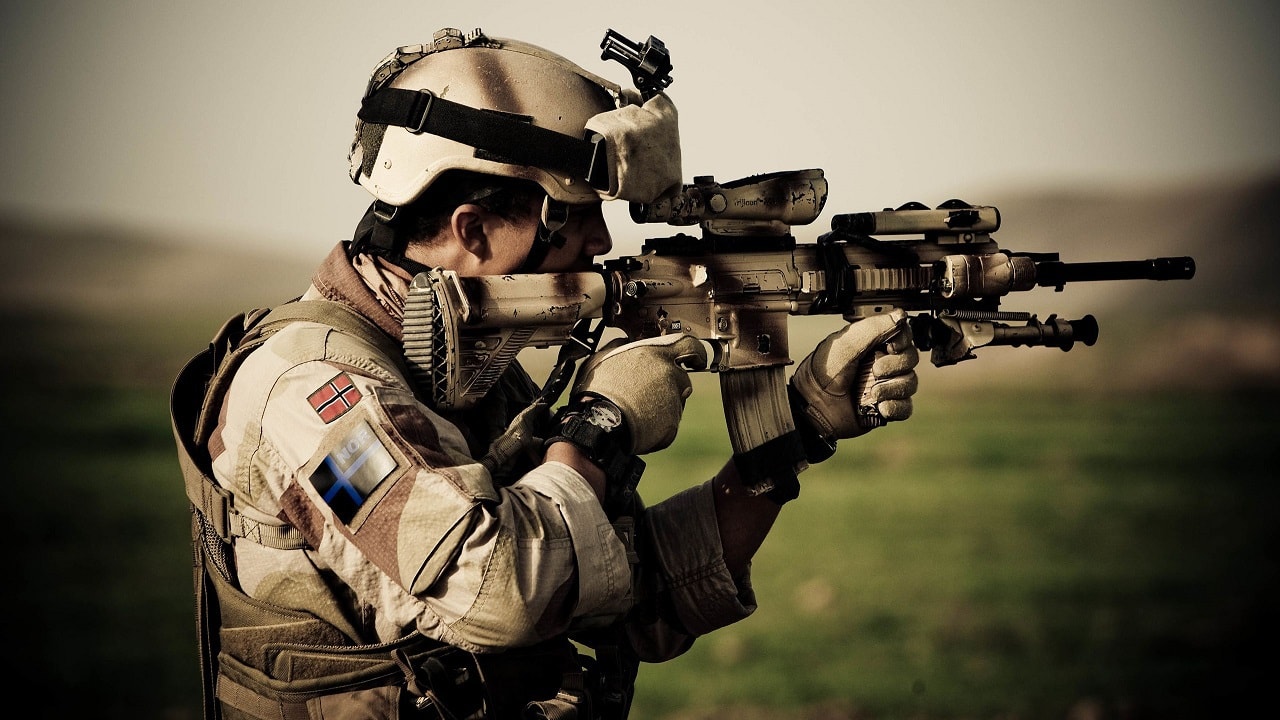
A Norwegian soldier in Afghanistan, armed with the HK416 N.
One operator put it simply: the system blows gas “forward and away from the bolt carrier group.” Everything else stays familiar.
The controls, manual of arms, and magazines are all pure AR, so a trained shooter can pick it up and go to work.
Why The SEALs Wanted It
So why would a Navy unit care about a gas system?
Because SEALs come out of the water. Delta and DEVGRU both valued the 416 for its over-the-beach capability, the ability to fire immediately after being submerged.
HK’s own literature states that properly configured variants can be fired immediately after submersion in water, sand, or mud.
With a conventional gas tube, water sitting in the system can turn the first shot into a serious problem.
In testing, operators found that the 416 kept running in water, while gas-tube rifles filled up.
DEVGRU reportedly favored the short D10RS with its 10.4-inch barrel, often wearing an AAC suppressor. That’s a compact package for clearing rooms and fast-roping out of helicopters, and it’s the setup where a piston earns its keep. Suppressed short barrels run dirty. The piston keeps that mess out of the action.
Then there’s the barrel. HK Cold Hammer Forges makes it and advertises a minimum service life of 15,000 rounds with minimal accuracy loss, with some users reporting more than 40,000.
For those keeping score at home, that is a lot of trigger time on one tube. In my opinion, that durability mattered as much as the gas system. Tier-one units shoot more in a month than most line units do in a year.
HK416 (D10RS) Specs
Cartridge: 5.56mmx45mm NATO
Dimensions Length: 30.9 inches (stock extended) / 27 inches (stock collapsed)
Barrel Length: 10.4 inches
Weight: 6.7 lbs empty
Effective Range: 400 yards
Rate of Fire: 700-900 rounds/min
Muzzle Velocity: 1700 feet per second
Feed: 20 / 30-round box magazine
The Weight Trade-Off
None of this came free. The 416 weighs over 8 pounds, compared to the M4A1’s roughly 7.5, and most of that extra weight sits out front, where you feel it.
The commercial version runs around $3,000, compared to under $2,000 for competitors like the CAR 816.
Many of its parts are proprietary.
Operators reported issues with tuning the gas system between suppressed and unsuppressed use, which HK addressed on the A5 with a two-position, tool-less adjustable gas block.
Those costs caught up with it.
Task & Purpose reports that the 416 was phased out by higher-echelon SOF units due to weight, cost, and limited modularity.
Say what you want about that decision. The rifle had already done what it was bought to do.
A Rifle That Went Mainstream
What started as a special-mission unit’s answer to a specific problem turned into a service rifle.
Norway made it standard issue in 2007.
France followed in 2017, the first time that country had adopted a foreign-made standard-issue rifle.
The Marine Corps adopted a variant, the M27 Infantry Automatic Rifle, to replace the heavier M249 SAW in the automatic rifleman role.
The M27 is still in service.
Its biggest competitors today are arguably its own children.
Hirt went on to work on the SIG516 and the Caracal CAR 816, both built on the same lessons.
The SEALs didn’t need a rifle that looked good on a spec sheet.
They needed one that would fire on the far side of that wall after a swim, a fast-rope, and a night of hard use.
That’s what they got.
About the Author: Steve Balestrieri
Steve Balestrieri is a National Security Columnist. He served as a US Army Special Forces NCO and Warrant Officer. In addition to writing on defense, he covers the NFL for PatsFans.com and is a member of the Pro Football Writers of America (PFWA). His work was regularly featured in many military publications.