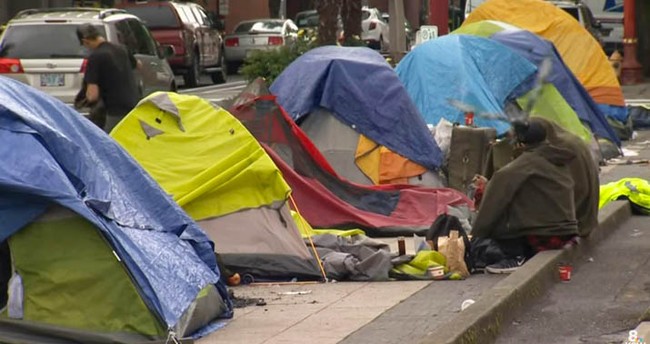

Can something simultaneously be a bad idea built on an absurd foundation and yet better than some of the alternatives? That’s the question I’m kicking around after reading this story about a tiny homes encampment in Portland called Dignity Village. The whole thing is worth reading but here’s a sample so you can maybe see what I’m seeing here.
Dignity Village is an intriguing answer to some of the thorniest questions posed by the homelessness crisis. Encampment sweeps are on the rise, fueled by a 2024 Supreme Court decision that overturned federal protections for those inhabiting public property if they had nowhere else to go.
But the question of where to put those who have been swept remains intractable. The core idea behind Dignity Village is to allow them to figure it out for themselves.
“Welcome to our radical experiment in collective self-empowerment to end homelessness!” exclaims the village manual. Residents are expected to contribute 10 hours of work each week to maintain the village, substance use must be confined to private spaces, and disputes are resolved by an elected council.
Already we’re glossing over so much. The 2024 Supreme Court decision put an end to a terrible ruling by the 9th Circuit which had essentially made it illegal to ask homeless people to move (off a sidewalk or out of a public park) unless the city had a bed available for them. Asking the homeless not to do illegal things that any normal person would be cited or arrested for doing was considered “cruel and unusual punishment under the 8th Amendment by the 9th Circuit. While this rule was in place, homelessness blossomed in many west coast cities because the hands of the police were effectively tied.
Eventually, a large group of progressive Democrats, including Gov. Newsom and the mayors of places like San Francisco asked the conservatives on the Supreme Court to save them and the court did. That’s the real backstory here.
As for the “radical experiment in collective self-empowerment” that’s the kind of BS autonomous zone language that makes me want to punch a hippie. For 25 years, this tiny homes village with no plumbing has been situated on city land. The city hasn’t endorsed it but also hasn’t evicted the residents.
Established in 2001, Dignity Village is the nation’s longest running experiment in what happens when the anarchic structure of an encampment gives way to a more permanent community. City leaders have not embraced its self-governed approach, but many homeless advocates hold it up as a reference for how peer-based solutions can sometimes succeed where bureaucratic solutions fall short. Dignity Village’s residents have found ways to survive, and even thrive, despite addiction, mental illness and extreme poverty, crediting the village’s messy, exhausting, small-D democracy as nonetheless critical to their stability…
What started as a collection of tents slowly grew into solid structures with the help of legions of volunteers. Under an obscure state law, the city designated the place as an urban campground, allowing some flexibility around building codes.
In short, this is still a place where homeless people are living outside the laws that apply to everyone else. The residents live full time on city land. They pay no property taxes. Their tiny homes aren’t up to any real building code. They are just allowed to sidestep all the rules that apply to most people because, for one reason or another, they have wound up on the street.
Last year, Dignity Village got electric power thanks to a donation of solar panels.
The long-time Northeast Portland homeless community has installed solar panels with the help of a grant from the city. Now, all 43 of the tiny homes have power.
Before, the community used candles for light and propane for heat and cooking, leading to multiple fires.
Now, residents can refrigerate or microwave food, use a fan and even charge their phones.
“It’s really helping a lot of people’s health and their mental well-being, because being in too hot of a place, of course, you’re going to just kind of lose your mind,” said Lisa Larson, who has lived in Dignity Village for 14 years.
Yes, that all does sound like an improvement but once again the residents had little to do with it. It was given to them, just like the land they are living on was de facto given to them and presumably most of the materials used to build the tiny homes. Unlike your average tent camp, the people at Dignity Village do pay a monthly fee to help administer the space.
And that brings us to what is probably the only clear positive about Dignity Village, at least in my view. Unlike a lot of other homeless spaces, the city is not spending a boatload of money on this.
At a recent gathering, they welcomed Mitch Green, an economist turned city councilor, whose downtown Portland district includes much of the city’s unhoused population. He was flabbergasted by Dignity Village’s annual operating budget: $60,000, or about $1,000 per person. He said Portland’s city-run tiny home villages cost taxpayers approximately $40,000 per person annually.
Truly the best thing you can say is that there are similar tiny home villages which are soaking taxpayers for a lot more money. All of them are having everything given to them. No one is paying their own way, but the cost of maintaining Dignity Village is a lot less than other camps this size. That does seem like a positive. Part of the problem at this point is all these blue cities have a homeless-industrial complex which gets paid to care for these people. They then also have a motivation to keep the money flowing from cities to their groups. Solving the problem would not benefit them at all. So the idea that Dignity Village cuts out the wasteful middle-man is appealing.
But it’s still hard to get past the fact that these people are living in a law-free zone, not much different from tent camps on a sidewalk. Try going onto city property and setting up a permanent base to live there and see what happens. If you’re a normal person with a job, you’ll be fined and maybe arrested if you refuse to leave. So at best we’re grading on a huge curve here. If the city hands over space and tolerates all the activity that would normally be illegal, Dignity Village can mostly avoid becoming an ongoing crime scene.
The comments are interesting. As you’d expect, a lot of people are outraged by any criticism of this supposedly brilliant exercise in self-governance. This one in particular really set people off.
Who holds the liability on public land not controlled by the public?
I can see why the City of Portland has qualms about Dignity Village.
How is Dignity Village indemnifying the city, residents, and private property owners in any tort cases, for example.
I did find the “village” article interesting, and it recalled to me the issues within communes sixty years ago.
Impressive that this effort has continued for a quarter century, but, like most of the communes were, it is dependent on the largesse of the society that surrounds it.
People are angry:
“… it is dependent on the largesse of the society that surrounds it.”
Yes and, I would argue (or at least suggest), so it is with “communities” of all sizes – towns, cities, counties, states; A state of being that seems much forgotten these days.
Another:
We are all dependent on the largesse of our surrounding society. No person is an island.
And so on:
Telling structurally unemployed people who handbuilt their homes and maintain their own community and council that they’re living by your largess because they’re technically violating one of your marginally-useful abstract legal fictions is like telling someone you’ll do them the favor of not forcing them to stand all day in your bread queue when your bakery has been out of bread all week.
But of course the first guy is right. They are living off the largesse of society. They provide nothing and get free land, free exemption from rules like taxes, housing codes, drug laws, etc. And suggesting that everyone does this is nonsense. Homeowners pay property and other state taxes that fund millions in help for these individuals. They also must abide by the laws everyone else is stuck with (except the homeless). It’s not remotely the same and pretending like Dignity Village is some proud experiment in self-government ought to be laughed at because it’s actually a quasi-legal experiment in handing free stuff to people and letting them pretend they are in charge.
That said, it does seem a lot cheaper than the very expensive alternatives the city is currently funding. So I’m of two minds on this. As you can probably tell, I genuinely hate the hype over this but maybe it is an improvement over the very low bar set by homeless activists in these cities.
Editor’s Note: The American people overwhelmingly support President Trump’s law and order agenda.
Help us fight back against the Democrats and Soros-backed DAs that refuse to enforce our laws to hold criminals accountable. Join HotAir VIP and use promo code FIGHT to receive 60% off your membership.
Read the full article here





![Shark Cruises Flooded New Jersey Streets as Violent Nor’easter Hammers Coast [WATCH]](https://www.lifezette.com/wp-content/uploads/2026/09/2026.09.28-12.59-lifezette-6aba64c3802c9.jpg "Shark Cruises Flooded New Jersey Streets as Violent Nor’easter Hammers Coast [WATCH]")