


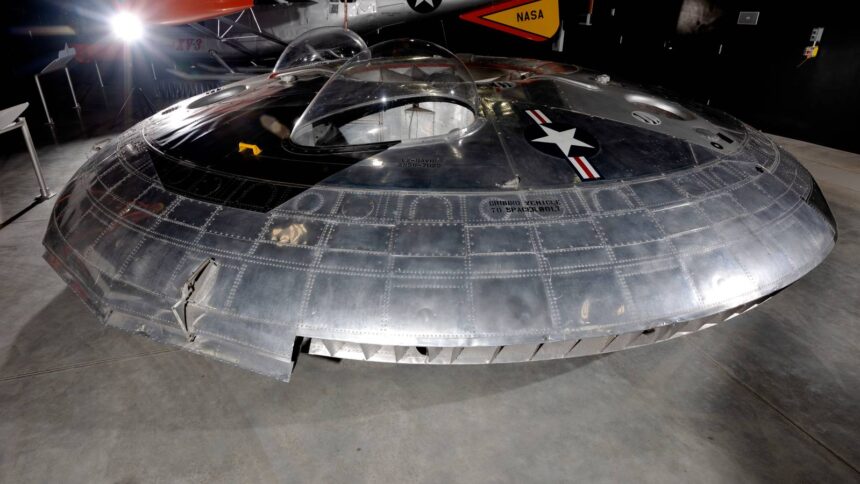

At first glance, the Avrocar looked like a prop from a 1950s science fiction movie. It was round, low to the ground and built for two people sitting on opposite sides of its center. But the VZ-9AV was a real aircraft project, backed by the U.S. Army and Air Force to explore whether a flying saucer could serve a military purpose.
The idea began in Canada. In the early 1950s, Avro Canada envisioned a vertical takeoff and landing fighter-bomber that looked like it came from the comic books. The craft would eventually be able to fly at supersonic speeds.
When the Canadian government withdrew funding as the project’s costs rose, Avro turned to the United States. By 1958, both the U.S. Army and Air Force were backing development of the unusual aircraft, though each service envisioned a different role for it, according to the National Museum of the U.S. Air Force.
Two Services, Two Missions of the Same Coin
The Army wanted a craft that was subsonic and could travel all over the ground. They wanted it to be able to carry troops and be used to conduct reconnaissance.
The Air Force wanted something a little more: an aircraft that could stay below enemy radar and have the capability to climb and accelerate above supersonic speed levels. The engineers from the original project, Avro, believed that the circular design could achieve both mission sets.
The design ultimately failed, but even the circular design was flawed in its logic. The project moved with two test vehicles to see what they were capable of.
The Avrocar’s unusual shape had a proposed engineering purpose. Three turbojet engines drove a circular rotor in the center of the aircraft. Directing thrust downward was supposed to create a cushion of air beneath it, allowing the craft to float close to the ground.
Redirecting that thrust toward the rear was meant to propel it forward and help it climb. In theory, it combined the flexibility of vertical takeoff with the speed of a jet. In practice, the transition from a low hover to controlled forward flight was a problem the aircraft could not solve.
Craft Meets the Wind Tunnel
Early tests at Wright-Patterson Air Force Base, Ohio, showed that the air cushion below the aircraft would not be able to be sustained just a few feet above the ground, much less than hundreds of feet in the air.
Testing also showed that the supersonic speeds the Air Force wanted were unviable. Researchers continued to investigate whether it could still do what the Army side wanted it to do, with not more much more success.
Avro sent the first prototype, serial number 58-7055, to NASA’s Ames Research Center in California. Wind tunnel tests there found that the aircraft lacked sufficient control for high-speed flight and was aerodynamically unstable.
The second prototype took these findings into the air. It could lift off and achieve some success at the stage, but past 3 feet, it began to rock and roll. The engineers called it “hub capping,” which actually ironically was fitting for the craft. It looked like that part of a tire anyway.
On the ground, it was also only able to reach a maximum speed of 35 mph, according to the release by the Air Force museum. The engineers tried to flix the flaw, but nothing could fix the problems that it had.
The Army’s version, which was much more modest in its tasks, was also quite out of reach. The low hover that it could achieve was shaky, and it wasn’t capable of keeping much weight on its top. It was deemed impractical.
The contrast with the original Air Force goal was enormous. A craft intended to rise out of a concealed hover and race away at supersonic speed could not maintain controlled flight more than a few feet above the surface.
The Ashes of a Promised Dream
The craft, which was an extreme letdown, gave researchers a full-scale test of a difficult idea. Later on, NASA decided to discuss the lessons from the project in an attempt to learn what they could have done better. They said that the challenges of controlling thrust and maintaining stability as a vehicle were the hardest part, and the technology of the age was incapable of achieving this mission.
Both prototypes survived. The first arrived at the National Museum of the U.S. Air Force in Dayton, Ohio, in 2007. The second went to the U.S. Army Transportation Museum at Fort Eustis, Virginia.
That surviving aircraft is 18 feet across and less than 5 feet tall. Its specifications make clear that the flying saucer was more than a sketch or a publicity stunt: Engineers built it, the military tested it, and pilots learned firsthand where its promise ended.
The Cold War designers were also looking to create scientific achievements that would put the United States in first place. This failed attempt was just an example of how far the engineers of the time were willing to push it.
For a brief moment, it was successful and could fly. While it could not go far or fast, it certainly was an interesting concept.

![Republican Cheers Explode as White House Shares New Immigration From Muslim Majority Nations Data [WATCH]](https://www.rvmnews.com/wp-content/uploads/2025/01/2025.01.02-07.42-rvmnews-6776ec3104a9f.jpg "Republican Cheers Explode as White House Shares New Immigration From Muslim Majority Nations Data [WATCH]")
![Hasan Piker Declares Ownership of TX Dem Senate Candidate James Talarico [WATCH]](https://www.rvmnews.com/wp-content/uploads/2026/09/2026.09.18-09.48-rvmnews-6aad08e3e20fe.jpg "Hasan Piker Declares Ownership of TX Dem Senate Candidate James Talarico [WATCH]")