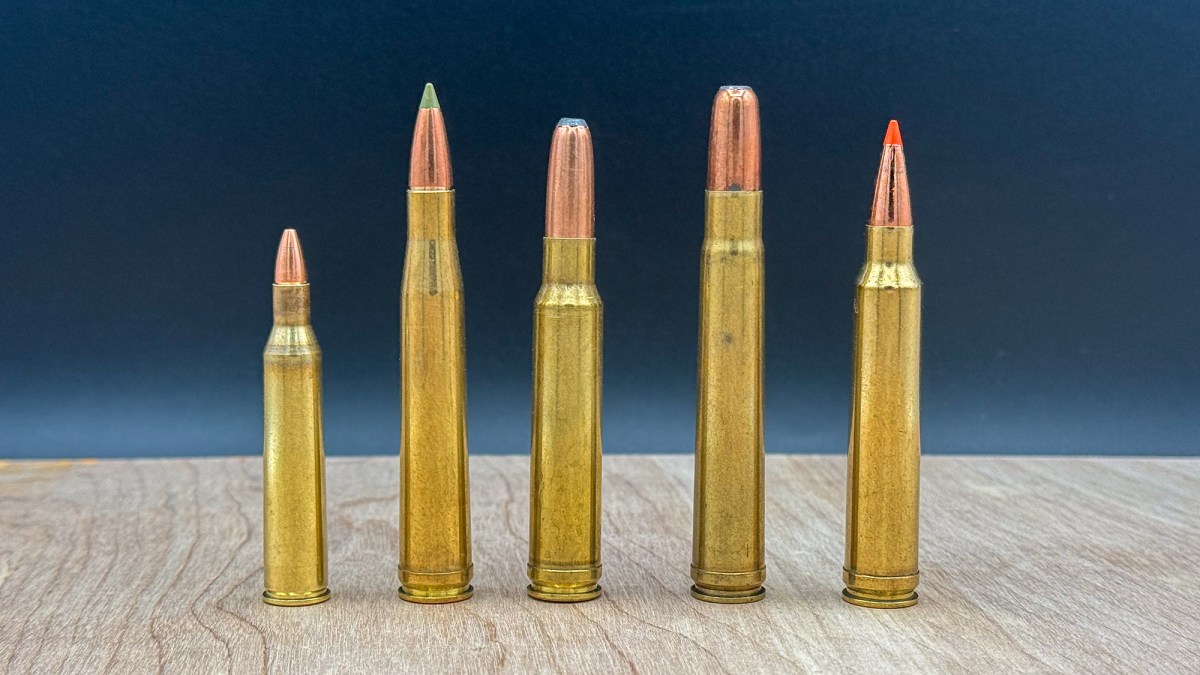

Many hunters and shooters care a great deal about their cartridges — and feel strongly about the subject of new ones. Some embrace the progress of cartridge design, as they see it. For others, it stokes contempt. To some, new is the way and the old is to be discarded. Others hold onto what they believe to be “good enough” and see little reason for trying the new. In reality, most of us fall somewhere between those two extremes.
Much has changed in the last decades but, as hunting and shooting culture relates to cartridges, much has remained the same. Older cartridges didn’t suddenly start becoming obsolete upon the introduction of the cartridge that, when named, summons a flurry of slurs and marketing conspiracy theories. (I am talking, of course, about the 6.5 Creedmoor.) Outdoor Life has, since its inception, covered new rifles, cartridges, and the like — many of which have now become relics. Disgruntled shooters may feel like old cartridges were all we had or ever needed, but our memories can be deceiving.
I’ve found that digging back through the OL archives provides some valuable perspective on what was really going on back in the good old days. The following column, originally titled “The Living Cartridges … and the Dead,” appeared in the March 1963 issue of Outdoor Life. It was penned 63 years ago by then-shooting editor Jack O’Connnor, and it gives us a look at a familiar topic: old, new, dying, and dead cartridges.
In it, O’Connor discusses many cartridges most of us have never seen or fired, describes how cartridges like the now defunct .222 Rem toppled the .220 Swift, and even predicts the introduction of the .300 Winchester Magnum. He speculates on the future of the .338 Win. Mag., which provided an alternative to the long H&H magnums and has enjoyed decades of popular use — despite the reality that competing cartridges have now out-classed it on both ends, as I detailed in a recent story. Even in 1963, as O’Connor notes, increased marketing did contribute to the quick rise and fall of some chamberings. But ultimately, if lots of rifles are chambered for a cartridge, it’s still going to cling to life. — Tyler Freel, senior staff writer
The .243 Winchester and the .244 Remington cartridges came out at the same time. Each was put on the market with appropriate advertising by a big company with great prestige. Ballistically, the two cartridges are about identical, and if there is any difference between them it is in favor of the .244. The .244 will deliver identical velocity with a bit lower pressure than the .243 — or higher velocity with the same pressure. The reason for this, of course, is that the .244 has somewhat more case capacity.
When the two cartridges appeared, I shot rifles chambered for them, chronographed them. I decided that of the two I preferred the .244, and I spent a not inconsiderable amount of scratch on a classy, custom-built .244 on a 7 mm. Mauser action.
But the .243 has gone on to become one of the most popular of the newer American centerfire cartridges, and the .244 has fallen on its face. Currently, the rifles in .243 caliber are made by Winchester (the Model 70, Model 88, and Model 100), by Savage (Models 99 and 110), by Remington (Model 700), by Browning, and by various foreign manufacturers who export to the United States. The .244 is an orphan, and at the present no mass-produced rifle is being chambered for it, even by the company that brought it out.
About the same time, Winchester introduced the big brother of the .243 and the .308 — the .358 Winchester, a .308 case necked up to .35 caliber. Some years before, in this department, I had outlined the specifications for what I called the ideal woods cartridge for deer, bears, elk, and moose. I said it would have the ballistics of the old .348 and yet be on a case short enough to work through the Model 99 Savage action. The .358 was it, and if there is a better brush rifle anywhere than a light, handy Model 88 Winchester or Model 99 Savage chambered for the .358 cartridge I have yet to see it. The 200 and 250-gr. bullets get through brush well, give deep penetration, smash heavy bones. All is well with the .358 except that it isn’t selling. I have no figures from Winchester, but I know that only about 1 percent of the Model 99 Savage rifles sold are in .358.
The .257 Roberts cartridge came out not quite 30 years ago, and much fanfare marked its appearance. Winchester chambered rifles for it. So did Remington. Custom rifle makers turned out .257’s by the hundreds. The cartridge was, and still is, one of the most useful ever manufactured in this country. It is a fine varmint cartridge, a very good deer, sheep, and antelope cartridge. With the proper bullets and in the hands of a good shot, it is adequate for elk. A gun-nut pal of mine, a physician who has now gone to the place where there is no closed season and all the bullets shoot into a minute of angle, told me he had killed about 30 elk with his .257.
For the one-rifle man who hunts varmints and deer, the .257 is just about right, and most people can shoot .257’s better than they can more powerful and harder-kicking rifles because the .257 is pleasant to shoot. Recoil and muzzle blast are both mild.
But for whatever the reason, the .257 was always a gun nut’s cartridge. For the most part, buyers of .257’s were the lads who already had half a dozen rifles, who reloaded, who did a lot of shooting, a lot of playing around with other calibers. It was one of the world’s best cartridges for the one-rifle man, but he was the guy who never bought it. When the gun nuts tired of it and started toying with other and sexier calibers, the demand for it plummeted. Now, as far as I know, not a single factory rifle is being produced for the .257, and if any custom rifle maker has built a .257 recently I have not heard about it. There are still a good many .257’s around, and ammunition is still loaded in the caliber, but the good cartridge is dying. It is, however, for the bolt-action rifle a better and more versatile cartridge than the .243.
Explanations are easy to give, but whether they are right or not is open to question. A good guess as to the reason the .244 fell on its face is that the Remingtons thought of the .244 as a varmint cartridge. Since they got slightly better accuracy with bullets weighing up to 90 gr. with a 1-12 twist than with a 1-10, they brought out their Model 722 rifle with the slower twist. It would not stabilize a spitzer 100-gr. bullet — or at least not all spitzer 100-gr. bullets. Instead of wanting a 6 mm. as simply a varmint rifle, the boys wanted an all-around rifle. So they went to the .243 with its 1-10 twist instead of to the .244. My own .244 on a Mexican Mauser action has a 1-10 twist, incidentally.
Related: Why Some Rifle Cartridges Fail, by Jim Carmichel
Why did the good .358 flop? I have two guesses. For one thing, it is a small, high-intensity cartridge, which packs a lot of punch in a small package. It just doesn’t look powerful. Tell the average gun buyer that the little .358 contains as much wallop as the much larger .348 and he’ll tell you that you’ve lost your marbles. Another guess: buyers of new factory rifles today are pretty much brainwashed in favor of high velocity. They may never shoot anything at over 150 yd., but they think they want a flat-shooting, fast-stepping cartridge. The .358 simply doesn’t have the appeal.
Buyers of new factory rifles today are pretty much brainwashed in favor of high velocity. They may never shoot anything at over 150 yd., but they think they want a flat-shooting, fast-stepping cartridge.
Sometimes I am right in my forecast as to how a new cartridge will go over, but I am wrong about as often as I am right. I predicted that the .280 Remington was not going to set the world on fire. For one thing, it was too much like the well-established .270; for another, the published ballistics on the 150 and 165-gr. bullets are a bit on the optimistic side — at least in a 22-in. barrel — and the story got around. One soothsayer in the gun-writing world made the naive statement that the .280 produced the same ballistics as the .270 with 10,000 p.s.i. less pressure. If that were true, it would be a major ballistic miracle. It simply isn’t so. The two cartridges have much the same general dimensions, the same shoulder angle, and almost identical powder capacities. The .280 has a bullet diameter of .284, the .270 of .277-.278. There is no great magic in a difference of .006.
The actual difference is that the .270, which was designed from the start and loaded from the start for strong, modern, bolt-action rifles, is loaded to a mean maximum pressure of 54,000 p.s.i., but the .280 was designed to approximate .270 ballistics in pump and automatic rifles and is loaded to a mean pressure of less than 50,000 p.s.i. A handloaded .280 cartridge with loads stepped up to .270 pressures and shot in a strong bolt-action rifle will do anything the .270 will do, but not with 10,000 lb. less pressure. With factory-loaded ammunition made to operate successfully in a semi-automatic rifle it is quite another story. And the tale has got around since good chronographs are now found behind every other bramble bush.
Whereas the .280 has been no howling success, the new Remington 7 mm. Magnum is going ahead like a jackrabbit with its tail on fire. I understand that in some sections of the country the Model 700 Remington rifles in 7 mm. Magnum are outselling the same model in .30/06, and the rifles and the cartridge have been delirious best sellers.
In my review of the 7 mm. Remington Magnum cartridge, I predicted that it would be highly successful. It has turned out that way, but I do not think it proves that I am the seventh son of a seventh son or that I have been communicating with the spirits. The cartridge is swimming with the modern current-high velocity cartridges on belted Magnum cases. It had a ready-made market, since there was already a great deal of interest in a 7 mm. on a short Magnum case. The cartridge it-self is an excellent compromise for the chap who wants a bit more soup, somewhat more velocity than he can get with the .270 and .280, and yet who doesn’t feel himself equal to the rather formidable recoil and blast of the .300 Weatherby, .308 Norma, and .338 Winchester. In addition, there is very little wind in the published ballistics of the 7 mm. Magnum. It stands up well on the chronograph when shot in factory rifles, whereas some of its rival cartridges do not. The sales have not been hurt by the fact that the 7 mm. Magnum is a sexy-looking cartridge, the very epitome of power and speed.
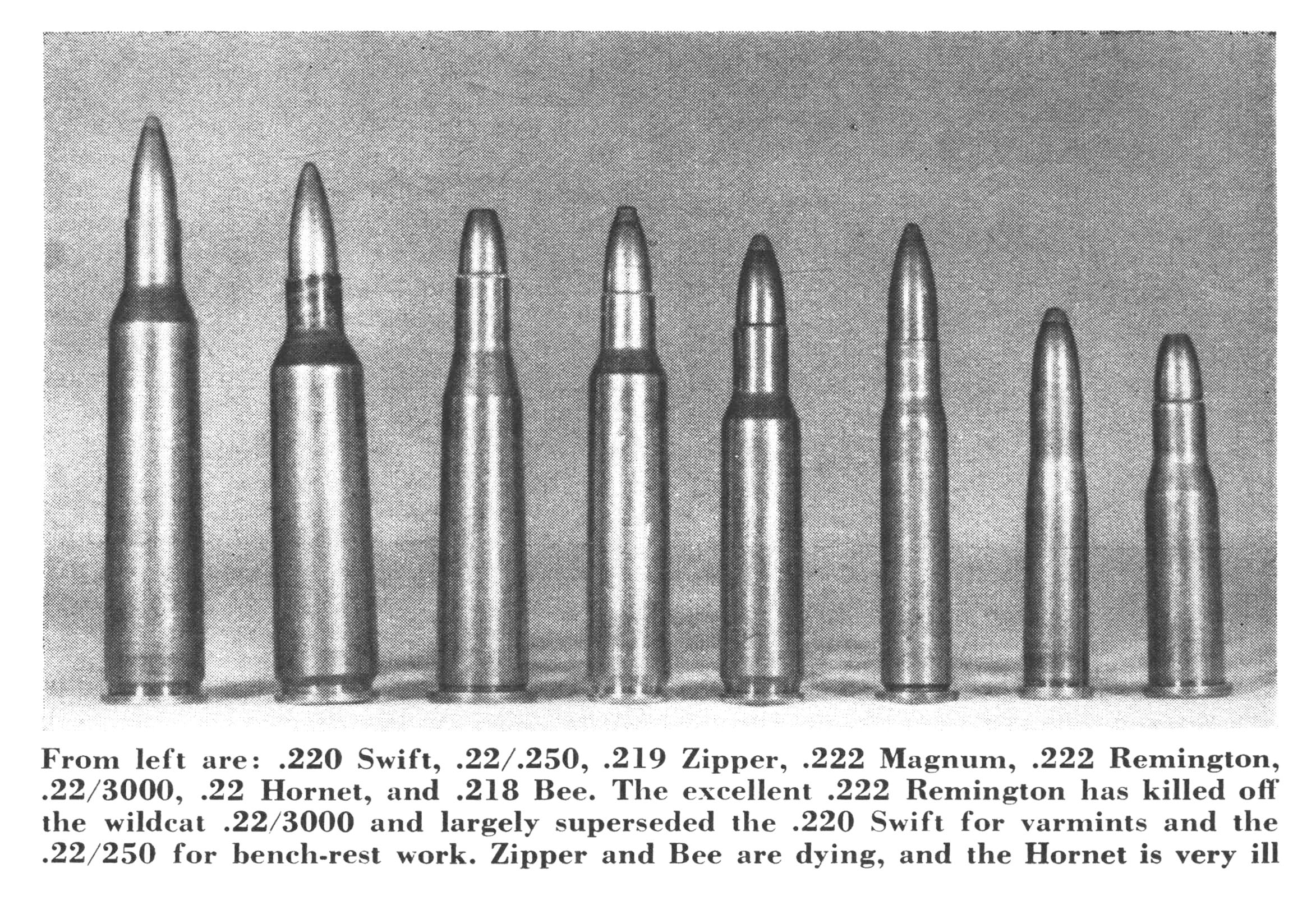
I predicted that the .280 would not set the world on fire, and I predicted that the 7 mm. Magnum would have the gun nuts rolling on the floor and shouting hosannas in seven languages. But one cartridge that caught me with my predictions down was the .222 Remington. I thought it would be successful. I had a hunch it would put a pretty bad crimp in the .22 Hornet and the .218 Bee. But I had no idea that it would go on to become the world’s most popular .22 centerfire cartridge and that it would soon have the great .220 Swift hanging on the ropes and hollering uncle.
With the benefit of hindsight, I can tell now that I was not too bright and that the .222 was a natural, a classy little number that would outgun the Hornet and the Bee and do about 80 percent of everything the Swift would do.

The .222 is now, after a decade of use, the No. 1 .22 centerfire, the queen of the benchrest cartridges. It is accurate, cheap to reload, and it gives long barrel life. Competition from the .222 on one hand and the .243 on the other has just about killed off the .220 Swift, a fact that saddens me no end as in many ways the Swift is the best varmint cartridge ever brought out.
Just as the .222 killed off the .22 Hornet, the .218 Bee, and the .219 Zipper, the .300 Weatherby, with its sensational ballistics, pretty well put the skids under the older .300 H. & H. Magnum from which it was derived. It would not astound me too much to see Winchester drop the .300 in the Model 70 series and substitute a cartridge on the order of the .300 Weatherby before many years have passed. Remington, which for a time chambered the Model 721 for the .300 H. & H., no longer makes a rifle in that caliber.
As we have seen, cartridges are often killed off by those the public thinks are better, whether they are or not. The great popularity of the .243 was surely a factor in putting the skids under the excellent .257. The .243 also had much to do with shooting down the good .250/3000 Savage cartridge, for which even Savage no longer builds rifles.
I am curious to see what effect the introduction of the .338 Winchester Magnum will have on the popularity of the .375 H. & H. Ballistically, the two cartridges are very similar, and what one will do on game the other will also do. With bullets of the same weight, the .338 has better sectional density. The .338 also has the advantage of a shorter case and consequently a shorter bolt throw. The .375, on the other hand, has the very real advantage of being a world cartridge. The owner of a .375 can get ammunition in London, Rome, Nairobi, New Delhi, Johannesburg, Cody, Wyoming, or Fairbanks, Alaska. It will be a long time before cartridges for the .338 are as well distributed.
New cartridges today receive more intensive promotion than they did a generation ago, and as a consequence they either catch on or flop quicker. When a new cartridge comes into being today, every gun writer in the country lets out a howl and springs to his typewriter.
This wasn’t so in the old days. When the .270 Winchester cartridge was introduced, OUTDOOR LIFE paid about as much attention to it as it did the newest thing in girdles. The American Rifleman didn’t run an article on the .270 until the cartridge had been on the market for about two years. I bought what was probably the first Model 54 Winchester rifle in .270 caliber sold in Arizona and possibly shot the first deer killed with the .270 in the Southwest. But I had read no one’s excited review. The only information I had on the cartridge, and the new bolt-action Winchester rifle to fire it, was what I obtained from a full-page ad in OUTDOOR LIFE.
When a new cartridge comes into being today, every gun writer in the country lets out a howl and springs to his typewriter.
Because of the modest promotion, the .270 picked up steam very gradually and was sold pretty largely by word of mouth. Those who used it found it deadly, accurate, flat, and pleasant to shoot. After it had been on the market about 10 years, considerable grassroots demand for the .270 existed and sales began to pick up. Now, in general, it probably outsells any other cartridge except the .30/06 in new, good-quality, bolt-action rifles. What effect the new Magnum hotshots like the .264 and the 7 mm. Remington Magnum will have on the .270 I cannot say. I suspect, though, that they’ll woo away some customers. It is interesting to note, though, that in 1961 the .270 sold better in the Model 110 Savage than it did in 1960.
Adoption by the military services always gives a cartridge tremendous prestige, and the .308 has come up from nowhere in the past decade to be one of the most popular of sporting cartridges. It is taking the place of the .300 Savage among those who want to approximate .30/06 performance but don’t care for the bolt action. The .30/06 is an all-time best seller for many reasons — military adoption, the fact that millions of military and sporting rifles to fire it are in existence, the fact that ammunition is obtainable all over the world, and finally the fact that it is a fine all-around cartridge. The newer .308 is a better cartridge for machine guns and semiautomatic rifles, but ballistically the .30/06 has the edge. It always will have because the case holds more powder.

In the past 20 years or so, many once fairly popular cartridges have been dropped from the loading company lists. Among them are most black-powder cartridges. A prewar Winchester ammunition catalog lists the .38/56, .38/72, .40/65, .40/72, .40/82, .40/60, .45/75, .45/90, and .50/110 cartridges. All of these have been dropped, and the only centerfire rifle cartridges originally designed for black powder that are still manufactured are the .32/40, .38/40, .38/55, .44/40, and the .45/70.
The .38/40 and .44/40 were used in both rifles and revolvers, and the .32/40 and .38/55 were tremendously popular at one time. The .45/70 is still alive because tens of thousands of old Model 1873 single-shot Springfield rifles are still in circulation.
A good many of the less popular smokeless powder cartridges that came out before World War I have been discontinued simply because there were so few rifles around to shoot them that there was too little demand for cartridges to pay anyone to make them or any dealers to stock them. The sensational .280 Ross and the cartridges of the Newton line have long since bitten the dust, and of the series of Remington rimless cartridges (.25, .30, .32, and .35) only the .35 survives. The .22 Savage Hi-Power, which was a nine-day wonder back about 1912, ran out of steam long ago and has been obsolete for about a decade.
With the exception of the .351, so popular with cops for shooting robbers, all of the other Winchester self-loading cartridges have shuffled off ‘ this mortal coil — the .35, the .32, and the .401. The two big, centerfire, smokeless-powder cartridges for the old box-magazine Model 95 lever-action Winchester, the .35 W.C.F. and the .405, are likewise dead ducks. The reason, of course, is that there was never in circulation any vast number of rifles to fire these cartridges.
On the other hand, it is almost impossible to kill off a cartridge for an old military rifle if great quantities have found their way into the hands of the consumer. No Krag rifles have been turned out for 60 years or more, and the last rifle for the .30/40 cartridge, the Model 95 Winchester, was dropped almost 30 years ago, but the .30/40 cartridge still sells quite well. The only rifle ever made in the United States for the .303 British cartridge was the long-dead Model 95 Winchester, but many thousands of surplus British short-model Lee Enfield rifles have been imported into the United States and sold since the war. As a result, the .303 cartridge outsells many newer and better cartridges and will be with us for a long, long time. Even the funny 8 mm. French Lebel cartridge is still loaded by Remington because many old Lebel rifles are still kicking around.

As far as I know, a rifle for the 8 x 57 Mauser cartridge has never been manufactured in the United States, but two wars have brought tens of thousands of them into this country. The rifles have been remodeled and used, and consequently the cartridge will be with us long after I have been hanged. The 7 x 57 Mauser cartridge has had its ups and downs. It owes its original popularity to the fact that soldiers brought captured Spanish rifles back from the Spanish-American war. Then other thousands of rifles in 7 mm. came over the border during the Mexican revolution. In the past 10 years or so, thousands of military 7 mm. Mausers have come into this country as various Latin American countries have shifted to other calibers. In addition, the 7 x 57 has many admirers who prefer it to anything else, at least for some purposes. Fancy custom rifle makers like Griffin & Howe, Biesen, and Brownell still build a surprisingly large number of expensive 7 x 57 rifles. Consequently, the 7 mm. cartridge is in no danger of an early death.
Any cartridge for which no rifle is presently chambered isn’t going to live forever.
How many Norwegian Krag and Swedish Mauser rifles for 6.5 x 55 cartridges have come into this country I have no way of knowing, but judging from the mail I receive about them it must be many thousands. Ammunition is imported for these rifles from Sweden and a lot of it must surely be sold. The cartridge is a very good one, accurate, pleasant to shoot, and adequate for deer and similar game. I have a hunch that Remington and Winchester-Western are passing up a nice dollar by not making the cartridge.
At one time, the loading companies turned out a fantastic number of different combinations of powder, shot, and case lengths in shot shells. Gradually this long list has been trimmed. Some shot sizes have been dropped, powder-shot combinations have been simplified, and nobody has suffered.
The centerfire rifle list has been trimmed, but it has also been added to. Feelings of dealers are mixed about the additions. New cartridges on the list mean sales of new rifles and a modest profit in the cash register, but they also mean more calibers to stock, more dough tied up in inventory. Calibers that have been dropped since the out-break of World War II include some oddball .22 rimfires, like the BB and CB caps, the .22 Auto, and the .22 Extra Long, the various .25 and .32 rimfires, and the ancient .41 Swiss rimfire. The list also includes a lot of black-powder centerfires and the less popular smokeless powder centerfires.
Read Next: The .338 Winchester Magnum Is a Cartridge That No Longer Makes Sense
But a lot of new cartridges have been introduced: the .22 rimfire Magnum, the .243 and .244, the .308, the .358, the .264, the .280, the 7 mm. Remington Magnum, the .338 Winchester Magnum, the .458, and among handgun cartridges the .44 Magnum, the .22 Remington Jet, and the .256 Winchester. In another 20 years the list will change as much or more. My spies tell me that at least three new cartridges will be added within the next few months. Perhaps some more will be dropped. Any cartridge for which no rifle is presently chambered isn’t going to live forever.
Read the full article here

![Trump Says U.S. “Locked and Loaded” to Destroy Iran’s “Crown Jewel” [WATCH]](https://www.rvmnews.com/wp-content/uploads/2025/12/2025.12.24-08.56-rvmnews-694baad15154b.jpg "Trump Says U.S. “Locked and Loaded” to Destroy Iran’s “Crown Jewel” [WATCH]")