


Turn on any TV show with a funeral scene. Watch any movie from 1915 to 2026 with a funeral scene.
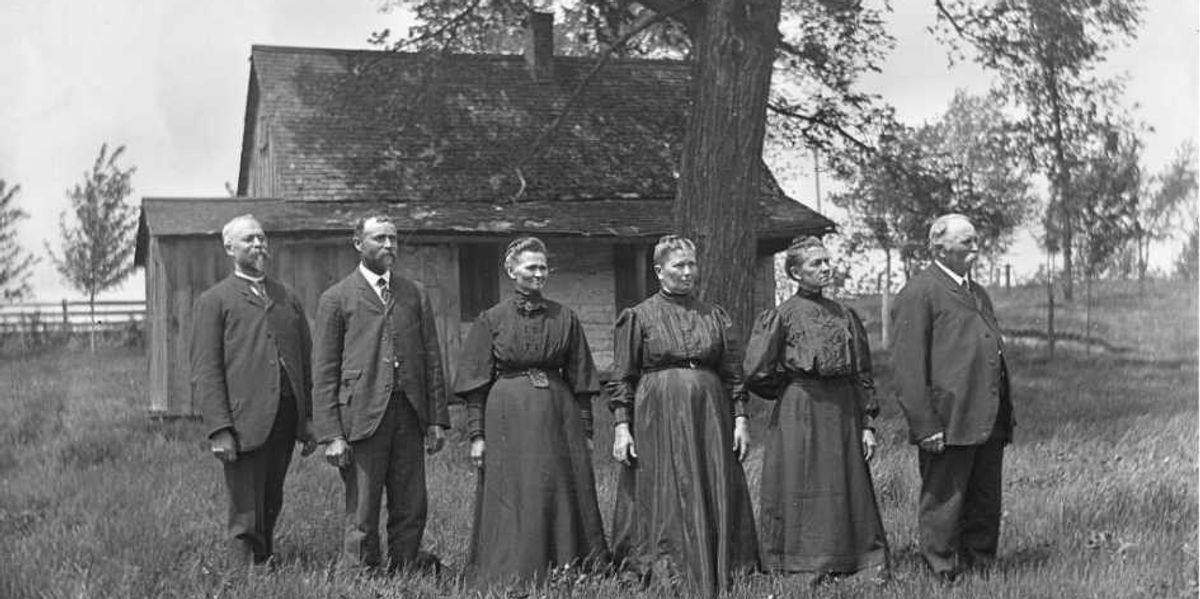
What do you see? Dignified grieving families all in tasteful, restrained black clothing. The men wear black suits. The women wear black dresses and obscure their faces with a veil, or at least the suggestion of one on a fascinator.
‘Personalization’ is precisely what most of us do not need at a moment of crisis.
You’ll never see a more unrealistic scene on film.
Putting the ‘fun’ in funeral
Very few reading this article have ever witnessed this kind of sober, black-clad mourning in real life. America in the late 20th and early 21st centuries has jettisoned nearly all etiquette as “lol boomer stupid,” and not even the most solemn occasion was spared the vulgarization.
Go to a funeral today and tell me what you see. I’ll tell you what I see: men who should know better walking into the parlor in jeans and name-brand sneakers in day-glo colors. Women wearing tarty outfits that barely cover enough leg to qualify for even the skimpiest Catholic schoolgirl uniform.
Since the hippie-commie takeover of the 1960s, we have decided to let it all hang out, including our backsides and cleavage. No matter what. Nothing is serious. Nothing is sacred. Not even death has enough gravitas to prod the average American into showing respect through sober dress.
It’s time to bring back the black. Contrary to modern glibness about everything, etiquette is not some silly, optional “Boomer” fixation on using the correct utensil at dinner. It’s not an oppressive regime. Etiquette is the word we use for the universally agreed-upon rules of behavior.
All human societies have etiquette. Without it, there is no society, only tribes and warfare. When etiquette is important enough to be codified, it becomes what we call “law.” That, too, is becoming seen as some quaint notion from a bygone era, and we can all look to our cities to see where this road is taking us.
Digging in
For 20 years I was the executive director of a nonprofit called Funeral Consumers Alliance. It was an educational organization and a watchdog group. Think of it like Consumer Reports magazine, but only for the funeral and burial purchase. Our aim was to give people accurate information so they could choose a send-off that was emotionally meaningful and affordable.
Strange as that may sound, contemplate the fact that Americans spend more than $20 billion annually to bury the dead. It’s easy to see how the grieving can be hoodwinked into paying premium prices for scams like “protective caskets” (the claim is that they keep the body dry and preserved; not true) and a host of other purchases that push the tab up to $10,000 or more.
My mentor was the outgoing organization director who became my dear friend. Lisa was a tough old no-nonsense broad. We spent many a night at her kitchen table working while drinking wine and chain-smoking, cracking each other up over the absurdity of the funeral business while figuring out how to arm grieving people against graveside upselling.
Lisa taught me almost everything I know about the subject. When we first met in 2002, she told me how “modern” consumers wanted something different in a funeral. “The Baby Boomers aren’t going to put up with cookie-cutter funerals. They want personalization,” she said.
Graveside groove
Lisa was correct, as I would discover after taking over her job. During my two decades, I spoke with more than 10,000 American families over the phone who needed counseling on funeral arrangements. This gave me a good baseline of understanding of the American mind on the topic of deathways.
The majority who called for advice wanted to avoid overspending, certainly. But the next biggest category of question was, “How do we do this the right way, but also our way?”
This never sat right with me. The more I thought about it, I began to realize why. “Our way” invariably meant conforming to a new set of assumptions about death, assumptions we had adapted en masse at some point in the last 50 years.
- To say someone “died” is offensively blunt; “passed away” or simply “passed” is preferred.
- “Funerals” are gloomy remnants of the Victorian era designed to make everyone suffer. What your friends and family really want is a “celebration of life.”
- And anyway, who cares what other people want? This is about you — not your loved ones and their messy, depressing grief. “Throw me a big party!”
In other words, we have agreed to pretend that death is just another stop on a soft-focus Life Journey™. If we maintain this fiction, then somehow the deaths of our husbands, wives, and friends won’t be real. Or we won’t hurt as much. We convinced ourselves that there was something pathological about being bereft.
Crisis without crutches
This is all fake. We can’t party away grief, and our efforts to do so have left people in mourning with no guideposts. Like G.K. Chesterton’s fence, we tore down the structures around death without asking why we built them.
Should I send invitations to the funeral or is that not “done” any more? Is it OK if I skip the wake? What kind of photos am I supposed to put in our PowerPoint Tribute™? Is it OK to play the pop standards of the 1950s that my dad loved? Am I wrong to think my granddaughter should not have worn a halter top to my husband’s wake?
Honestly, there’s no need for any of this flailing, but we did it to ourselves by insisting that what mattered most was “personalization.” Well, no. “Personalization” is precisely what most of us do not need at a moment of crisis. We need dependable crutches, and that’s what our former customs did for us.
Sadness welcome
Judith Martin is one of the wisest philosophers of the American mind of the past century. You know her as the arch etiquette columnist “Miss Manners.” Years ago, I read an essay in which she said in more eloquent words the same thing I’m trying to communicate now: Death is no time for improvisation. Funeral customs were support structures that buttressed the grieving, taking pressure off of them so they didn’t have to stand on their own when it was impossible to think through the emotions.
I’m pleased to see that she hasn’t changed her tune. And I’d like to persuade you to take her viewpoint seriously. In her column from March 2025 in the Washington Post, Martin responds to a reader who went all in on the “celebration of life” approach. Martin’s gentle reader asked her if she made a distinction between “funerals” and “celebrations of life.” She also asked Miss Manners if it was acceptable to wear white instead of black.
Martin responded this way:
Funerals used to be set rituals, usually religious ones. Eulogies were given by clergy members, who were unlikely to have known the deceased as well as their relatives and friends and could inadvertently make mistakes — misattributing specific virtues, for example.
She acknowledged that many modern people prefer “celebrations of life,” but find themselves making mistakes in tone at a time of solemnity because they’re preoccupied with putting on a “personalized” performance at the wrong time.
“But there is another danger in the very premise of a celebration of life: the attempt to banish sadness,” Martin wrote.
So please do not mandate cheerfulness. This loss is a tragedy, and grief should not be made to seem out of place. You may succumb to it yourself. The American color of mourning is black, although the code is only sporadically observed (except in cases of funerals for national figures). But Miss Manners is not going to say you should not wear white — a mourning color in other cultures — if it makes you feel better.
I’m going to out Miss-Manners Miss Manners and be a little less gentle to the readers. No, you may not wear white. Or green. Or what “feels comfortable.” The funeral is not about you. It is about standing together with people in sorrow and showing them that you recognize the depth of their loss. It is your moral duty to voluntarily forswear your own comfort and vanity as a signal of respect and love.
Get back into black.
Read the full article here


![‘Most Vulnerable Democrat’ Completely Exposed Over His Voter ID Hypocrisy [WATCH]](https://www.lifezette.com/wp-content/uploads/2025/11/2025.11.01-06.43-lifezette-690654cedfe75.jpg "‘Most Vulnerable Democrat’ Completely Exposed Over His Voter ID Hypocrisy [WATCH]")

![NBC Says Vance Was Booed at Olympics, Cameras Tell a Very Different Story [WATCH]](https://www.drewberquist.com/wp-content/uploads/2026/02/2026.02.09-01.00-drewberquist-6989da648b11e.jpg "NBC Says Vance Was Booed at Olympics, Cameras Tell a Very Different Story [WATCH]")