
I have lost grandparents, childhood friends, and college friends. As you age, death becomes familiar. Each loss shakes you briefly, reminds you that life is fragile, and then fades. You drift back into the illusion that tomorrow is guaranteed. That you will have time later to become a better Christian, husband, and father.
That illusion shattered on September 10, the day Charlie Kirk was assassinated by a leftist.
Charlie Kirk showed us how a Christian lives and how a Christian dies. His race is finished. Ours must now begin.
I did not know Charlie personally. I worked as his publicist last summer for what became his second-to-last book, “Right Wing Revolution,” but we never spoke directly. Still his death devastated me in a way no other loss had.
I had to understand why. Answering that question became the genesis of this book, “For Christ and Country: The Martyrdom of Charlie Kirk.”
On the day Charlie was killed, I joined my wife to pick up our 2-and-a-half-year-old daughter from preschool. The day before, she had asked again and again, “Dada in car? Dada here?” This time, I wanted to be there when she came running out.
As we pulled into the parking lot, my phone lit up. Charlie Kirk had been shot. My stomach dropped.
I had felt that dread once before. On July 13, 2024, I was rocking my daughter to sleep when an alert flashed that President Trump had been shot in Butler, Pennsylvania. Minutes later, dread gave way to relief. Trump survived.
This time, the dread did not lift.
While my wife walked toward the school entrance, I sat frozen in the car, refreshing news feeds. Then I saw the video. The moment the bullet struck Charlie.
One look told me no one could survive that wound.
Then my daughter appeared.
Her face lit up when she saw me. Pure joy. The same joy Charlie’s daughter would never experience again.
As my little girl ran toward the car shouting, “Dada!” another child had just lost her father forever. His daughter. His son. His wife. They would never again live a moment like the one unfolding before me.
Nothing had changed for my daughter. Everything had changed for me.
That night, I slept on the floor beside my oldest daughter’s crib. I lay awake for hours, listening to her breathing and thinking of Charlie’s children and of Erika, facing the impossible task of explaining why their father would never walk through the door again.
In the days that followed, I cried more than I ever had. I am not a man who cries. But something in me died with Charlie, and something else was born.
I began studying Charlie’s words, speeches, debates, and sermons. Not as content but as testimony. What I saw changed me. Charlie possessed a maturity beyond his years, a steadiness most men twice his age never reach. He knew who he was and whom he served. He knew his mission and the cost of it. He accepted that cost.
In Charlie, I saw the man I wanted to be. Strong yet gentle. Courageous yet humble. Unmoved by hatred because he feared God more than man. That recognition exposed an uncomfortable truth. I shared many of Charlie’s convictions but not his courage.
I had spoken boldly only when it was safe. I avoided conflict when it was convenient. The wounds of losing lifelong friends in 2020 because I voted for Trump still stung, and I carried a residual fear of losing more.
Charlie did not hesitate. He lived Matthew 5 and Mark 8 not as verses but as marching orders. He carried his cross onto hostile campuses and into debates before crowds that despised him, knowing exactly what it cost.
When that hatred finally culminated in a sniper’s bullet, it ended his life but not the mission that made him a target.
His death exposed my compromises. It forced me to confront the gap between the man I was and the man God was calling me to be. It demanded that I stop postponing courage and start living the truth now. Costly truth. Dangerous truth. Biblical truth.
Charlie’s life and death were not political events. They were spiritual ones.
He defended the family because God commanded it. He rejected identity politics because every person bears God’s image. He championed fathers because fatherlessness destroys nations. He defended black Americans by insisting on their dignity as individuals created by God, not as pawns of a political movement. He confronted transgender ideology because lies about human nature are lies about God Himself.
For that, he was vilified, dehumanized, and finally murdered.
The ideology that killed Charlie did not emerge overnight. It grew in the silence of those who knew better but feared the cost of speaking. Evil advances when good men retreat, and too many of us did.
RELATED: America’s new lost generation is looking for home — and finding the wrong ones
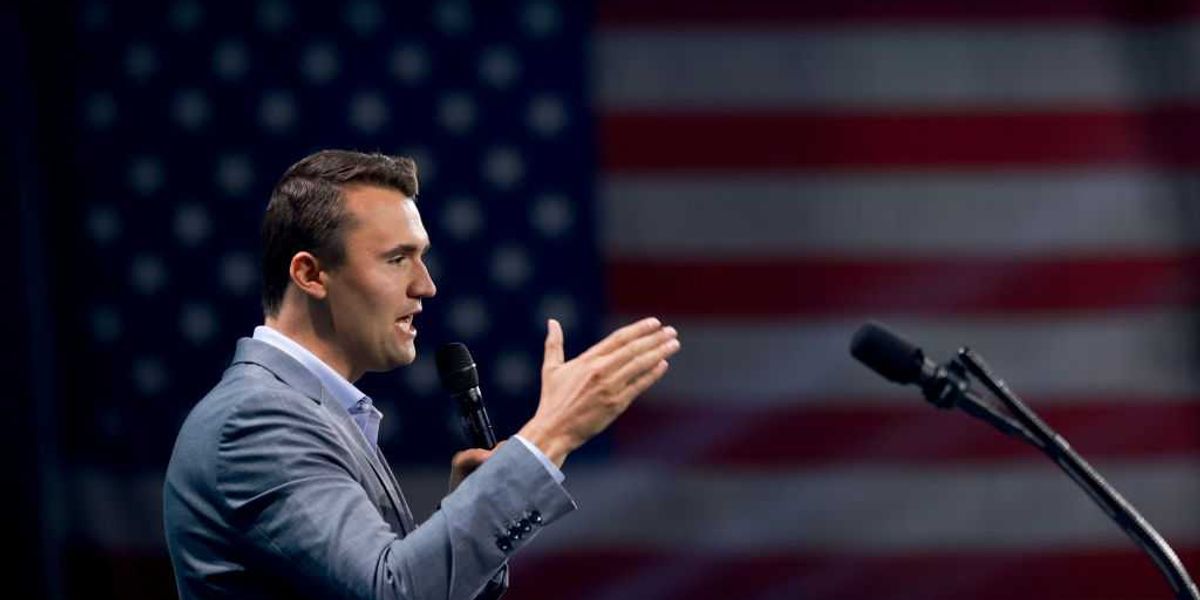
Photo by Matt Cardy/Getty Images
Charlie did not retreat. Now none of us can afford hesitation.
The man I was — cautious and hesitant — died with Charlie. In his place stands a man who understands that truth requires sacrifice, that silence is surrender, and that the only approval that matters comes from God.
My daughter deserves a country where political murder is condemned, not excused. Where truth is spoken even when it is dangerous. Where courage is not outsourced to a handful of men like Charlie Kirk but lived by millions.
That is why I wrote “For Christ and Country: The Martyrdom of Charlie Kirk.” Not simply to remember Charlie but because his death demanded my transformation and now demands yours.
Charlie Kirk showed us how a Christian lives and how a Christian dies.
His race is finished. Ours must now begin.
The torch is ours to carry — for Christ, for country, and for Charlie.
Editor’s note: This article is adapted from the author’s new book, “For Christ and Country: The Martyrdom of Charlie Kirk” (Bombardier Books, Post Hill Press).
Read the full article here