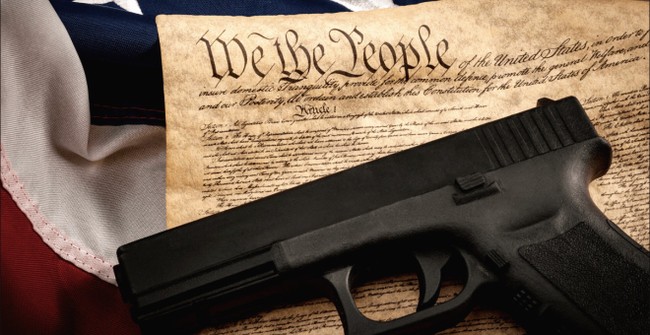

When the Fifth Circuit Court of Appeals tossed out Ali Danial Hemani’s conviction for possessing a firearm while an “unlawful” drug user, it did so on Second Amendment grounds. In defending that decision, though, several Second Amendment groups are looking beyond the right to keep and bear arms.
I covered the New York State Rifle & Pistol Association’s brief earlier today, which raises objections to Section 922(g)(3) under both the Fifth and Eighth Amendments. The Firearms Policy Coalition is also putting a non-2A argument front and center in its amicus brief; namely, that Congress has no constitutional authority to impose a gun ban, either temporary or permanent in nature.
The Constitution “withold[s] from Congress a plenary police power that would authorize enactment of every type of legislation.” Madison stressed that “[t]he powers delegated by the proposed Constitution to the federal government are few and defined. Those which are to remain in the State governments are numerous and indefinite.”
… The United States focuses on the policy rationale fo r§ 922(g)(3) rather than any Article I power that would authorize the ban: It asserts that “Congress was justified in determining that armed habitual drug users endanger public safety in multiple ways, including through the physical and mental impairments caused by many illegal drugs, the violent crime associated with drug addiction and the drug trade, and particular dangers to the police.”
But the vast majority of states already have laws on the books addressing the possession of firearms by drug users or addicts, argues FPC, which makes 922(g)(3) a clear example of the police power, which, according to the Court in Morrison, “the Founders denied the National Government and reposed in the States,” particularly for the “suppression of violent crime and vindication of its victims.”
Indeed, the government itself demonstrates that this is a classic exercise of police power when it touts that “at least 43 States, the District of Columbia, and all five permanently inhabited territories have laws restricting the possession of firearms by drug users or addicts.” The States have thus already exercised their police powers to accomplish precisely what § 922(g)(3) aims to accomplish.
Lopez explained how this overlap undermines federalism:
Under our federal system, the States possess primary authority for defining and enforcing the criminal law. When Congress criminalizes conduct already denounced as criminal by the States, it effects a change in the sensitive relation between federal and state criminal jurisdiction.
Therein lies the problem. The power to enact§ 922(g)(3), like any federal law, must be conferred by Article I. Here it is not.
Article 1 of the Constitution lays out the powers conferred on the legislative branch. The only mention of the word arms is in Section 8, Clause 16, which gives Congress “[p]ower to … provide for organizing, arming, and disciplining the Militia … .”
FPC notes that the government has “not asserted that §922(g) is an exercise of Congress’ militia power, nor could it.” The letter of the clause gives Congress power to arm, but not to disarm them.
What about Congress’s power to ““regulate Commerce … among the several States”? FPC argues that Supreme Court precedent requires a showing of “economic endeavor,” which is absent in a law dealing only with possession of a firearm. The mere fact that Hemani’s gun may have traveled in interstate commerce from the factory where it was made to the gun shop where it was sold to ending up in Hemani’s home doesn’t implicate the Commerce Clause, at least when it comes to 922(g)(3).
The FPC’s argument goes into great detail that, frankly, I don’t feel equipped to address as a non-lawyer. I will say, though, that I wonder how much weight will be given this brief (as well as the NYSPRA brief) given that the question presented to the Court is “whether 18 U.S.C. 922(g)(3), the federal statute that prohibits the possession of firearms by a person who ‘is an unlawful user of or addicted to any controlled substance,’ violates the Second Amendment as applied to the respondent?”
Thankfully, the FPC brief does have a backup argument; that if the Court does decide this case on Second Amendment grounds, it should look at 1791 and the ratification of the amendment as the appropriate time to consider a “national tradition” of gun ownership and regulation.
Some commentators have argued that, since individual amendments are incorporated against the States through the Fourteenth Amendment, the public understanding as of 1868 about the scope of protected rights should control. With due respect, it is nonsense to posit that incorporation could “invest” the Second Amendment with “new 1868 meanings” inconsistent with the understanding of the Second Amendment at the Founding, and that such “new 1868 meanings” henceforth establish the scope of the right.
Despite purporting to leave open the “1791 vs. 1868“ debate,” Bruen itself stressed that “we have made clear that individual rights enumerated in the Bill of Rights and made applicable against the States through the Fourteenth Amendment have the same scope as against the Federal Government.”
After all, “incorporation” simply asks the question whether, long after the passage of the FourteenthAmendment, a particular limitation on the federal government in the Bill of Rights should also apply to state and local governments.
And the answer is yes. Now, I can understand why Everytown and other gun control groups believe that 1868 should matter as much or more than 1791. Of course, they’d argue that 1968 should matter too, but if forced to choose between the ratification of the Second Amendment and the ratification of the Fourteenth, gun control groups will pick 1868 every time.
Most simply, there were more states. That means more laws, which means more opportunity to parse out a “national tradition” from a handful of statutes. But 1868 was also a time when some states were looking to disenfranchise both newly freed slaves and those whites on the lower rungs of the economic ladder; sometimes with laws that explicitly targeted them for the color of their skin and their former status as property, but often couched in racially neutral language that was selectively enforced against former slaves and poor whites.
In the South, those two groups could undo the Democrats’ political stronghold if they joined the Republican Party in large enough numbers. A number of laws were enacted to limit the power of those groups, as well as to divide poor whites and blacks along a color line.
The Supreme Court doesn’t need to address all of that sordid history, but the justices should be aware of it because it helps explain why there were more gun regulations in place in the aftermath of the Civil War than after the War of Independence. Even in northern states, memories of the draft riots in New York and burgeoning anti-immigration sentiment lead to restrictive gun laws that weren’t always equally enforced, no matter how neutral they were on their face.
Time will tell if there are any justices who are looking for a way to decide Hemani without implicating the Second Amendment or firmly settle whether 1791 or 1868 is the appropriate time period to look for evidence of a “national tradition” regarding gun ownership and regulation, but the Firearms Policy Coalition’s brief offers strong arguments for both of these issues, and will hopefully be helpful to Hemani and his team of attorneys.
Editor’s Note: Regardless of who is saying what about guns and gun rights, Bearing Arms will stand firm on the right to keep and bear arms.
Help us continue to report on and expose anyone’s gun control policies and schemes. Join Bearing Arms VIP and use promo code FIGHT to get 60% off your VIP membership.
Read the full article here

![Don Lemon Doubles Down After Spending a Night in Jail, Reactions Pour In [WATCH]](https://www.lifezette.com/wp-content/uploads/2025/09/2025.09.23-09.05-lifezette-68d262ce55ce6.jpg "Don Lemon Doubles Down After Spending a Night in Jail, Reactions Pour In [WATCH]")


![Dems Catch Child Care Funds Flying to Overseas Computers, Shut Off Tracking to Keep Heist Alive [WATCH]](https://www.lifezette.com/wp-content/uploads/2025/12/2025.12.31-09.05-lifezette-695590229ed11.jpg "Dems Catch Child Care Funds Flying to Overseas Computers, Shut Off Tracking to Keep Heist Alive [WATCH]")