



In 2025, the nomenclature caught up with the reality. For decades, the United States had operated under the fiction of a Department of Defense, a name that suggested protection, reaction, and a reluctance to engage. When Secretary Pete Hegseth signed the memoranda that would redefine the American military for the algorithmic age, the letterhead had changed. It was the Department of War again.
The revival of the old title was not merely cosmetic. It was an unapologetic signal, a shift from a defensive posture to a mission-focused one. Then between late 2025 and early 2026, Hegseth released a flurry of new memos announcing that the United States intended to become an “AI-first” war-fighting force. The language was clipped, urgent, and devoid of the hand-wringing that usually accompanies the introduction of new lethal means. The department now treats AI not as a support tool but as a core element of warfare, intelligence, and organizational power.
There is a simulation engine that alludes without irony to Orson Scott Card’s novel about child soldiers fighting insectoid aliens.
Reading through these documents, one is struck by the anxiety of the “algorithm gap,” which echoes the “missile gap” of the Cold War, with the stakes shifted from megatonnage to processing speed. The prevailing sentiment is that falling behind an adversary’s AI capabilities would be as catastrophic as falling behind in nuclear weapons. The Department of War does not intend to be a laggard. “Speed and adaptation win,” one memo states.
To achieve this speed, the Department has declared war on its own bureaucracy. The memos speak of a “wartime approach” to innovation, dismantling the risk-averse culture that has defined Pentagon procurement for half a century. The endless committees and boards have been dissolved, replaced with a “CTO Action Group” empowered to make quick calls. The ethos is that of Silicon Valley, grafting Mark Zuckerberg’s call to “move fast and break things” onto an institution whose business is to break things in a more literal sense.
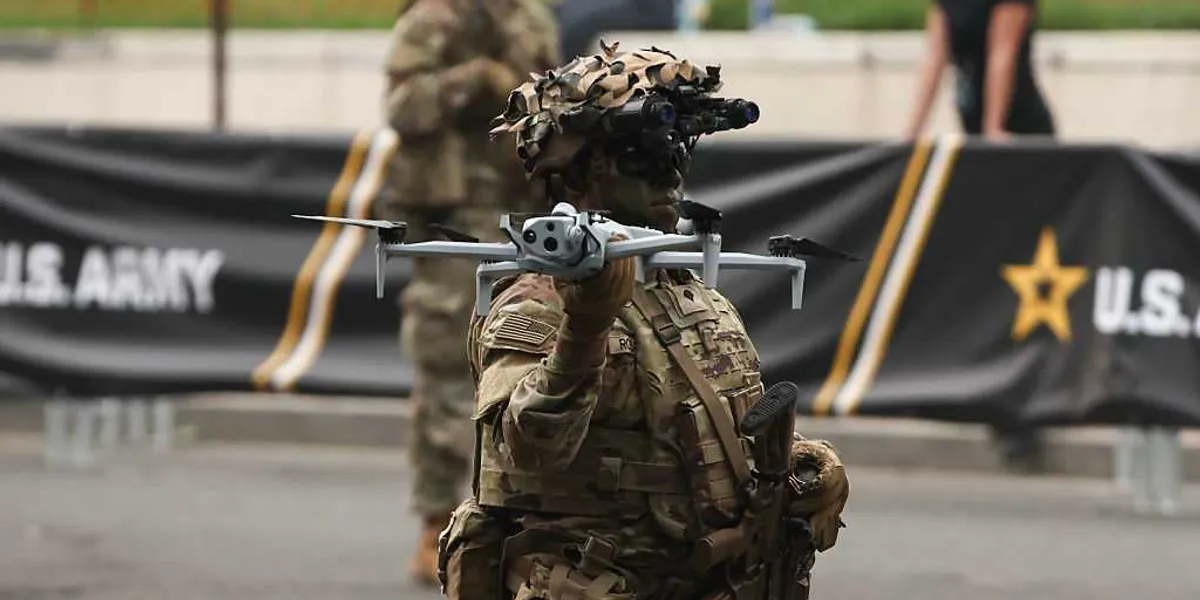
The specific initiatives, what the Department calls “Pace-Setting Projects,” read like the chapter titles of a science-fiction novel. There is “Swarm Forge,” a project designed to pair elite war-fighters with technologists to experiment with drone swarms. There is “Ender’s Foundry,” a simulation engine meant to war-game against AI adversaries, a name that alludes without irony to Orson Scott Card’s novel about child soldiers fighting insectoid aliens. There is “Open Arsenal,” which promises to turn intelligence into weapons in hours rather than years.
RELATED: ‘Reckless and seditious’: Hegseth issues brutal demotion of Democrat senator over ‘illegal orders’ video
Photo by ANDREW CABALLERO-REYNOLDS / AFP via Getty Images
What is being built here is “civil-military fusion,” a concept the Chinese have long championed and which the United States is now adopting with a convert’s zeal. The Department is actively courting the private sector, mentioning commercial AI models such as Google’s Gemini and xAI’s Grok. It is bringing in tech executives to run the show, with a new chief technology officer empowered to clear bureaucratic blockers.
The transformation is not limited to the battlefield but permeates the “enterprise,” a sterile word for the three million personnel who make up the Department’s nervous system. The vision is total: Under a program called GenAI.mil, every analyst, logistician, and staff officer will be issued a secure AI assistant to draft reports and code software. The goal is to embed AI systems across war-fighting, intelligence, and support functions until the distinction between soldier and data processor dissolves. The focus is on “decision superiority,” out-thinking the opponent at every turn.
The drive for decision superiority leads to a profound shift in the role of human judgment. The memos describe “Agent Network,” a project to develop AI agents for battle management “from campaign planning to kill chain execution.” They speak of “interpretable results,” a concession to the idea that humans should know why the machine decided to fire. The momentum is toward “human on the loop,” in which a human may abort an attack, rather than “human in the loop,” in which the human must initiate it. We are entering an era of “hyper-war,” in which AI systems could escalate a conflict in seconds, before a human commander can pour a cup of coffee.
The Department is betting that American ingenuity, harnessed in code, will secure the future, that it can maintain “America’s global AI dominance” through force of will and capital. The memos outline a future in which algorithms join soldiers on the battlefield, data platforms become as crucial as tanks, and decisions are increasingly informed by machines. It is a grand experiment in efficiency. We have decided that if warfare is now a battle of algorithms, we intend to algorithmically outgun the world. The name on the building has changed to reflect the reality: We are no longer defending. We are computing the kill.
Read the full article here


![California’s Homeless Industrial Complex Is Just a Giant Money-Laundering Operation [WATCH]](https://www.lifezette.com/wp-content/uploads/2026/01/2026.01.28-08.49-lifezette-6979cd829bae4.jpg "California’s Homeless Industrial Complex Is Just a Giant Money-Laundering Operation [WATCH]")





![Former Army Employee Indicted Over Allegedly Leaking Classified Information to Journalist [WATCH]](https://www.rvmnews.com/wp-content/uploads/2025/01/2025.01.04-12.48-rvmnews-67792e1bded5c.jpg "Former Army Employee Indicted Over Allegedly Leaking Classified Information to Journalist [WATCH]")