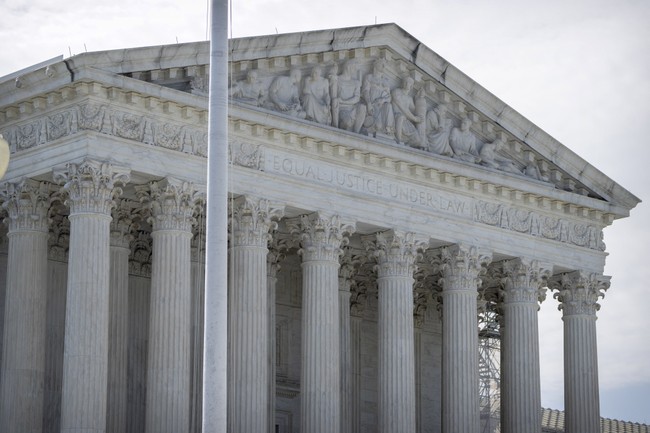

Several Second Amendment groups have filed amicus briefs today in U.S. v. Hemani, which is the case dealing with the constitutionality of Section 922(g)(3); the prohibition on gun ownership by “unlawful” drug users.
Tom covered the brief from a coalition of 2A groups including Second Amendment Foundation, California Rifle & Pistol Association, and the MN Gun Owners Caucus, but I’ll be taking a look at the other briefs today and over the weekend; starting with the brief filed by the New York State Rifle & Pistol Association.
NYSPRA has been actively involved in litigation for many years, and was the main plaintiff in the Bruen case that led to SCOTUS declaring “may issue” carry laws unconstitutional. While the Second Amendment was at the heart of their argument in that case, their brief in Hemani focuses on the alleged violation of the Fifth and Eighth Amendments.
The amicus brief, authored by attorneys William A. Brewer III and William A. Brewer IV of Brewer, Attorneys & Counselors (yes, the same William A. Brewer III who represented the NRA from 2018 through 2024), argues that 922(g)(3) violates the Fifth Amendment’s Due Process clause because the phrases “unlawful user” and “addicted to” aren’t defined in statute. Without a clear definition, there is “no temporal limitation, no quantitative threshold, and no conduct-based anchor that would allow an ordinary person to determine when lawful firearm possession becomes a federal felony,” which in turn “leaves citizens to guess at the reach of the statute and invites arbitrary and discriminatory enforcement.”
The ATF has recently tried to remedy that by proposing a new definition of unlawful user that essentially defines an “unlawful user” of drugs as “[a] person who regularly uses a controlled substance over an extended period of time continuing into the present, without a lawful prescription or in a manner substantially different from that prescribed by a licensed physician.” That definition wasn’t in play at the time of Danial Ali Hemani’s arrest, though, and shouldn’t have any bearing on the outcome of his case.
The NYSPRA brief further argues that Hemani’s Eighth Amendment rights were violated by his arrest and conviction under Section 922(g)(3) because the statute “imposes criminal punishment without a culpable act.”
The government’s effort to justify the statute by emphasizing “habitual use” is unavailing because frequency or duration of past drug use does not satisfy the constitutional requirement of a culpable act at the time punishment is imposed. Section 922(g)(3) operates by making the exercise of a fundamental constitutional right illegal based wholly and entirely on one’s status. This is violative of the most basic principles of justice and fairness which undergird not only American law but all of its progenitors from Babylonia to Rome to England.
The brief cites a case called Robinson v. California, which challenged a state law that made it a crime to “be addicted to the use of narcotics.” SCOTUS vacated the law, and Brewer argues that, “[c]ritically, the constitutional defect in Robinson was not that California regulated drugs, or because the defendant’s drug use was occasional or ‘habitual,’ but rather that it dispensed with the requirement of a culpable act that can be reasonably tied to the arrest and prosecution altogether. This is because criminal punishment may not be imposed unless the accused has engaged in some wrongful conduct.”
I have to say that to my non-lawyerly mind, this may be a bit of a reach. 922(g)(3) specifically states that “unlawful” users of drugs cannot possess firearms, which to me suggests that the accused has engaged in wrongful conduct (at least in the eyes of the federal government).
The brief contends, though, that “habitual use, like addiction itself, describes a status or condition—not a culpable act—and does not supply the temporal nexus that the Eighth Amendment requires.”
In this respect, § 922(g)(3) mirrors the California statute in Robinson, which permitted conviction without proof of any narcotics use, possession, or criminal behavior. Like the statute in Robinson, § 922(g)(3) authorizes conviction without proof of any contemporaneous unlawful act. Even more concerning—unlike Robinson, it does so while imposing felony punishment and disarming individuals engaged in otherwise lawful conduct. Indeed, § 922(g)(3) is even more punitive than the statute invalidated in Robinson. The California law imposed a misdemeanor sentence of up to ninety days’ imprisonment. Section 922(g)(3), by contrast, imposes felony liability, carries significant prison exposure, and strips individuals of a core constitutional right without a need for a prior conviction or finding of dangerousness.
That last sentence is important, and might actually invalidate my earlier point. 922(g)(3) doesn’t require a conviction or even an arrest for “unlawful” drug use before someone can be charged with violating the statute. A gun owner who tells police that he used to regularly smoke marijuana, but hasn’t for a few days, weeks, or even months could still be charged with possessing a firearm as an “unlawful drug user. That doesn’t apply to Mr. Hemani, who did allegedly tell law enforcement that actively used marijuana “about every other day.”
In a statement provided to Bearing Arms, Brewer III declared the case, “goes to the heart of whether criminal law is governed by clear rules or by after-the-fact judgments about personal status,” adding that, “when Congress imposes felony penalties without clearly defining the prescribed conduct, it is the Supreme Court’s responsibility to reaffirm the constitutional limits that protect individual liberty and the rule of law.”
NYSPRA President Tom King says that Hemani prsents another “constitutional moment” for the Court.
“The Supreme Court’s review will determine whether Americans are subjected to felony punishment under unbounded laws, or whether our freedom is protected by clear, enforceable limits on government power. The NYSRPA wants to ensure those principles are forcefully presented to the Court.”
The NYSPRA brief is interesting, and the fact that it doesn’t depend on the Second Amendment to invalidate 922(g)(3), at least as it applies to Hemani, could theoretically give the liberal wing of the Supreme Court an avenue to side with Hemani while still remaining true to their anti-gun ideology (or, for that matter, conservative justices who might take a dim view of drug use). I’m curious to see if any of the justices bring up the arguments presented by the brief when oral arguments take place in early March. If so, I’d consider that a good sign for the defendant, and cause for concern among those who want to see 922(g)(3) strictly enforced going forward.
Editor’s Note: The radical left will stop at nothing to enact their radical gun control agenda and strip us of our Second Amendment rights.
Help us continue to report on and expose the Democrats’ gun control policies and schemes. Join Bearing Arms VIP and use promo code FIGHT to get 60% off your VIP membership.
Read the full article here





![Mike Lee Refuses to Back Down from Democrat Cheating Agenda [WATCH]](https://www.rvmnews.com/wp-content/uploads/2026/01/2026.01.31-07.28-rvmnews-697e57d8e07bc.jpg "Mike Lee Refuses to Back Down from Democrat Cheating Agenda [WATCH]")