


In 1989, Justice Antonin Scalia cast the deciding vote to overturn the conviction of Gregory Lee Johnson, who was arrested and found guilty of violating a Texas statute after he burned the American flag outside the Republican National Convention.
The author of the 5-4 opinion was Justice William Brennan, the leading liberal and advocate for the “living Constitution” on the Supreme Court. For conservatives, it was one of the two most widely criticized votes of Justice Scalia’s illustrious career (the other being his vote refusing to recognize that parents have a natural, constitutionally protected right to direct the upbringing of their children).
The president’s executive order is not only much needed and long overdue, but is also very likely to be upheld by the Supreme Court when the inevitable challenges arise.
But the opinion by Brennan, which Scalia joined, is not as absolute as it has subsequently been portrayed.
The historical context
It specifically held that Texas violated the First Amendment by prosecuting Johnson “in these circumstances” — that is, expressive conduct or symbolic speech as part of a political protest that was not designed to incite a crowd (nor did it have that effect). It also held that the “government generally has a freer hand in restricting expressive conduct than it has in restricting the written or spoken word.” Only laws directed at restricting the communicative nature of expressive conduct implicate the First Amendment, and even then they can be upheld for a valid governmental interest.
Texas offered two governmental interests in defense of its flag-burning statute: 1) preventing breaches of the peace and 2) preserving the flag as a symbol of national unity. The court rejected the second because it was related to the suppression of expression, and it rejected the first because “it was not implicated” in the case.
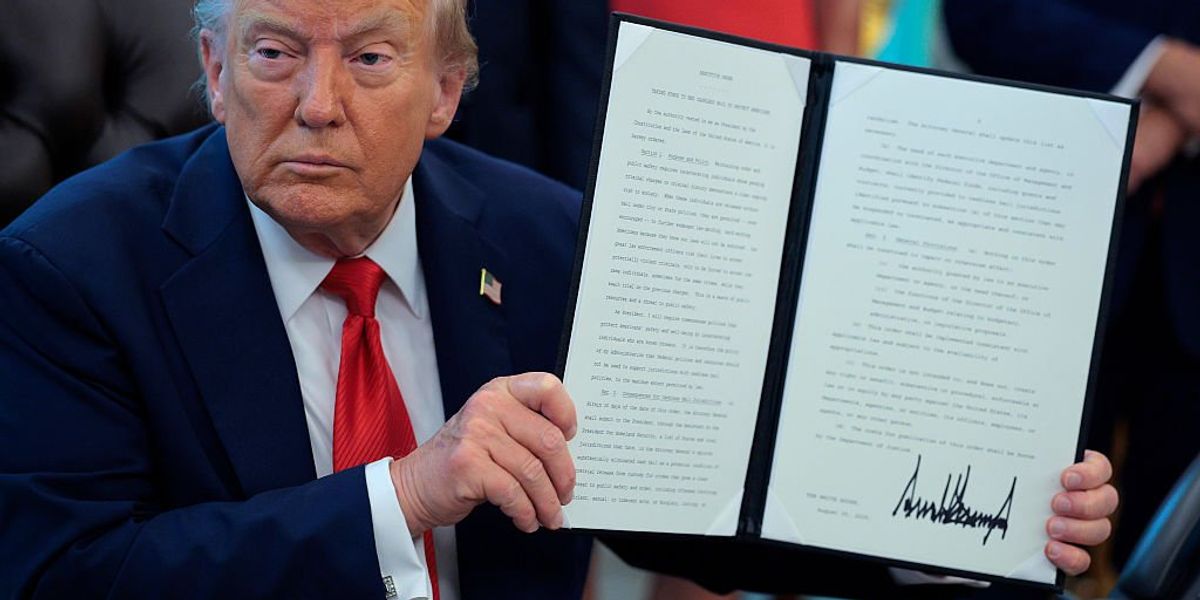
That is the important caveat in Texas v. Johnson that President Donald Trump’s executive order, “Prosecuting Burning of the American Flag,” seeks to capitalize on.
A needed change
After articulating why the flag is such a cherished symbol, one for which “many thousands of American patriots have fought, bled, and died to keep … waving,” the order asserts, “Desecrating it is uniquely offensive and provocative,” and is “a statement of contempt, hostility, and violence against our Nation.”
It then invokes the Texas v. Johnson caveat: “Burning this representation of America may incite violence and riot. American Flag burning is also used by groups of foreign nationals as a calculated act to intimidate and threaten violence against Americans because of their nationality and place of birth.”
The order correctly points out that the Supreme Court “has never held that American Flag desecration conducted in a manner that is likely to incite imminent lawless action or that is an action amounting to ‘fighting words’ is constitutionally protected.” And it laudably directs the attorney general to prioritize the enforcement of civil and criminal laws against flag desecration, quite correctly limiting it to flag-burning conduct that causes harm “unrelated to expression” in order to be consistent with the First Amendment as interpreted by the Supreme Court in Texas v. Johnson.
RELATED: College students say American flag symbolizes ‘genocide,’ ‘extremism,’ ‘injustice,’ and ‘sins’ we’ve committed against others
Photo by BRANDONJ74 via Getty Images
Maintaining precedent
After 35 years of timid responses to the flag-burning case, in which elected officials and law enforcement at every level thought flag-burning was constitutionally protected no matter the circumstances (an erroneous view repeated ad nauseam by many critics of the president’s order), President Trump has taken a long-overdue stand to protect the flag. He is seeking to safeguard it from those who would burn it to incite violence, provoke with “fighting words,” or more broadly, seek to intimidate Americans from expressing patriotism and applauding American exceptionalism.
The incitement, fighting words, and intimidation exceptions have sometimes themselves been limited to acts targeting particular individuals rather than groups. But as the Supreme Court recognized in Virginia v. Black, a cross-burning case that was decided 14 years after Texas v. Johnson, the First Amendment doesn’t necessarily protect such conduct when targeting groups rather than specific individuals.
The aggressive use of American flag-burning as a tactic of incitement and intimidation, which has been on display in cities across the country in response to President Trump’s efforts to enforce our nation’s immigration laws, demonstrates that “in these circumstances” (as distinct from the milquetoast circumstances at issue in Texas v. Johnson), the president’s executive order is not only much needed and long overdue, but is also very likely to be upheld by the Supreme Court when the inevitable challenges arise.
Editor’s note: This article was originally published on the American Mind.
Read the full article here

![MIT Professor Shot and Killed in His Massachusetts Home [WATCH]](https://www.rvmnews.com/wp-content/uploads/2025/06/2025.06.05-01.25-rvmnews-68419abfb862e.jpg "MIT Professor Shot and Killed in His Massachusetts Home [WATCH]")