


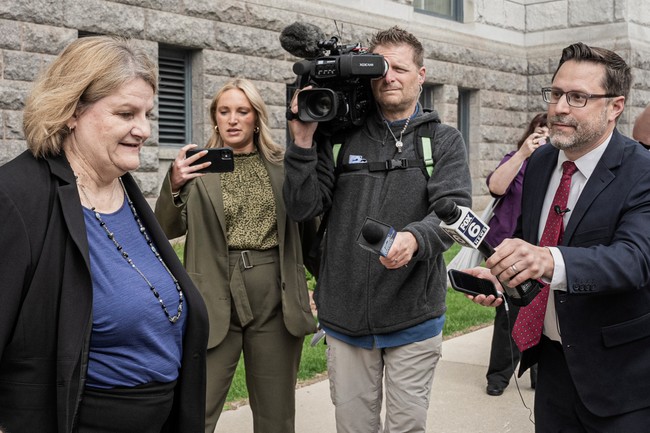

If you’re following the trial then you already know that yesterday afternoon was a big win for the prosecutors. Judge Dugan’s fellow judge, the person she chose to bring with her to confront the arrest team in the hallway, was Judge Kristela Cervera.
Cervera testified that had appeared in her courtroom early that morning and told her to come along to check a warrant. She testified that Judge Dugan told her to leave her robe on and that she felt uncomfortable wearing it into the public hallway. “I didn’t want to walk in the hallway with my robe on,” she said.
She also confirmed that the agents they confronted acted professionally but that Judge Dugan seemed irritated and angry. Judge Cervera was surprised when, after Judge Dugan had roped her into this, she turned around and Judge Dugan had vanished, seemingly leaving her to take the agents to the chief judge’s office alone.
Later that day, she was praised by several of the defense attorneys, one of whom told her ” we know what you guys were trying to do.” Judge Cervera said she was “mortified” that they thought she’s been trying to help a defendant escape arrest.
And the most damning bit of all was testimony that Judge Dugan had come to her later that day and told her she (Dugan) was in the dog house with the chief judge for trying to help “that guy.” All of this undermines any claim that Dugan is innocent or that she was behaving in a neutral manner on that day in April.
Jonathan Turley, who wrote about the same testimony today, wonders if Judge Dugan isn’t counting on jury nullification. (Thanks to David for passing this along.)
The testimony supports the allegation that Dugan knowingly sought to help Flores-Ruiz and that her actions were outside her role as a judge in the courthouse.
Dugan is charged with obstruction of a federal agency, a felony, and concealing a wanted person, a misdemeanor. As I discussed in earlier columns, the defense may be hoping for jury nullification in the liberal district. The reaction of lawyers lionizing the judges for facilitating the escape of a suspect may suggest that such a conclusion is possible in this district. The defense may be hoping that at least one juror will discard any testimony and stand with Dugan against ICE and the Trump Administration.
The jury pool can only be viewed as overwhelmingly in favor of Dugan. Kamala Harris won Milwaukee by a margin of 68%-30% over Trump. The chances of getting politically motivated jurors are obviously significant, though that obviously does not mean that jurors cannot be persuaded in the end by the strength of this evidence.
It’s not looking good for Judge Dugan heading into day three. And this morning the case against her got even stronger. First up today was Stephanie Garbo, administrator for Milwaukee County district court. She was the person who helped two agents make a call to Chief Judge Carl Ashley who was at home that day. She testified she’s been alerted by Ashley that ICE agents might show up that day but she was not told to do anything about that. She also testified to her understanding of the police about arrests as it existed on that day.
According to Garbo, she said Chief Judge Carl Ashley was primarily discussing a draft policy regarding ICE at the courthouse with an agent. She had it was her understanding that the policy was still in draft form, and there was no interim policy on April 18.
Next to take the stand was Chief Judge Carl Ashley himself. He confirmed that there was no policy about ICE in place, only a draft that had circulated. He also testified about the legality of arrests in the public hallway.
Ashley initially sent an email to his colleagues April 3, saying he was “not sure if we have the authority to intervene in what happens in the public hallway.”
When asked by prosecutors again if the judiciary has that authority, Ashley said, “I do not believe so.”
In other words, judges including Judge Dugan had no right to intervene. He also spelled out the differences between a judicial and an administrative warrant.
The draft policy also said, according to Ashley’s testimony, an ICE administrative warrant authorized them to conduct an arrest – but that such a warrant did not compel courthouse personnel to let ICE into non-public areas or search certain records.
Ashley testified that a judicial warrant, on the other hand, would grant ICE access to a non-public space if necessary.
So far as we know, the arrest team never went into any non-public area of the courthouse. The were waiting in the public hallway when Judge Dugan asked if they had a judicial warrant. When they said they did not, she ordered them to the chief judge’s office. Nothing like this was described in the draft policy. On the contrary, the draft policy (which wasn’t even in place) would allow ICE to make an arrest in the hallway. In fact, Ashley confirmed he communicated his understanding that arrests were allowed in the hallway to the agents over the phone that morning. He also sent out an email that afternoon confirming that a hallway arrest was consistent with the draft policy.
Chief Judge Ashley just blew away any defense claim that Judge Dugan was following some courthouse police or draft of a policy which hadn’t been instituted yet. The actual policy said judge’s could not interfere with arrests by ICE in the hallway, regardless of which type of warrant they had.
And that’s not even the most damning part of his testimony. He testified that he had texted Judge Dugan that day asking her to give him a call.
“My message was pretty short: Give me a call,” Ashley testified, saying he wanted to find out from her perspective what occurred.
Dugan did not respond, he said. Later in the day, she responded that she had left to attend a church service and would get back to him later.
He texted: “Never mind. Have a great holiday.”
Ashley testified he thought further communication wouldn’t be appropriate.
“I was concerned about what might have happened and I did not want to put her in a position to have to talk about it,” he said.
As an attorney he recognized that text messages or even a phone call would create a trail of evidence which would be discoverable later on. If this became an issue, he decided Judge Dugan was better off not having to explain herself. Once again, this suggests the Judge was concerned Judge Dugan may have done something wrong.
Next up was Milwaukee County Assistant District Attorney Melissa Buss, who was in Dugan’s courtroom that day. Buss testified Dugan seemed “frustrated” that morning and that Flores-Ruiz’s attorney appeared “frazzled” when Dugan told them to leave by a non-public door.
She also testified that she knew Flores-Ruiz’s victims were in the courtroom that day but she didn’t recall hearing his case being called. So when the victims asked later what had happened, she didn’t know.
On cross, Buss agreed that judges have control of what happens in their courtroom, including which doors people use when leaving.
That may be true but judge’s do no have the right to interfere with federal agents by sending defendants out a side door. That would be an improper use of her authority.
As I write this, Judge Dugan’s clerk is taking the stand. He was involved in a lot of what happened that morning so his testimony should be interesting. If it is I may do another post later today. Stay tuned.
Editor’s Note: Do you enjoy Hot Air’s conservative reporting that takes on the radical left and woke media? Support our work so that we can continue to bring you the truth.
Join Hot Air VIP and use the promo code FIGHT to get 60% off your VIP membership!
Read the full article here


![MTG Declares the ‘Dam Is Breaking’ and GOP Defections Spell Trouble, Trump Keeps Moving [WATCH]](https://www.rvmnews.com/wp-content/uploads/2024/11/2024.11.01-05.26-rvmnews-67250f46e6ecf.jpg "MTG Declares the ‘Dam Is Breaking’ and GOP Defections Spell Trouble, Trump Keeps Moving [WATCH]")
![Adam Carolla Rips Gavin Newsom for Smearing Guy Busting Open CA’s Fraud Empire [WATCH]](https://www.boredtrashpanda.com/wp-content/uploads/2025/11/2025.11.15-09.52-boredtrashpanda-69184d5a98102.jpg "Adam Carolla Rips Gavin Newsom for Smearing Guy Busting Open CA’s Fraud Empire [WATCH]")


![Ted Cruz Just Torched Communism and Its Hypocrite Kings [WATCH]](https://www.lifezette.com/wp-content/uploads/2026/02/2026.02.05-07.17-lifezette-6984ecb4cbf5d.jpg "Ted Cruz Just Torched Communism and Its Hypocrite Kings [WATCH]")
