



This morning’s Gospel reading is Matthew 5:17–37:
Jesus said to his disciples:
“Do not think that I have come to abolish the law or the prophets. I have come not to abolish but to fulfill. Amen, I say to you, until heaven and earth pass away, not the smallest letter or the smallest part of a letter will pass from the law, until all things have taken place. Therefore, whoever breaks one of the least of these commandments and teaches others to do so will be called least in the kingdom of heaven. But whoever obeys and teaches these commandments will be called greatest in the kingdom of heaven. I tell you, unless your righteousness surpasses that of the scribes and Pharisees, you will not enter the kingdom of heaven. You have heard that it was said to your ancestors, You shall not kill; and whoever kills will be liable to judgment. But I say to you, whoever is angry with his brother will be liable to judgment; and whoever says to his brother, ‘Raqa,’ will be answerable to the Sanhedrin; and whoever says, ‘You fool,’ will be liable to fiery Gehenna. Therefore, if you bring your gift to the altar, and there recall that your brother has anything against you, leave your gift there at the altar, go first and be reconciled with your brother, and then come and offer your gift. Settle with your opponent quickly while on the way to court. Otherwise your opponent will hand you over to the judge, and the judge will hand you over to the guard, and you will be thrown into prison. Amen, I say to you, you will not be released until you have paid the last penny.
“You have heard that it was said, You shall not commit adultery. But I say to you, everyone who looks at a woman with lust has already committed adultery with her in his heart. If your right eye causes you to sin, tear it out and throw it away. It is better for you to lose one of your members than to have your whole body thrown into Gehenna. And if your right hand causes you to sin, cut it off and throw it away. It is better for you to lose one of your members than to have your whole body go into Gehenna.
“It was also said, Whoever divorces his wife must give her a bill of divorce. But I say to you, whoever divorces his wife—unless the marriage is unlawful— causes her to commit adultery, and whoever marries a divorced woman commits adultery.
“Again you have heard that it was said to your ancestors, Do not take a false oath, but make good to the Lord all that you vow. But I say to you, do not swear at all; not by heaven, for it is God’s throne; nor by the earth, for it is his footstool; nor by Jerusalem, for it is the city of the great King. Do not swear by your head, for you cannot make a single hair white or black. Let your ‘Yes’ mean ‘Yes,’ and your ‘No’ mean ‘No.’ Anything more is from the evil one.”
“Blessed are they who follow the law of the Lord,” we will say today as our responsorial from Psalm 119. We ask the Lord to give us the strength to remain firm in keeping His statutes, and that our eyes be opened to “the wonders of your law. … Give me discernment, that I may observe your law and keep it with all my heart.”
But what is the law? In our first reading from Sirach, we are told that the laws gave Moses were sufficient for salvation. “If you choose,” the prophet wrote, “you can keep the commandments; they will save you[.]” This is what Moses himself preached after receiving the Law in stone tablets.
And yet, the Decalogue was not sufficient – or better put, the Israelites were insufficient to truly adhere to the Law in that form. It is in our nature to look for the easiest and least rigorous path to compliance. This stems from our true Original Sin, in which we seek to supplant God Himself and put ourselves on His throne to determine good, evil, and the Law. Moses saw this unfold and received the laws that are written primarily in Leviticus, more specific and stringent statutes designed to eliminate any ambiguity left within the Ten Commandments. Even this, however, lent itself to a number of abuses, either through overly scrupulous enforcement or through manipulation in rationalizing avoidance or outright evasion.
All of this missed the point and purpose of the Law. The Lord did not hand the Law to the Israelites and to us as a means of bondage, but as the infrastructure by which we might flourish in His grace. The Ten Commandments are not penal laws, although the Levitican laws might be closer to that status; the Ten Commandments are a love letter from God, intended for His beloved to adopt and then to teach to all the nations on Earth. He wrote them on stone tablets to emphasize their universal and enduring qualities as well as evidence of His love for all of us.
What do the Ten Commandments tell us about love? The first two tell us how to love the Lord, by recognizing His sole position as Creator and to honor His name, just as we would anyone we deeply love. The next two express His love to us, by gifting us a day from all labors to spend time in communion with Him, and then to honor our parents, who created us through the gift of God’s creative powers. The rest tell us how to love each other: not to kill, cheat, steal, lie, or view our neighbors with envy. The Ten Commandments are all about love, and mainly love for each other, while recognizing God’s lordship as the framework by which all love flows.
In Jesus’ time, as well as in our own, the Law had calcified into a tool for judgment rather than an expression of love and unity. The temple authorities enforced the Levitican laws with harsh judgment, missing the intent of its formation and guidance. In his ministry, Jesus clashes with the Pharisees and others over this scrupulosity, most notably with the attempted stoning of the adulteress, the gleaning of wheat on the Sabbath, and the healing of the lame man at the pool. As a result, the temple authorities accused Jesus of attempting to discard the Law and lead the Judeans astray.
Today’s reading is Jesus’ powerful rebuttal to these claims. To make that rebuttal, Jesus has to explain how His ministry intends to fulfill “the law and the prophets,” rather than contradict them. He explains that people have learned the law in their minds, but have not allowed it into their hearts. The Ten Commandments and the rest of the Law are not municipal codes set up as an obstacle course, Jesus tries to explain in this passage, but a key to unlock love and mercy in our hearts and bring us back to the Lord. In every example Jesus uses from the Ten Commandments, He shows how conforming only to the letter of the Law fails us. Only by embracing the Law in our hearts and reordering our priorities and appetites to it can we hope to unlock the love that God intended to express within it.
Literal compliance alone misses the point. The Lord wants sons and daughters after His own heart, not compliance specialists who think they can subvert His love and His will through technicalities. Compliance matters, but it is only the entry point. What the Law truly does is offer us the opportunity to commune with the Lord by raising ourselves up past our own desires and appetites and engaging Him and all others in love.
Consider each of these examples Jesus offers. In each, Jesus isn’t just teaching about the consequences of failure in a penal sense. Jesus is talking about transcendence, whether in the example of Thou shalt not kill to the Levitican statute of divorce, or any of these other arguments. He wants us to recall the words of Sirach to truly adopt the loving nature of the Law rather than become fixated on literal compliance and nothing else. The Law is designed for transcendence, and Jesus calls us to level up to it, as we would say in our own time.
Blessed are they who follow the law of the Lord, we will sing or chant today. Blessed are we more when we consider – and truly appreciate – the wonders of His law.
Previous reflections on these readings:
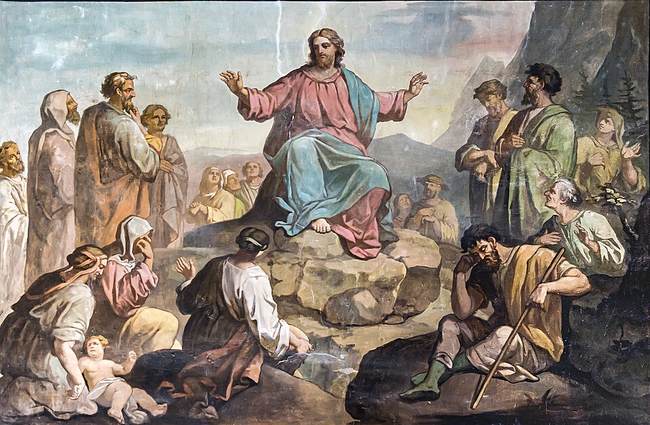
The front page image is “Sermon On the Mount” by Robert Arsène, 1870. On display at the Église Saint-Martin de Castelnau-d’Estrétefonds in France. Via Wikimedia Commons.
“Sunday Reflection” is a regular feature that looks at the specific readings used in today’s Mass in Catholic parishes around the world. The reflection represents only my own point of view, intended to help prepare myself for the Lord’s day and perhaps spark a meaningful discussion. Previous Sunday Reflections can be found here.
Join our VIP Membership program! Choose VIP to support Hot Air and access our premium content, VIP Gold to extend your access to all Townhall Media platforms and participate in this show, or VIP Platinum to get access to even more content and discounts on merchandise. Use the promo code FIGHT to join or to upgrade your existing membership level today, and get 60% off!
Read the full article here


![Barack Obama Throws Gavin Newsom Under the Bus Over His Homelessness Scandal [WATCH]](https://www.lifezette.com/wp-content/uploads/2025/09/2025.09.24-11.11-lifezette-68d3d1e6b90a4.jpg "Barack Obama Throws Gavin Newsom Under the Bus Over His Homelessness Scandal [WATCH]")
![Legal Latino Immigrants Are Carrying Water for White Supremacy: Jemele Hill [WATCH]](https://www.lifezette.com/wp-content/uploads/2026/03/2026.03.07-10.51-lifezette-69ac031f8cb61.jpg "Legal Latino Immigrants Are Carrying Water for White Supremacy: Jemele Hill [WATCH]")



![Kamala Forgets the Internet Exists as Her Own Words on Iran Come Back to Make Her Look Silly [WATCH]](https://www.lifezette.com/wp-content/uploads/2024/10/2024.10.21-01.35-lifezette-671658b910b27.jpg "Kamala Forgets the Internet Exists as Her Own Words on Iran Come Back to Make Her Look Silly [WATCH]")