


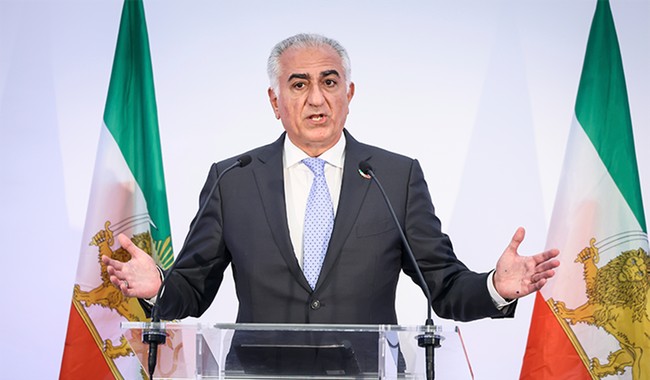

Has the regime in Tehran succeeded in putting down a popular revolt? Has Donald Trump been dissuaded from intervening in Iran on behalf of the massive numbers of demonstrators, thousands of whom have been murdered by the mullahs and the IRGC? And what exactly would replace the regime?
The son of the last Shah of Iran wants to claim his place among those who would decide the last question. Some of the demonstrators have demanded a restoration of the monarchy, while others vehemently oppose it. Reza Pahlavi made his case for leadership this morning in a press conference, while expressing confidence that the weight of momentum has irrevocably shifted to ending the current regime. Pahlavi also expressed confidence in Trump as “a man of his word” when it comes to supporting the revolt, speaking with Time Magazine:
Now, as fear and force push demonstrators indoors, Pahlavi says he and “the Iranian people” are counting on President Donald Trump to step in to protect them, even after the president said on Wednesday he had been told “the killing in Iran is stopping.”
“The Iranian people see President Trump as a man of his word and believe he will follow through with the promise he made to defend them,” Pahlavi told TIME on Thursday in written responses to a series of questions. …
Based on conversations with Iranians and chants such as “O’ king of Iran, come back to Iran, the mullahs have trashed the country” that echoed across the rallies, many were also encouraged to march for Pahlavi. When asked if it was irresponsible to call Iranians into the streets without protection, Pahlavi placed the blame on Iran’s Supreme Leader, his regime and “their supporters in the West.”
“They have the lives of tens of thousands of my bravest compatriots on their hands,” he said. “But we will ensure their sacrifice is not in vain and we will win.”
Pahlavi met with Trump this week to improve his bargaining position among the factions of the Iranian opposition. The most well-organized of these in the US is the National Council of Resistance of Iran, which strongly opposes any return of the Pahlavis, even in a ceremonial position. Other democracy activists also oppose a monarchy as an alternative, preferring a direct change to a popular republic with a secular constitution. None of these factions has the strength on its own to overthrow the mullahs – yet, anyway – and Pahlavi wants Trump to include him in any US strategy for a Day After scenario.
Reportedly, Trump remains skeptical that Pahlavi can build the necessary partnerships to succeed. Reuters noted this week that Trump likes Pahlavi personally but questions his support in Iran:
U.S. President Donald Trump said on Wednesday that Iranian opposition figure Reza Pahlavi “seems very nice” but expressed uncertainty over whether Pahlavi would be able to muster support within Iran to eventually take over. …
The U.S.-based Pahlavi, 65, has lived outside Iran since before his father was toppled in the 1979 Islamic Revolution and has become a prominent voice in the protests. Iran’s opposition is fragmented among rival groups and ideological factions – including the monarchists who back Pahlavi – and appears to have little organized presence inside the Islamic Republic.
Echoing Trump’s caution, Sanam Vakil, deputy director of Chatham House’s Middle East and North Africa Program, said Pahlavi had gained prominence among some protesters and had helped mobilise them to some extent. “But I wouldn’t overstate it. It’s very hard to see how much support he has or how much support any figure has in Iran,” she said.
The calls for the restoration from the demonstration may get Pahlavi a seat at the table, perhaps. His ability to sustain the momentum by getting more people to demonstrate in the streets may add to his contribution. However, some of the other factions suffered at the hands of Pahlavi’s family before the mullahs arrived, and they will need a great deal of convincing before attaching themselves to the monarchy again.
That may be why Pahlavi called the press conference this morning. After meeting with Trump, he needs to demonstrate that he can contribute to the post-regime change conversation. He declared that “the Islamic Republic will fall – not if, but when,” from Washington DC. Pahlavi committed to a transitional role to a secular democracy while serving as a point of unity, and expressed hope that the West would finally take decisive action to ensure it:
Pahlavi said he wants to serve as a figurehead to lead a transition to a secular democracy, despite detractors.
Pahlavi has repeatedly called for intervention by US President Donald Trump, who has not acted despite several warnings to Tehran.
“Iranian people are taking decisive actions on the ground. It is now time for the international community to join them fully,” Pahlavi said.
He called on the international community to “protect the Iranian people by degrading the regime’s repressive capacity, including targeting the Islamic Revolutionary Guard leadership and its command and control infrastructure.”
Will Pahlavi convince the other factions that he’s only interested in a “figurehead” role? Some of them won’t see that as a feature; after all, the 1979 revolution itself was a popular revolt against the oppressive Shah’s regime. Some Iranians may be cheering the “king” as an honest desire, but that may turn off a lot of Iranians who still recall the nature of the previous regime. The best option would be to find a way to unite all of these factions and use whatever works as a unifying rallying point. If a humbled Pahlavi could serve in that role, great, but don’t expect all Iranians to buy into that.
What else can the US and the West do in this moment, assuming the opposition factions find a way to work with each other? Retired general Jack Keane explains that the US can’t actually force regime change, but they have plenty of options to keep weakening the regime, some of which we’re already doing. We know our limitations, Keane argues, but we also know our capabilities, and we still have aces up our sleeve:
U.S. weighs military response amid Iran uprising pic.twitter.com/dKCK2kSqWy
— Brian Kilmeade (@kilmeade) January 16, 2026
Here’s the entire presser from Pahlavi as well. It might be worth bookmarking.
Editor’s Note: Thanks to President Trump and his administration’s bold leadership, we are respected on the world stage, and our enemies are being put on notice.
Help us continue to report on the administration’s peace through strength foreign policy and its successes. Join Hot Air VIP and use promo code FIGHT to get 60% off your membership!
Read the full article here

![Tim Walz Blasted for Calling Pedophiles and Murderers ‘Neighbors of Color’ [WATCH]](https://www.lifezette.com/wp-content/uploads/2025/08/2025.08.05-05.07-lifezette-68923a5548c09.jpg "Tim Walz Blasted for Calling Pedophiles and Murderers ‘Neighbors of Color’ [WATCH]")
![Trump Rips NATO as “Paper Tiger” Over Hormuz Strait Standoff [WATCH]](https://www.rvmnews.com/wp-content/uploads/2026/03/2026.03.02-01.28-rvmnews-69a5908859bc9.jpg "Trump Rips NATO as “Paper Tiger” Over Hormuz Strait Standoff [WATCH]")

![Dems Turn on John Fetterman as Intraparty Rift Deepens Over Key Votes [WATCH]](https://www.rvmnews.com/wp-content/uploads/2026/02/2026.02.15-11.29-rvmnews-6991ae23c8e02.jpg "Dems Turn on John Fetterman as Intraparty Rift Deepens Over Key Votes [WATCH]")