
Will the Board of Peace get its first win in Abu Dhabi?
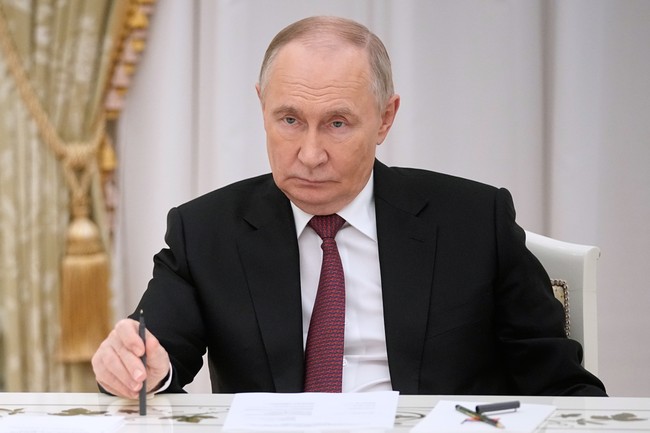
For the first time since the start of the Russian invasion of Ukraine four years ago, the two sides have sat down to talk about a resolution. The Trump administration is mediating the talks, shortly after concluding bilateral negotiations with Russia. The talks in Abu Dhabi will undoubtedly run into the same obstacle that has halted indirect negotiations for months – territorial concessions beyond the front lines of the war:
Ukraine and Russia were holding joint peace talks Friday with the United States, the first trilateral meeting since the Kremlin’s full-scale invasion nearly four years ago.
The talks in Abu Dhabi follow marathon overnight discussions at the Kremlin between President Donald Trump’s envoys and Vladimir Putin. Trump met earlier Thursday with Ukraine’s Volodymyr Zelenskyy. …
The UAE’s Ministry of Foreign Affairs confirmed the talks were underway in a statement and expressed hope “that these discussions would contribute to tangible steps toward ending a crisis that has persisted for nearly four years and resulted in immense humanitarian suffering.”
But the key sticking point remains the future of territory in Ukraine’s east, with Moscow showing little sign of budging on its hardline demands.
Vladimir Putin still wants all of the Donbas under Russian control. However, the Russian army has been unable to dislodge the Ukrainians from about 20% of that area, even after four years. Russia has opted for terror tactics by attacking Kyiv and cities even farther to the West in an attempt to break the Ukrainian will to resist, attacks which Putin has escalated in recent weeks. Volodymyr Zelensky has refused to comply, given the sacrifices already made to hold that territory, not to mention the outrageous nature of both the invasion itself and the manner in which Putin has fought the war.
The Trump administration has pressured Zelensky to make more concessions nonetheless, and that will likely continue in Abu Dhabi. Until now, Putin has refused to talk unless Zelensky concedes that territory up front. What changed? Putin decided to join Donald Trump’s Board of Peace and presumably paid the billion-dollar fee, which likely was contingent on pushing Putin to the table. Putin wants to have some influence over American policy in the Middle East, especially on Iran, and he can’t afford to sit out the Board of Peace. (Israel joined for the same reason.)
But is there another reason for Putin’s decision to come to the table? Former DIA analyst Matthew Shoemaker wrote yesterday that the Board of Peace isn’t the primary reason for the change. Instead, the real catalyst was a piece of legislation that will provide a “kill shot” to Putin’s ability to continue the war:
The most significant development of 2026 isn’t a new missile system; it’s a tariff. The Graham-Trump Bill, greenlit by the White House on January 7, has fundamentally rewritten the rules of economic warfare. By threatening a mandatory 500% tariff on any country—including China and India—that continues to purchase Russian petroleum or uranium, the U.S. has finally weaponized the one thing Russia’s allies value more than cheap crude: access to the American consumer.
The shockwaves were instantaneous. On January 15, reports emerged that China’s largest state banks, including ICBC and Bank of China, began halting Ruble-denominated settlements. They aren’t waiting for the bill to be signed into law; they are pre-emptively cutting Russia loose to save their own export margins. When Beijing chooses its $500 billion trade surplus with the U.S. over its “strategic partner” in Moscow, the Russian war machine loses its primary life support system.
While the external walls are closing in, the internal floor is rotting. On New Year’s Day, Russia’s VAT officially jumped to 22%. This isn’t a sign of strength; it’s an act of desperation. The Kremlin is cannibalizing its own middle class to plug a federal budget revenue gap that fell 20% short of targets in 2025.
We are now seeing the first signs of a systemic banking fracture. In cities like Yekaterinburg and Novosibirsk, reports of ATM shortages are no longer fringe rumors—they are the physical manifestation of a “liquidity trap.” When the state raises taxes while inflation remains double-digit and interest rates hover near 20%, the result is a “medically induced coma” for the civilian economy.
Well, maybe. We’ve been predicting the imminent collapse of Russia’s economy ever since the war turned into a stalemate almost as soon as it began. Putin has managed to keep it together for four years, in part by cannibalizing reserves, and the oligarchs have not budged in their support. Despite the grinding losses on the front lines and low morale, the Russian army has not collapsed … yet. Even the attacks by Ukraine on Moscow and the Russian energy sector has not provoked a repudiation of Putin or measurably weakened his regime. Any claim that Putin’s economic foundation is on the brink of collapse has to be viewed with a great deal of skepticism at this point.
However. The Graham-Trump tariff bill may not be the only catalyst in action. The US has gone on offense against the black-market merchant fleet that sells sanctioned oil. At first, that appeared aimed at the Nicolas Maduro regime in Venezuela, and that certainly was its first target. The US snatched Maduro three weeks ago, though, and the US Navy and Coast Guard continue to seize black-market tankers. In fact, we’re getting so many of them that we are creating a new market for resales:
The world’s largest cash buyer of ships for scrap is setting its sights on the shadowy tankers that ferry illicit oil from Iran, Russia and Venezuela.
GMS filed a request this month with the Treasury Department’s Office of Foreign Assets Control for a license to buy sanctioned ships.
The company’s founder and chief executive, Anil Sharma, says if OFAC grants the license it will help the U.S. slash the size of the so-called shadow or dark fleet by allowing sanctioned vessel owners to exit the industry.
In other words, the US Navy and Coast Guard has damaged the black-market economic model to the point where it may make more sense for tanker owners to sell off their ships for scrap. And that might be the real tipping point for Russia, which has almost no other way to get the hard currency necessary to float the war in Ukraine. Putin’s ante for the Board of Peace may be his attempt to get sanctions lifted as fast as possible before the wheels truly do come off, at which point the only interest in black-market shipping will be in Tehran, and … well … you know.
Stay tuned. So far today, Russia isn’t moving off of its claim on the entire Donbas. They are, however, still at the table.
Editor’s Note: Thanks to President Trump and his administration’s bold leadership, we are respected on the world stage, and our enemies are being put on notice.
Help us continue to report on the administration’s peace through strength foreign policy and its successes. Join Hot Air VIP and use promo code FIGHT to get 60% off your membership!
Read the full article here

![President Trump Explains Hand Bruise, Dismisses Health Conspiracies During Davos Trip [WATCH]](https://www.rvmnews.com/wp-content/uploads/2025/12/2025.12.24-08.56-rvmnews-694baad15154b.jpg "President Trump Explains Hand Bruise, Dismisses Health Conspiracies During Davos Trip [WATCH]")
![Half-Naked Twerker Thrown from Jeep in Spring Break Crash Has Passed Away [WATCH]](https://www.rvmnews.com/wp-content/uploads/2026/03/2026.03.16-03.23-rvmnews-69b82069d7699.jpg "Half-Naked Twerker Thrown from Jeep in Spring Break Crash Has Passed Away [WATCH]")

![Whistleblower Points Finger at Newsom as Congress Digs Into California Hospice Fraud [WATCH]](https://www.lifezette.com/wp-content/uploads/2025/08/2025.08.07-10.03-lifezette-68947a09e93a6.jpg "Whistleblower Points Finger at Newsom as Congress Digs Into California Hospice Fraud [WATCH]")