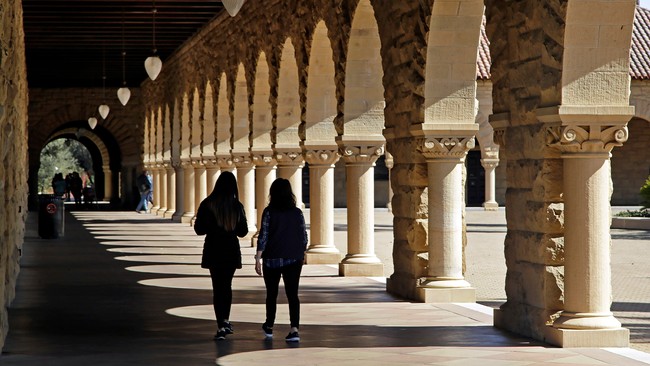

I have a son in the process of applying to colleges at this moment, so stories like this are on my radar more than they might normally be. Today the Atlantic has a report about disability designations at some of America’s top universities.
If you grew up in the era I did, having a disability meant something pretty specific. It meant people who had major physical or mental issues that were obvious to anyone who looked at them. If you were in a wheelchair you had a disability. But that’s not what it means today. These days, lots of students claim a disability based on as little as a doctor’s note and ask that special accommodation be made for them. The percentage of students making these claims, especially at elite schools, has tripled over the past 10-15 years.
Accommodations in higher education were supposed to help disabled Americans enjoy the same opportunities as everyone else. No one should be kept from taking a class, for example, because they are physically unable to enter the building where it’s taught. Over the past decade and a half, however, the share of students at selective universities who qualify for accommodations—often, extra time on tests—has grown at a breathtaking pace. At the University of Chicago, the number has more than tripled over the past eight years; at UC Berkeley, it has nearly quintupled over the past 15 years.
The increase is driven by more young people getting diagnosed with conditions such as ADHD, anxiety, and depression, and by universities making the process of getting accommodations easier. The change has occurred disproportionately at the most prestigious and expensive institutions. At Brown and Harvard, more than 20 percent of undergraduates are registered as disabled. At Amherst, that figure is 34 percent. Not all of those students receive accommodations, but researchers told me that most do. The schools that enroll the most academically successful students, in other words, also have the largest share of students with a disability that could prevent them from succeeding academically.
“You hear ‘students with disabilities’ and it’s not kids in wheelchairs,” one professor at a selective university, who requested anonymity because he doesn’t have tenure, told me. “It’s just not. It’s rich kids getting extra time on tests.” Even as poor students with disabilities still struggle to get necessary provisions, elite universities have entered an age of accommodation. Instead of leveling the playing field, the system has put the entire idea of fairness at risk.
How did this happen? In 1990 Congress passed the Americans with Disabilities Act. But the impact of that law was initially somewhat limited by rulings made by the Supreme Court. In 2008, Congress amended the ADA and expanded the definition of disability to specifically include problems “learning, reading, concentrating, thinking” even if those problems weren’t obvious in daily life.
A group called the Association on Higher Education and Disability (AHEAD) responded to those changes to the law by arguing that disability decisions shouldn’t solely be based on medical determinations. At the same time, getting a doctor’s note for something like ADHD became much easier thanks to changes in the DSM manual. And from there the need to offer accommodations expanded to other disabilities.
Over the past decade, the number of young people diagnosed with depression or anxiety has exploded. L. Scott Lissner, the ADA coordinator at Ohio State University, told me that 36 percent of the students registered with OSU’s disability office have accommodations for mental-health issues, making them the largest group of students his office serves. Many receive testing accommodations, extensions on take-home assignments, or permission to miss class. Students at Carnegie Mellon University whose severe anxiety makes concentration difficult might get extra time on tests or permission to record class sessions, Catherine Samuel, the school’s director of disability resources, told me. Students with social-anxiety disorder can get a note so the professor doesn’t call on them without warning…
Professors told me that the most common—and most contentious—accommodation is the granting of extra time on exams. For students with learning disabilities, the extra time may be necessary to complete the test. But unlike a wheelchair ramp, this kind of accommodation can be exploited. Research confirms what intuition suggests: Extra time can confer an advantage to students who don’t have a disability.
The likelihood that many of these students are just gaming the system hasn’t escaped the notice of researchers who’ve looked into this issue. If widespread disabilities were really a problem, we’d be as likely to see them at two-year colleges as at elite colleges, but that’s not the case.
According to [Professor Robert] Weis’s research, only 3 to 4 percent of students at public two-year colleges receive accommodations, a proportion that has stayed relatively stable over the past 10 to 15 years. He and his co-authors found that students with learning disabilities who request accommodations at community colleges “tend to have histories of academic problems beginning in childhood” and evidence of ongoing impairment. At four-year institutions, by contrast, about half of these students “have no record of a diagnosis or disability classification prior to beginning college.”
It’s a bit hard to reconcile the performance of the top students who get accepted to these schools with their claims that they have disabilities. It’s like selecting out the top 2% of runners at a track meet and having a third of them claim a physical disability that requires they be given a ten yard head start.
And yet, the number of students making these claims keeps growing. At some schools it is already approaching 50%. The article relays a conversation that happened at Stanford about the obvious question: Where does this end?
Paul Graham Fisher, a Stanford professor who served as co-chair of the university’s disability task force, told me, “I have had conversations with people in the Stanford administration. They’ve talked about at what point can we say no? What if it hits 50 or 60 percent? At what point do you just say ‘We can’t do this’?” This year, 38 percent of Stanford undergraduates are registered as having a disability…
And 24% of Stanford undergrads are receiving some sort of accommodation for a disability.
In case you’re wondering, Stanford usually accepts students with SAT scores between 1510 and 1570 (that’s the middle 50% of accepted students) and an unweighted GPA of 3.94 (plus lots of evidence of extracurricular activities). These are literally the top 1% of students nationwide. How is it possible 24% of Stanford undergrads require an accommodation (such as extra time on tests)?
And yet no one appears willing to say the problem has gone too far because that would eventually mean telling some individual no. And how do you tell one person no when nearly 40% of students have been told yes? In an era of rampant grade inflation where nearly everyone at Harvard gets an A in every class, this is just one more way in which students get ahead.
Editor’s Note: Do you enjoy Hot Air’s conservative reporting that takes on the radical left and woke media? Support our work so that we can continue to bring you the truth.
Join Hot Air VIP and use the promo code FIGHT to get 60% off your VIP membership!
Read the full article here



![‘Ilhan Omar Definitely Committed Immigration Fraud Against the United States’: JD Vance [WATCH]](https://www.lifezette.com/wp-content/uploads/2026/01/2026.01.11-10.47-lifezette-69637fa833c5d.jpg "‘Ilhan Omar Definitely Committed Immigration Fraud Against the United States’: JD Vance [WATCH]")


![Democrats Are Waging ‘Legislative Terrorism’ to Protect Welfare Cheats [WATCH]](https://www.lifezette.com/wp-content/uploads/2025/08/2025.08.26-06.13-lifezette-68adf933a85c0.jpg "Democrats Are Waging ‘Legislative Terrorism’ to Protect Welfare Cheats [WATCH]")