


Last weekend I wrote a post about a new coalition that’s hoping to find common ground on gun laws that was based on an article in the Milwaukee Journal Sentinel. While I didn’t have access to the in-depth policy proposals at the time, I’ve since had a chance to read over the material, as well as a lengthy look at how the sausage was made by Bridging the Divide panelist, Open Source Defense contributor, and Recoil writer B.J. Campbell, so I feel like I can offer up a much more informed opinion than what I was able to glean from the brief outline of the proposals that I used for the basis of my first post.
My bottom line a week ago was that there were a few ideas that I could support without reservation, but many of the proposals (at least as outlined) were either “unreasonable” on their face or “ripe for abuse based on the vague language contained in the proposal.” Now that I’ve had a closer look I’m inclined to support more of the policy proposals, but I still have some serious objections to others.
I want to start with the idea of a state-level universal background check system. In my first post, I mentioned that Open Source Defense has published an interesting way to perform “universal” background checks that preserves the privacy of the buyer, and said if that’s what is being offered I’d be far less likely to object. But, I added, the outline offers no detail at all on what this state-level background check system for private sales would look like… including their proposed penalties for violating the law.
The good news is that the policy proposal itself does closely resemble OSD’s plan, mainly because Campbell had a major role in drafting the language. As he describes the system in his Substack post linked above (which you really should read in its entirety):
It’s a state database and a smartphone app or website where you put a buyer’s information in, and it instantly returns a green flag or red flag on the prospective sale, without an owner registry. The state uses this for all peer to peer transfers which wouldn’t require a NICS check, and requests that the ATF allow it for FFL transfers as well. The policy also gets rid of state bans on SBRs and suppressors. This is the cornerstone, because it closes the supposed “gun show loophole” but does so in a way that is a convenient win for gun owners without a registry.
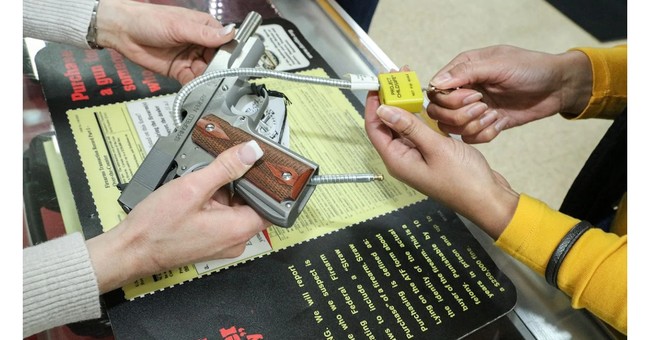
Under Bridging the Divide’s proposal, anyone buying a gun would have the option of having a NICS check run or using the state database, which would require the seller to submit the buyer’s driver’s license or state-issued ID number to an automated program run by the state law enforcement agency that would provide a “red light” or “green light” to let the seller know whether the buyer is prohibited from possessing a firearm.
There would also be a number of exemptions to the otherwise universal background check system, at least for private sellers:
i. A member of the seller’s or transferor’s immediate family who is not a prohibited person;
ii. An active or retired law enforcement agent or active or militarily retired military officer or serviceperson with appropriate documentation who is not a prohibited person; or
iii. A paid member of the seller/transferor’s gun club, if that gun club runs a physical range facility, is licensed by the state as a business, has been in existence for at least 2 years, and both the transferor and transferee have been members in good standing of the gun club continuously for at least the past one year.
iv. Anyone who is a certified firearm safety/shooting instructor by a national organization and is not a prohibited person.
The policy proposal also states that “restrictions on the ownership of short-barreled rifles, short-barreled shotguns, andsilencers (suppressors) shall be governed by federal law” and “it is recommended that any existing state prohibitions of the purchase or possession of short-barreled rifles, short-barreled shotguns, or suppressors be repealed.”
Is this an improvement to the current “universal” background check laws that are in place in almost two dozen states? Absolutely. There are, however, still a couple of concerns on my part.
The policy proposal makes it a felony to sell or transfer a firearm without putting the transferee through a background check, and compliance is mandatory. Sellers “shall” put buyers through a background check process of their choice if they don’t fall into one of the exempt categories, which means that there must be some sort of enforcement mechanism in place, even if it can’t proactively police every private transfer.
So what happens to the gun owner who doesn’t run his best friend’s drivers license information through the system before selling them a gun? And if the system doesn’t keep a record of searches, as the policy proposal outlines, then how would law enforcement know whether or not the check was performed in the first place? Presumably, this law would only come into play after law enforcement ran a trace on a firearm and found that it was not in the possession of the original buyer, at which point the seller (or original owner) would be looking at felony charges unless they could prove that the firearm was lost or stolen (and a “lost or stolen” reporting law is one of the other proposals the group endorses).
If this state-level system was an option available to any private seller who had concerns or wasn’t sure about a buyer’s status, I can’t think of any objection I’d have to it, at least not offhand. But the goal of Bridging the Divide was to find consensus among gun owners, 2A supporters, and gun control advocates, and keeping that system optional instead of making it mandatory may have been a bridge too far for some or all of the panelists from gun control supporters.
Which brings me to a broader concern. In the comment section of his write-up on how these policy proposals came to be, Campbell says that “the frame was ‘craft a policy that red states could possibly live with’ not necessarily craft a policy that would be used to roll back blue states,” adding that “now that it’s out there, I imagine anyone can use the document to do anything with it, including rollbacks” of existing laws in blue states.
While these proposals could certainly be used to argue against existing gun laws in blue states, when was the last time a Democrat-controlled state rolled back or repealed any gun control measures without being ordered to by a court?
As Campbell acknowledges, the thrust of this exercise was to come up with gun control measures that “red states could possibly live with.” What gun owners may view as a ceiling and the upper limits of what they could support, though, gun control activists get to use these policies as a floor for even more restrictions in the future.
Bridging the Divide’s package doesn’t include any discussion or recommendation of gun or magazine bans, waiting periods, “gun-free zones”, or qualifications for concealed carry licenses (or permitless carry laws), but since the group was aiming for consensus that’s not really a surprise. It does mean though, that gun control advocates could sign on to these proposals and still push for even more restrictive laws. Gun owners and Second Amendment advocates, on the other hand, would be endorsing the idea of “red flag” laws, universal background checks, prohibitions on gun ownership for those convicted of violent misdemeanors, storage mandates, and allowing lawsuits against the firearm industry for marketing firearms… at least under certain conditions. Once those laws are in place, though, there’s nothing stopping gun control advocates from seeking to make the provisions of these laws more restrictive than what Bridging the Divide has endorsed.
As I’ve said from the get-go, there are some policies that I think are worth pursuing in the policy proposals offered by Bridging the Divide. I don’t think the gun owners and Second Amendment advocates involved in the drafting of these proposals are gun-grabbing Communists, nor do I think they are all “useful idiot[s] for the communist party” as Campbell suggests in his piece.
I do believe, though, that ultimately the framework presented by Bridging the Divide benefits gun control advocates more than Second Amendment advocates, and to that extent the participation and endorsement of this package is useful to those who want more restrictions on the right to keep and bear arms. That doesn’t make any pro-2A participants idiots either, but my use of the phrase “useful idiot” was never meant to be taken literally to begin with. As I said in my first post on this topic, it was generally used to describe people working against their own interests while believing they are fighting for a righteous cause.
Working to reduce gun-involved deaths is indeed a righteous cause. I just happen to think that the proposed policies, taken as a whole, do work against the interest of Second Amendment advocates. In no way, though, was I suggesting then or now that Campbell, Rob Pincus, or any other individual from the 2A community who participated in this exercise is an actual idiot, and I sincerely apologize if anyone got that impression.
Bridging the Divide is supposed to be about finding consensus, not unanimity, in support of these proposals. While I can’t consent to every one of these measures (and in fact Campbell couldn’t either), I believe there are some ideas worth exploring in their policy proposals, and we’ll do so on Tuesday’s Bearing Arms’ Cam & Company, when I’ll be talking to Wake Forest professor, gun owner, and Second Amendment advocate David Yamane about his participation as a panelist and some of the ideas that I think are worth supporting.
Editor’s Note: The radical left will stop at nothing to enact their gun control agenda and strip us of our Second Amendment rights.
Help us continue to report on and expose the Democrats’ gun control policies and schemes. Join Bearing Arms VIP and use promo code FIGHT to get 60% off your VIP membership.
Read the full article here






![Liberal Judge Resigns After Investigation Reveals Hundreds of Political Donations [WATCH]](https://www.lifezette.com/wp-content/uploads/2025/09/2025.09.09-12.23-lifezette-68c01c2f20b5b.jpg "Liberal Judge Resigns After Investigation Reveals Hundreds of Political Donations [WATCH]")
![California Hero Vaults Through Restaurant Window and Disarms Stick-Wielding Rampager [WATCH]](https://www.lifezette.com/wp-content/uploads/2026/05/2026.05.15-09.47-lifezette-6a06ebb0c4f05.jpg "California Hero Vaults Through Restaurant Window and Disarms Stick-Wielding Rampager [WATCH]")