



But for how long? That question doesn’t apply to military resources or effort. It might apply to geopolitical will.
As far as US Central Command (CENTCOM) goes, the first day of the blockade on Iran’s ports succeeded on all measures. No ships made it to the open sea, and no ships entered into the exclusion zone. Six vessels tested the waters, literally as well as figuratively, but did not test the US Navy’s will to fight:
More than 10,000 U.S. Sailors, Marines, and Airmen along with over a dozen warships and dozens of aircraft are executing the mission to blockade ships entering and departing Iranian ports. During the first 24 hours, no ships made it past the U.S. blockade and 6 merchant vessels… pic.twitter.com/dpWAAknzQp
— U.S. Central Command (@CENTCOM) April 14, 2026
The U.S. Central Command said Tuesday no ships from Iranian ports have gone through the U.S. blockade within its first 24 hours.
Meanwhile, six merchant vessels obeyed direction from U.S. forces to reverse course and re-enter an Iranian port on the Gulf of Oman, according to Centcom.
More than 10,000 U.S. sailors, marines and airmen were involved in the mission, as well as more than a dozen warships and aircraft, Centcom said. Warships involved include the USS Abraham Lincoln aircraft carrier, the USS Tripoli amphibious assault ship and several guided-missile destroyers. U.S. forces began Monday morning a blockade of all vessels entering or leaving Iranian ports, according to Centcom. The blockade doesn’t stop ships from traveling through the Strait of Hormuz but is designed to prevent vessels entering and leaving Iran’s port and coastline.
On the other side of the picket line, shipping that had been bottled up began to move through the Strait of Hormuz. The numbers are still small, but the momentum has begun to move in the right direction:
Several commercial ships have sailed or started to travel through the Strait of Hormuz since the U.S. blockade of Iranian ports began.
Tanker Rich Starry was heading out through the waterway on Tuesday, according to financial-data provider LSEG. The ship, built to carry chemicals and oil products, is owned by a Chinese company and flies a false Malawian flag, according to maritime database Equasis. The U.S. barred Americans from dealing with the tanker in February 2023 under its Iranian sanctions program.
The U.S. hasn’t said it would target sanctioned vessels, promising only to act against ships entering and leaving Iranian ports in response to Iran’s effective closure of the strait to Western shipping.
Three Iranian-linked vessels have transited the strait, but not on behalf of Tehran. Reuters notes that their ports of call are in other Gulf states, and their destinations are also outside of the Persian Gulf. The three ships have been sanctioned in the past for helping Iran evade sanctions, but CENTCOM has already said that the naval blockade would not enforce previous sanctions. It will remain focused solely on the blockade of shipping originating in or traveling to Iranian ports. That would allow China to conduct its merchant traffic with other Gulf states, although it would also force Beijing to pay market rates for oil for the first time in several years.
Clearly, a lot more work remains to be done before shippers fully restart operations through the strait. However, the US Navy’s blockade forces Iran to suffer from their threats to that traffic for the first time. That may well provide enough pressure to force the IRGC to give up its claims of control over the passage. If not, the missile destroyers and other assets will make those claims moot anyway.
The question of political will remains, however, and its source may be surprising. The Saudis have reportedly gone wobbly over concerns about escalation from the Houthis:
Saudi Arabia is pressing the U.S. to drop its blockade of the Strait of Hormuz and return to the negotiating table, fearing President Trump’s move to close it off could lead Iran to escalate and disrupt other important shipping routes, Arab officials said.
The blockade is aimed at raising the pressure on Iran’s already crippled economy. But the officials said Saudi Arabia has warned Iran might retaliate by closing the Bab al-Mandeb—a Red Sea chokepoint crucial for the kingdom’s remaining oil exports.
The pushback is a sign of the risks and limitations of U.S. efforts to pry open the Strait of Hormuz, which Iran shut early in the war by attacking ships in the waterway, cutting off around 13 million barrels a day in oil exports and sending futures prices above $100 a barrel.
That is an understandable concern. However, the alternative would be to allow Iran to impose their Mullahgeld on the Strait of Hormuz, putting themselves at the mercy of the lunatics in Tehran. The actual solution to this predicament would be for the Saudis to deal with the Houthis directly in Yemen, as they tried to do initially, but got pushed in a different direction by Joe Biden almost immediately after taking office. If the Saudis want to join the effort to contain Iran, the Houthis might be their most logical target, especially considering the risks to their oil exports in both directions.
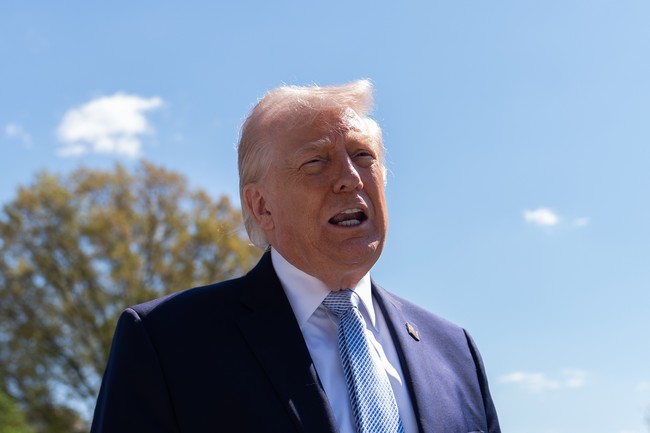
Meanwhile, Trump believes the blockade will produce diplomatic movement, he told the New York Post today. However, Trump warned that his redline on nuclear weapons and Iran’s highly enriched uranium remain in place:
Additional US-Iran peace talks “could be happening over next two days” in Pakistan’s capital, President Trump told The Post on Tuesday.
In an initial phone interview, Trump had claimed that discussions were “happening, but, you know, a little bit slow” before indicating that a second round of direct negotiations to end the seven-week war would likely happen somewhere in Europe. …
Trump did not say who would represent the US in a potential second round of talks, but confirmed he would not take part.
The president also indicated he was not pleased with reports that the US had asked Iran to suspend its uranium enrichment program for at least two decades during this past weekend’s unsuccessful talks.
“I’ve been saying they can’t have nuclear weapons” he said, “so I don’t like the 20 years.”
Asked about proponents suggesting a moratorium may encourage Iran make an agreement, Trump answered: “I don’t want them [Iran] to feel like they have a win.”
The blockade won’t feel like a win for the IRGC, especially if the US Navy succeeds in restoring shipping through the strait. The longer the blockade lasts, the worse it gets for the regime remnants and the economic damage they have created. They may need to give Trump a win just to survive … if they can.
Update: This is good analysis of the strategic advantages for the US in this blockade:
I’m going to make many of you spitting mad at me for pointing this out, but now that we have started the naval blockade, Iran’s strategic position (which was already hopeless) has become terminal. They are soon going to run out of storage space for their oil. And we haven’t even…
— Ken Gardner (@KenGardner11) April 13, 2026
And we haven’t even yet taken Kharg Island. This will force them to shut down current oil production, which itself is a drastic step that will further wreck their economy. Without their oil money, they’re finished. And no one is coming to save them, either. Nobody wants to mess with the two best militaries on the planet.
Meanwhile, pretty much the entire rest of the globe is demanding that Iran reopen the strait. And because markets always adjust, the Gulf states are already adopting workarounds in order to avoid this same problem in the future.
When the history of this war is written, it will be recorded that the regime’s decision to close the strait was a colossal miscalculation that relied too heavily on short term consequences (a hike in the price of oil, coupled with the belief that nations would unite against us rather than them). In chess, there is a famous quote to the effect that the threat is always stronger than the execution. Here, the threat to close the strait was stronger, especially with Trump and with countries in Europe and the Far East. The decision to close the strait was never going to work as long as we refused to budge. And it has greatly weakened Iran’s position.
Be sure to read it all. Ken also emphasized the need for American “persistence” to fully succeed. This is abouy geopolitical will, and Ken also remarks that a new round of negotiation may be the greatest threat to success.
Editor’s Note: For decades, former presidents have been all talk and no action. Now, Donald Trump is eliminating the threat from Iran once and for all.
Help us report the truth about the Trump administration’s decisive actions to keep Americans safe and bring peace to the world. Join Hot Air VIP and use promo code FIGHT to get 60% off your membership!
Read the full article here

![Sheriff Files $1M Defamation Suit After Woman’s ICE Detention Story Falls Apart [WATCH]](https://www.rvmnews.com/wp-content/uploads/2026/03/2026.03.27-12.45-rvmnews-69c67bf86429b.jpg "Sheriff Files $1M Defamation Suit After Woman’s ICE Detention Story Falls Apart [WATCH]")




![Federal Judge Clears Path for Trump Administration to End Somali TPS [WATCH]](https://www.lifezette.com/wp-content/uploads/2026/07/2026.07.12-20.51-lifezette-6a53fe507fd56.jpg "Federal Judge Clears Path for Trump Administration to End Somali TPS [WATCH]")
![Delano Squires Nukes the War on Marriage [WATCH]](https://www.lifezette.com/wp-content/uploads/2025/12/2025.12.09-03.16-lifezette-69383d455c1a3.jpg "Delano Squires Nukes the War on Marriage [WATCH]")