


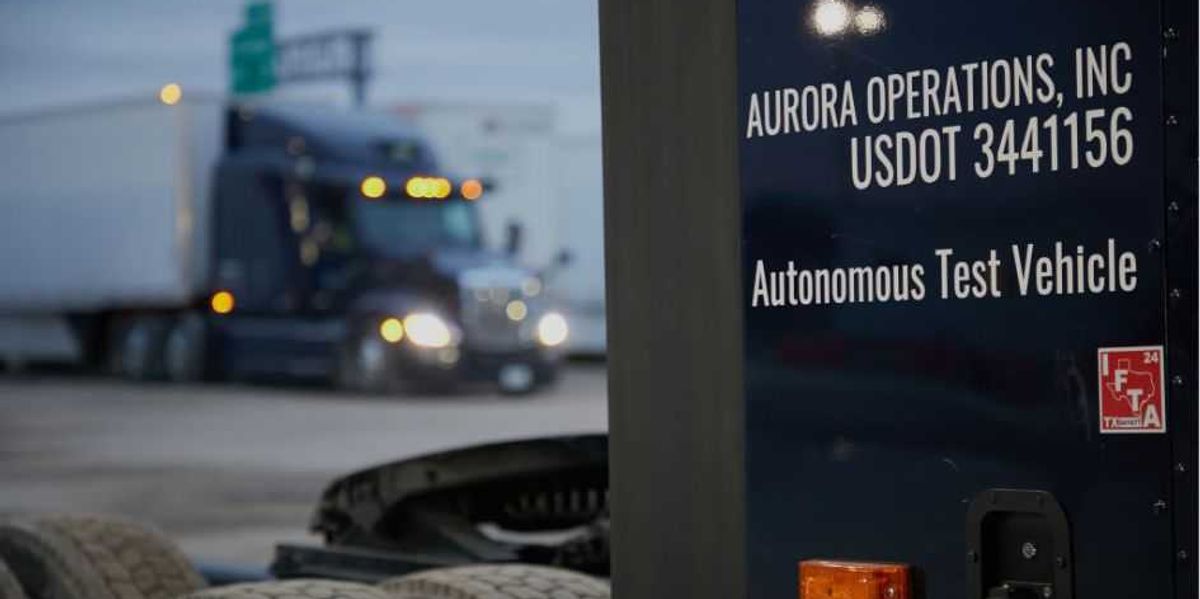

Americans have become strangely accustomed to driverless cars. In cities like San Francisco and Austin, people casually summon Waymo robo-taxis the way they once called Uber.
Now imagine the same technology attached to an 80,000-pound tractor-trailer moving at highway speed.
My fellow truckers already know the problem. Modern collision-avoidance systems have been triggered by shadows, weather conditions, lighting changes, and animals.
It’s happening; large carriers are already purchasing hundreds of robotically operated highway trucks as they prepare to eliminate one of the country’s most common occupations: the truck driver.
Supermarket swindle
Those pimping the technology tell us it is the necessary solution to a catastrophic shortage of truckers, with the additional benefit of making the roads safer. As I explain in my new book, “End of the Road: Inside the War on Truckers,” neither claim holds up under scrutiny.
This hardly matters, as the demand for more road robots is hardly organic. Instead, it is the product of a massive marketing campaign designed to acclimate us to a radical new future, one that may ultimately curtail the rights of all American drivers. Picture something like the “motor law” envisioned in the classic Rush track “Red Barchetta.” The late Neil Peart was a man who understood the precious freedom of the open road.
Waymo robo-taxis already roam San Francisco and Austin, while autonomous tractor-trailers test on Texas interstates. The technology, however, remains immature and heavily dependent on human oversight.
You won’t see this mentioned in recent paid content from Aurora Innovation, one of the leading developers of autonomous big-rig systems. Almost seamlessly inserted among actual articles on online news platform Axios, the piece’s headline promises to explain “the link between autonomous trucks and your grocery bill.”
The article opens with a bold claim: “Autonomous trucks — trucks that operate without a driver — could lower shipping costs, helping reduce grocery prices while improving safety and supply chain efficiency.”
But what the slick interactive video infographic and official-looking statistics fail to reveal is that the cost of trucking, in general, only represents between 1% and 3% of any consumer product. Consider that the industry has spent the last four years in a “freight recession” driven by weak demand, oversupply, and depressed rates. Did you notice your groceries getting cheaper? Of course you didn’t.
‘Shortage’ scam
Aurora’s advertorial also employs one of the autonomous truck lobby’s favorite justifications: the so-called shortage of truck drivers. This “crisis” has been going on since the 1980s, when deregulation and the attendant sharp decline in truck driver pay and working conditions created massive turnover in the industry. Now it is being used to convince investors and lawmakers that we don’t need truck drivers at all.
The problem is that even the trucking industry itself has largely stopped pretending the shortage exists.
Bob Costello, chief economist for the American Trucking Associations, allegedly declared that the “truck driver shortage is gone” at a recent carrier conference in Florida; just prior to this, he told trucking media outlet CCJ Digital that “what we have in the United States is a quality problem around drivers, much more so than an absolute number.”
That distinction matters because the trucking industry, like much of the country, has spent years lowering standards. The Biden administration’s de facto open borders policy opened the industry to large numbers of illegal aliens, refugees, and dubious asylum-seekers. Truckers — and the motoring public — have been dealing with the consequences ever since.
RELATED: The deadly trucker crisis — and why mass migration is to blame
Justin Hamel/Bloomberg/Getty Images
Unsafe at any speed
Road safety could improve overnight by revoking the questionable CDLs and driver’s licenses handed out to poorly vetted, poorly trained migrants in recent years. Instead, declining standards are quietly accepted while automation is presented as the solution. One doesn’t have to be a wild-eyed conspiracy theorist to wonder whether a more chaotic and less trustworthy driving environment makes the public easier to sell on “safer” autonomous systems.
As mentioned above, however, these “driverless” systems still depend heavily on human oversight. Aurora, for example, requires remote operators to monitor its trucks. In a July 2024 investor report, the company promised to reduce the number of such operators by increasing the number of trucks under each assistant’s watch. In the report, that number is 100.
Most readers will understand how difficult it can be to keep an eye on all of the traffic around you while operating one vehicle. What Aurora is proposing here is that the company will hand off the responsibility for 100 tractor-trailers to one remote “driver.”
Controller cowboys
And what skills does it take to pull this off? Anyone with a CDL or actual road experience can move to the back of the line; apparently this is a job for gamers and flight simulator enthusiasts.
The autonomous taxi industry is no better. Waymo has admitted it uses remote operators in the Philippines. An insider tells me Kodiak Robotics, whose supposedly driverless trucks operate in Texas’ Permian Basin, does the same. America’s highways already resemble “Mad Max” often enough. Soon they may look more like “Grand Theft Auto: 18-Wheeler.”
To be fair, language recently added to the proposed Build America 250 Act would require remote operators to possess CDLs and be based in the United States. Whether that language survives the lobbying process remains to be seen.
Virtual insanity
The industry’s safety claims deserve skepticism for another reason: Much of the confidence behind autonomous systems comes from “virtual miles,” simulations where AI software learns by effectively playing billions of miles of video games. Real-world highway testing – which subjects drivers to less predictable, more challenging situations — remains only a tiny fraction of that total.
Waymo, the current leader in autonomous cars, already accounts for most autonomous vehicle incident reports filed with the California DMV. Those are only the incidents publicly reported. What happens once thousands of autonomous semis begin operating across Texas?
Texas became the center of autonomous truck testing precisely because regulators took a light-touch approach. Investors certainly appreciate that; the public, unwittingly enlisted in the beta testing of this technology, may not.
Phantom menace
A major potential danger is phantom braking, a problem the industry is barely willing to acknowledge. As Dr. Missy Cummings, a former Navy fighter pilot and director of the Mason Autonomy and Robotics Center at George Mason University, recently warned the New York Times: “There is no identified solution on the horizon for phantom braking. And it will not be addressed soon, because nobody wants to admit that it’s happening.”
Cummings added that this malfunction — which has already caused incidents with robo-taxis — will likely have far more dangerous repercussions in significantly heavier class-eight semis.
My fellow truckers already know the problem. Modern collision-avoidance systems in human-operated trucks have been triggered by shadows, weather conditions, lighting changes, and animals, sometimes causing jackknife accidents.
Human touch
Autonomous driving technology is clearly flawed, and there’s no reason to assume that more bugs won’t emerge in the future. Yet developers continue to insist that software-driven vehicles are safer than those operated by humans. The steady drip of dramatic dashcam crash footage on social media subtly encourages this view.
But human drivers are already remarkably safe overall. Automotive site Jalopnik calculated that autonomous vehicles would need to avoid crashes 99.999819% of the time just to outperform human drivers.
Even if autonomous driving were capable of meeting such a high standard, we would have to consider the economic impact. What is being proposed here is not some minor technological upgrade. Truck driving directly employs roughly 2.5 million Americans, while the broader trucking industry supports around 8 million jobs and contributes an estimated $200 billion annually in wages.
The math pushed by autonomous vehicle boosters is absurd. They tell us that every 1,000 autonomous trucks will “create” 190 jobs, while conveniently ignoring the hundreds — perhaps thousands — of driving jobs simultaneously eliminated.
Who gets to DRIVE?
If we take the inevitability of driverless vehicles as a given, at the very least the people pushing that inevitability should be much more honest about the consequences. Lawmakers ought be more concerned for their constituents, rather than pandering to tech investors or indulging in baseless fearmongering about China flooding the market with robot vehicles.
At least three bills currently before Congress seek to accelerate autonomous vehicle deployment. One of them, sponsored by Republican Rep. Vince Fong of California, would effectively prevent states from regulating autonomous vehicle technology on their own roads.
So much for federalism.
The name of Fong’s bill? The “America DRIVES Act.” Ironic, considering that the people behind these policies seem to want a future in which Americans no longer drive at all.
As a trucker who has spent nearly 30 years on the road without a single collision, I have one response to all of this: No thanks. I’m sure millions of Americans agree.
Read the full article here





![Sean ‘Diddy’ Combs Reportedly Turns Prison Into a Lavish VIP Playground With Booze, Massages and Contraband [WATCH]](https://www.boredtrashpanda.com/wp-content/uploads/2025/04/2025.04.26-09.58-boredtrashpanda-680cae5940953.jpg "Sean ‘Diddy’ Combs Reportedly Turns Prison Into a Lavish VIP Playground With Booze, Massages and Contraband [WATCH]")
![Reported Flydubai Cockpit Fight Sparks Hijacking Panic and Israeli Fighter Jet Scramble [WATCH]](https://www.lifezette.com/wp-content/uploads/2026/09/2026.09.30-09.54-lifezette-6abcdc5e21bf8.jpg "Reported Flydubai Cockpit Fight Sparks Hijacking Panic and Israeli Fighter Jet Scramble [WATCH]")