


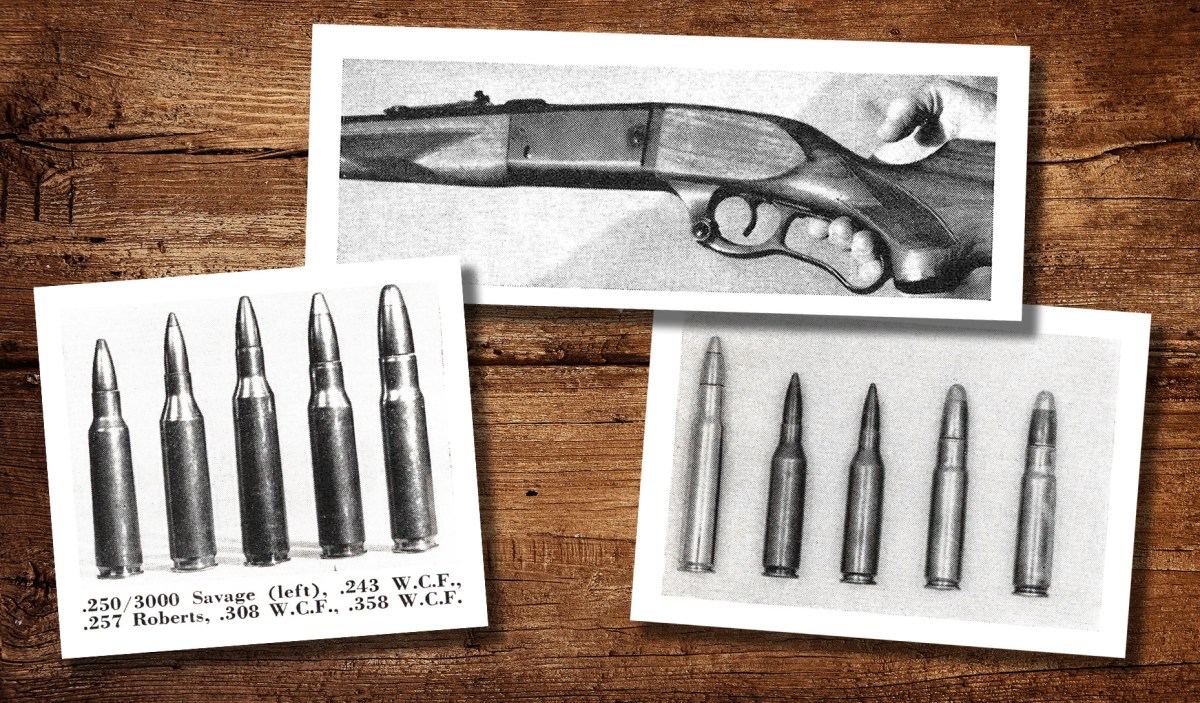

This column, “Two New Shorties: .243, .358” appeared in the October 1955 issue of Outdoor Life.
For many a month the rumor has been kicking around that Winchester was about to jump with a couple of new cartridges. They were to be running mates of the .308 Winchester and on the same case. Now the .308, as is known even to us simple peasants who dwell out where the pines grow tall and the catamount cries eerily in the night, was developed by the ordnance department of the United States Army.
The military lads were looking for a short cartridge, lighter than the .30/06 yet giving comparable ballistics. At first they cast a moist and loving eye at the .300 Savage cartridge, which does indeed approximate the ballistics of the M-2 military cartridge with which we fought World War II. But after long months of lonely brooding, the ordnance lads decided that what they wanted was not quite the .300 Savage but a modified version of it. And so, some years ago, they developed the cartridge we uncombed country boys now call the .308 W.C.F.
For a long time it was known as the T-65, and at present the military version is called the 7.62 NATO — 7.62 mm. meaning .30 in the metric system. Presumably all NATO forces will one day be armed with short, light, automatic rifles chambered for the little cartridge.
But at any rate Winchester brought out its first featherweight Model 70 bolt action for the .308 Winchester, and hence got its name on the cartridge, something which is worth many, many thousands of dollars in advertising. Last spring the new Winchester Model 88 lever action — also something which had been rumored for years — was announced. It too was chambered for the .308.
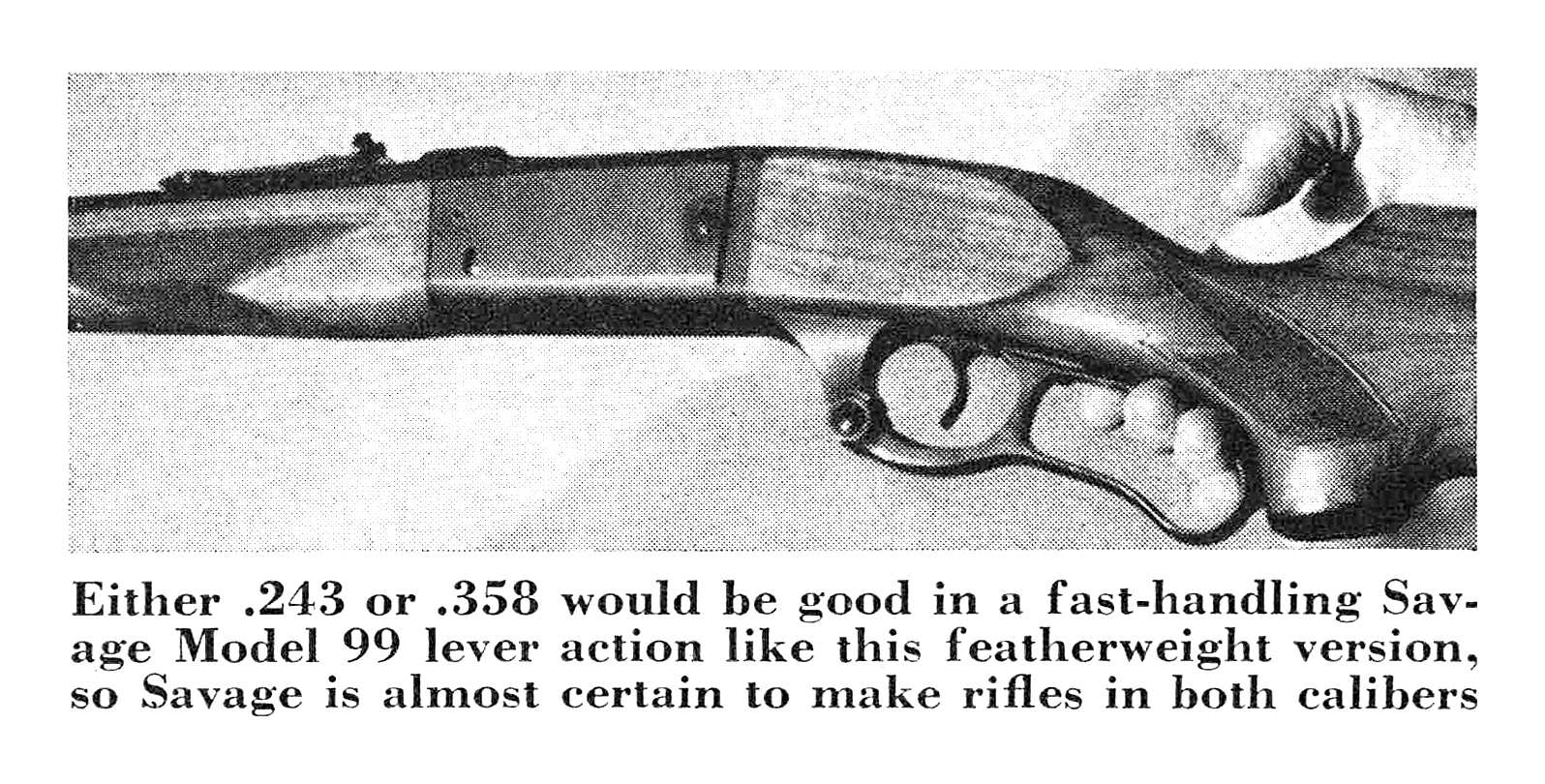
Then came Savage with a Model 99 lever action for the .308. The Model 99 in .300 Savage caliber has killed all North American and most foreign game very neatly, and in the somewhat more powerful .308 it should also be excellent. With its superb rotary magazine, strong action, short lever throw, and generally fine handling qualities, the Model 99 has been one of the all-time favorites of American hunters. Pressures of the various .308 loads run somewhat higher, I understand, than those of the .300 Savage; but the 99 action is strong enough to handle them.
With three good rifles now chambered for it, the .308 cartridge should become more popular. Just how good is it? It is lighter than the .30/06. More rounds can be carried by the soldier, but that feature is of little importance to the big-game hunter. It is better adapted than the .30/06 to use in a short, light semi-automatic or automatic rifle. Otherwise there are those who sourly say there isn’t anything the .308 can do as a big-game cartridge that the .30/06 cannot do better.
According to the ballistics in the Western Cartridge Co. Ammunition Handbook, the .308 cartridge pushes a 110-gr. bullet out of the muzzle at 3,340 feet per second, a 150-gr. at 2,860, and a 180-gr. at 2,610, as compared with 3,420 for the 110-gr. .30/06 as loaded by the same outfit, 2,970 for the 150-gr., and 2,700 for the 180-gr.
As can be seen, the .308 is not too far behind the much larger .30/06. The Western people did the trick with their now famous ball powder, which is made in many types with different rates of burning. All the various brews of ball pack a lot of oomph into a small space. That is why it is possible to get such high performance with small cartridge cases.
But now the .308 case has spawned a couple of offspring.
One is the .243 W.C.F., the combination of a 6 mm. bullet and the .308 case. Although the 6 mm. is an odd size, it is by no means new. Back in the Spanish-American War, the U.S. Navy was using a cartridge that was far ahead of its day, the 6 mm. Lee-Navy. And prior to the last war, some chaps were experimenting with varmint cartridges in 6 mm.
One was Hervey Lovell, who also necked down the old .25/20 single-shot case to .22 and produced the wildcat .22/3000 that had gun nuts singing nearly 20 years ago. He also necked down and re-formed the old .275 H. & H. Magnum case to take a .24 caliber bullet weighing 70 gr., if I remember correctly. He claimed a velocity of 5,000 f.p.s. but I doubt if he reached it. I suspect he arrived at that figure by shooting into a steel plate, working backward from bullet drop, or reading the signs and portents in the entrails of a slaughtered bull.
Another job was the .240 Super Varminter, developed by the chap who popularized the .250/3000 Savage case necked to .22. He called it the Varminter. Nowadays it’s usually called the .22/.250, and it’s still one of the most popular of all wildcats. Anyway, his Super Varminter was a right-hot cartridge. I played with one. I blew primers with recommended loads and chambers; whatever the reason, I could never get the accuracy I expected.
To create new wildcats by necking down, blowing out, and otherwise re-forming existing cartridge cases is for the most part an innocent and harmless hobby, and one upon which I look with a tolerant eye. After the war the wildcatters fell upon the 6 mm. and were at it again, before you could say Katzenjammer — pushing brass this way and that and coming out with creations so bizarre that strong men shuddered and turned pale when they saw them.
Some lads took the .220 Swift case and necked it up to .240, or sharpened the shoulder, or blew it out. Others tackled the .257 case necked to .240, changed the shoulder slope, and otherwise fancied it up. One version is the .243 Rock Chucker. This was worked out by my amigo Señor Fred Huntington, the Falstaff of Oroville, Calif., and proprietor of a worthy enterprise which builds reloading tools, makes dies, and calls itself — for some odd reason too involved for me to follow — the R.C.B.S. Gun & Die Shop. This .243 Rock Chucker, which Fred brought into the world in a careless moment, is the basis of a new .244 Remington cartridge which I propose to describe elsewhere.
Still others fell upon the T-65 case even before it got the “.308” handle attached to it. They necked it up to this, down to that. One of many resulting wildcats was a 6 mm. or .240.
Now, long years of bitter experience have taken away my youthful bounce and taught me the painful lesson that no one is going to save the world by necking down a case or by changing a shoulder angle. I have also found out that all you can put in a case is powder and all that comes out of the end of the barrel is a bullet. So when I began to hear that the various wildcat .240’s could read Hindustani, broil a steak, and play the piccolo, I took it with a grain of salt.
Let us look at some figgers: A standard .25 caliber bullet measures .257 in. in diameter and a 6 mm. bullet for the various .240’s measures .243. The difference, if my arithmetic is to be trusted, is .014 in. A .308 case necked to .25 and loaded with .25 caliber bullets makes a good cartridge. The same case necked to .24 likewise is a good cartridge, but I don’t think that .014-in. difference is going to make the world safe for democracy. In fact, I think the two calibers could be shot in the field for years without discovering any great difference between them.
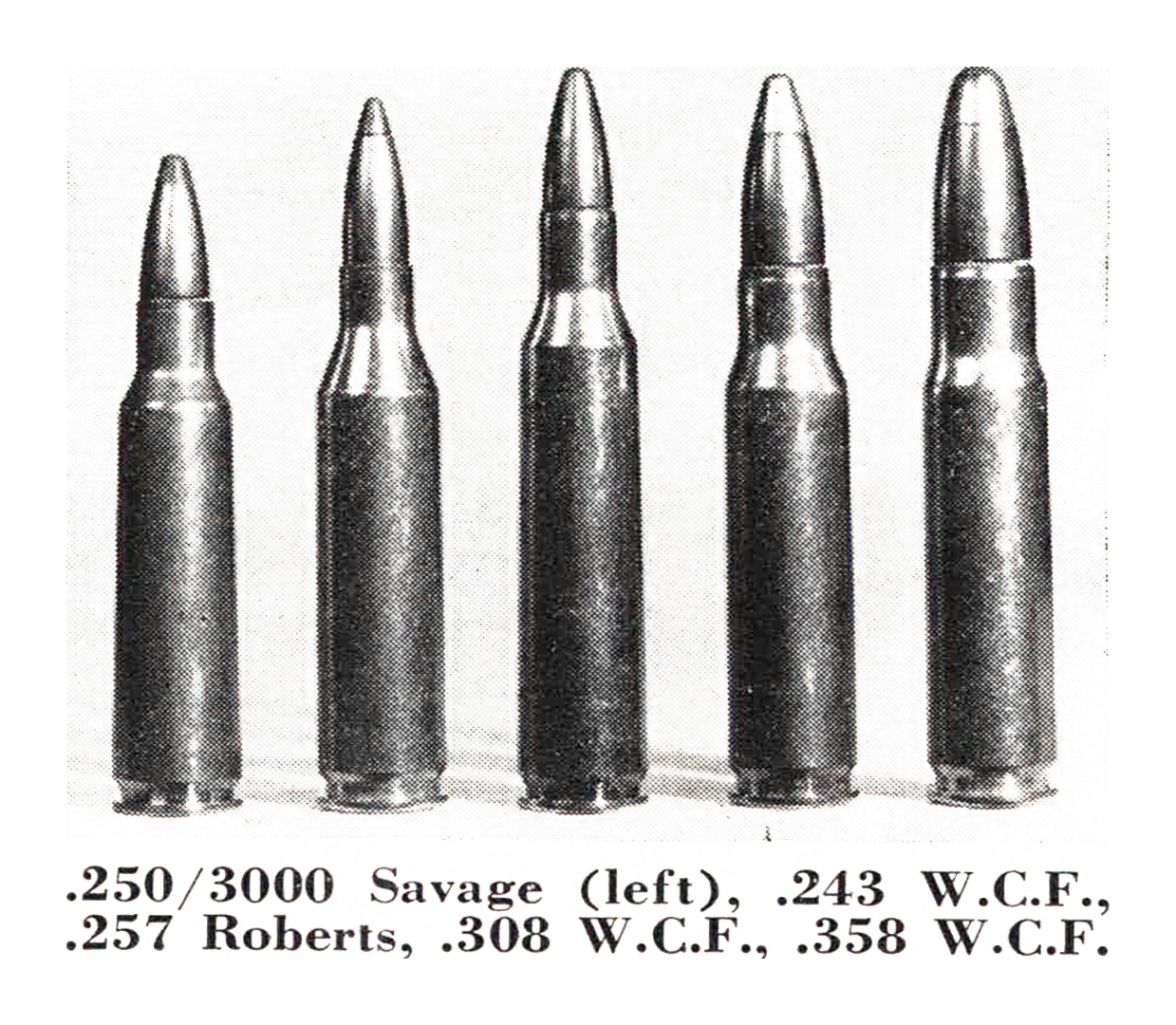
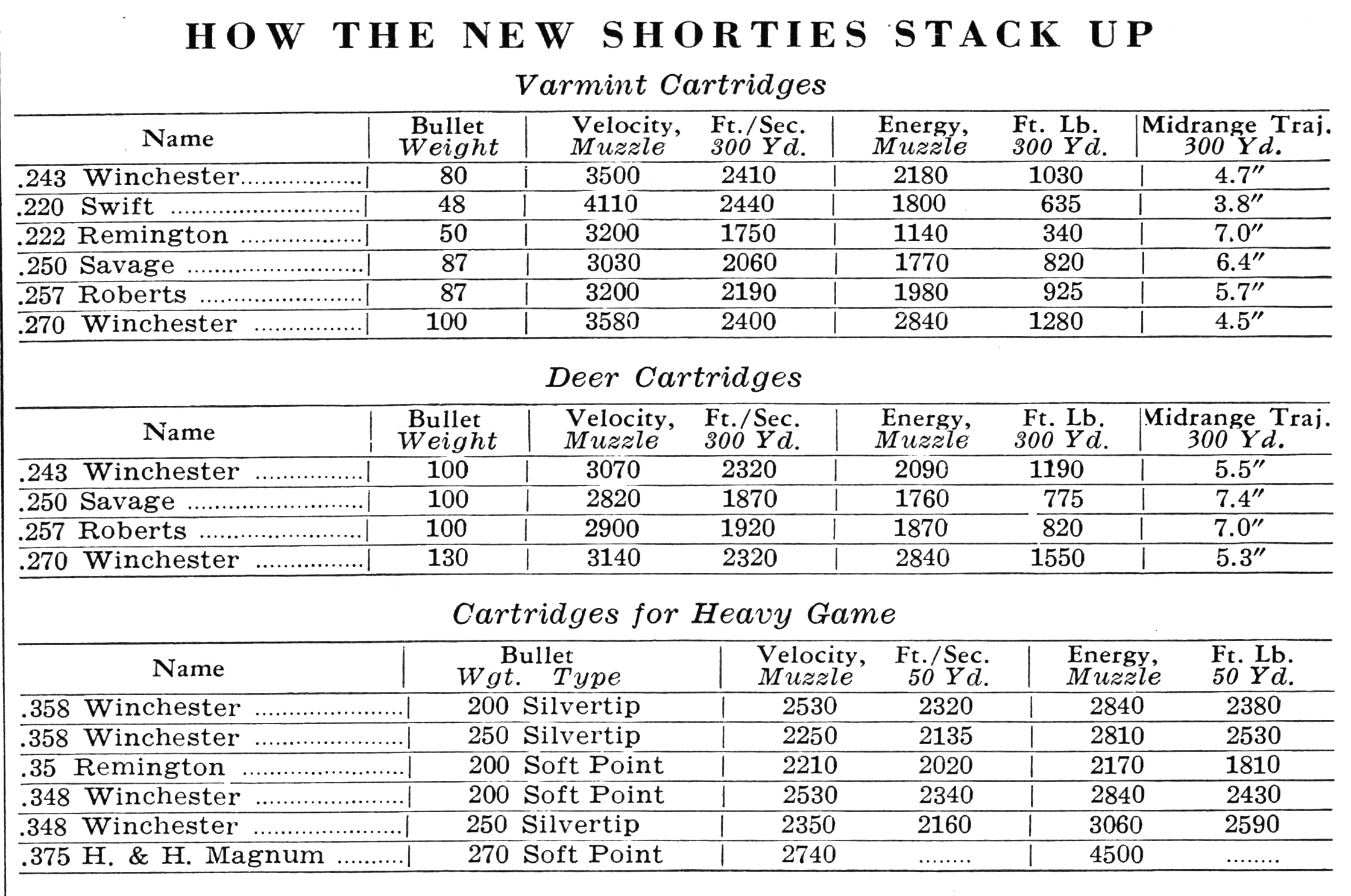
Anyway, the new Winchester cartridge is the .308 necked down to .24 caliber. It is loaded at the factory with an 80-gr. bullet at a muzzle velocity of 3,500 f.p.s., according to Winchester dope, and with a 100-gr. at 3,070. By comparison with maximum loads the .25 Souper, one of many wildcats developed on the .308 case, gives a velocity of 3,373 f.p.s. with the 87-gr. Speer bullet and a velocity of 3,160 with the 100-gr. bullet, according to the Handloader’s Manual. The same source says the humble, but for my money excellent, little .250/3000 Savage case will give 3,210 f.p.s. with the 87-gr. bullet, 3,088 with the 100-gr.
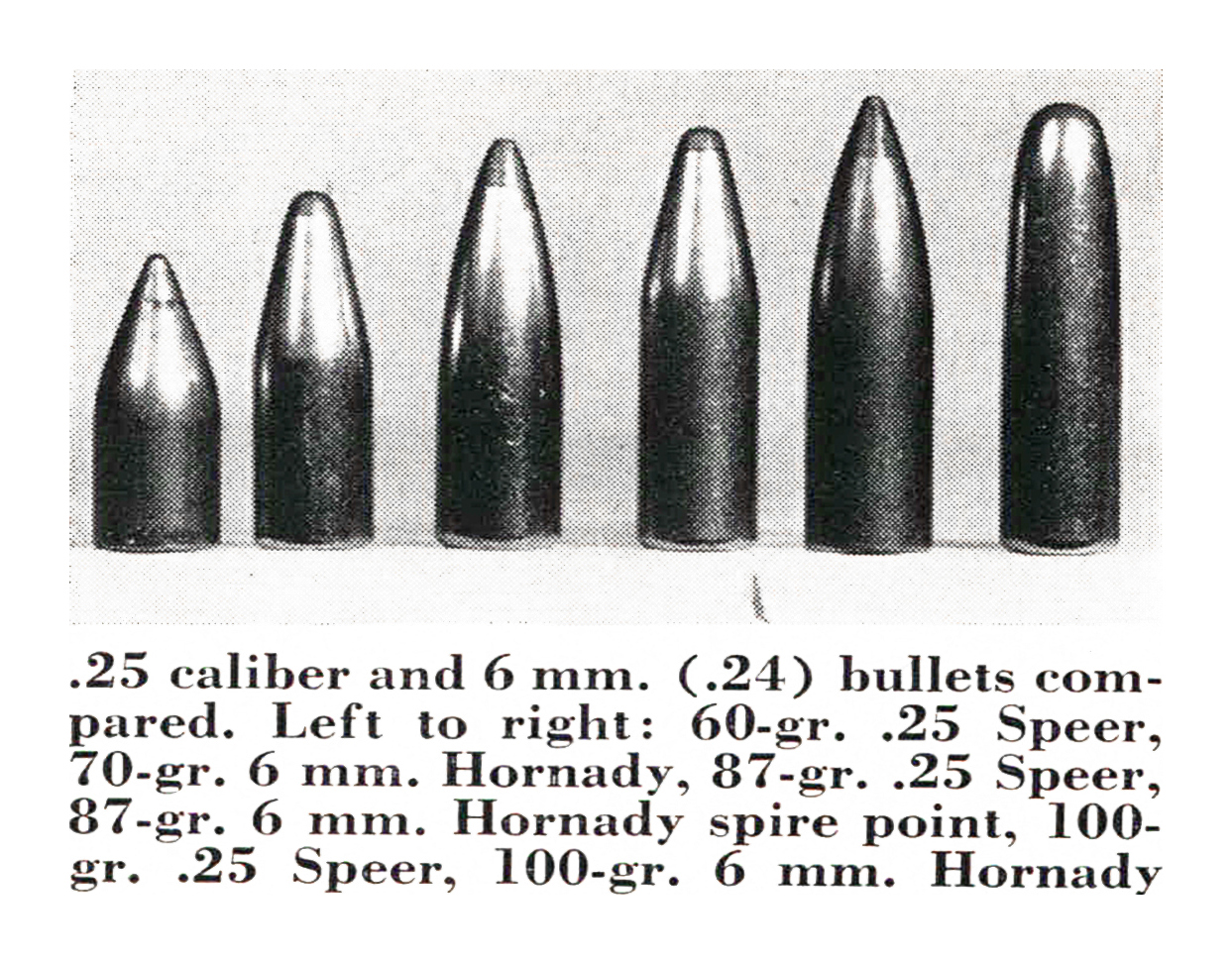
Said manual gives a good many .257 Roberts loads which will push an 87-gr. bullet along at 3,350 f.p.s., and one (49 gr. of No. 4831 powder) which will give a 100-gr. bullet 3,200 f.p.s. in this same .257. While we are at it, the sectional density of a 100-gr. .243 bullet is .238, somewhat but not astonishingly better than that of a 100-gr. .257 bullet, which is .216.
Winchester’s figures for the .243 give trajectory rise at midpoint over a 300-yd. course as 4.7 in. with the 80-gr. bullet, and as 5.5 in. with the 100-gr. bullet. In reviewing the cartridges another writer compared the trajectories with that of the 150-gr. factory load for the .270, much, of course, to the disadvantage of the .270. Just in case you are interested, figures for the comparable 100 and 130-gr. bullets in the .270, according to Western’s handbook, are 4.5 in. and 5.3 in.
Point is that the new .24’s are probably loaded to get out of them all that is in them, whereas factory cartridges for the .25’s (.250/3000 and .257) are definitely underloaded and their potentialities are not realized — not by several city blocks.
Velocity of the .250/3000 with the 87-gr. bullet was standardized 40 years ago with powder made of fingernail parings and old celluloid combs. With the 100-gr. bullet, velocity was standardized 20 years ago. Velocities for the .257 were arrived at with No. 3031 powder, and there they have stayed. As anyone who has handloaded the .257 knows, the cartridge is much more efficient with slower-burning propellents like No. 4350 and No. 4831. The fine .257 is being killed with neglect.
Likewise even the dullest Turkoman on the remote steppes of central Asia knows that with a certain slow-burning du Pont powder .270 velocities can be greatly stepped up from figures set many years ago with far less efficient powders.
Nevertheless the two new cartridges in .24 caliber are excellent. Other things being equal, they’ll shoot a little flatter than the similar .25’s, because weight for weight the .24 bullets have a little better sectional density. Because the hole in the barrel is smaller, they’ll have a little less report and recoil. They’ll be grand on varmints, particularly when it is breezy, and either should do nicely on the lighter big game.
Good thing about the .243 is that it can be used in the snappy little Model 88 Winchester lever action. The featherweight Model 70 bolt action will also be chambered for it, likewise the standard 70 and the target-weight 70 with the heavy 26-in. barrel and either the standard or the marksman stock.
As for the second new cartridge in the Winchester family, it makes a lot of sense to me. This one is the .358, or as I first heard of it, the 8.8 mm. In a small package it packs the power of the much larger .348 W.C.F. Like the .243, the .358 is based on the .308 case and can be had in the whole list of Model 70 bolt actions and in the lever-action Model 88. A rumor which I’ve never had officially confirmed says that, back in the darkest recesses of the Winchester plant, designers are laboring over a semi-automatic rifle for the same line of cartridges.
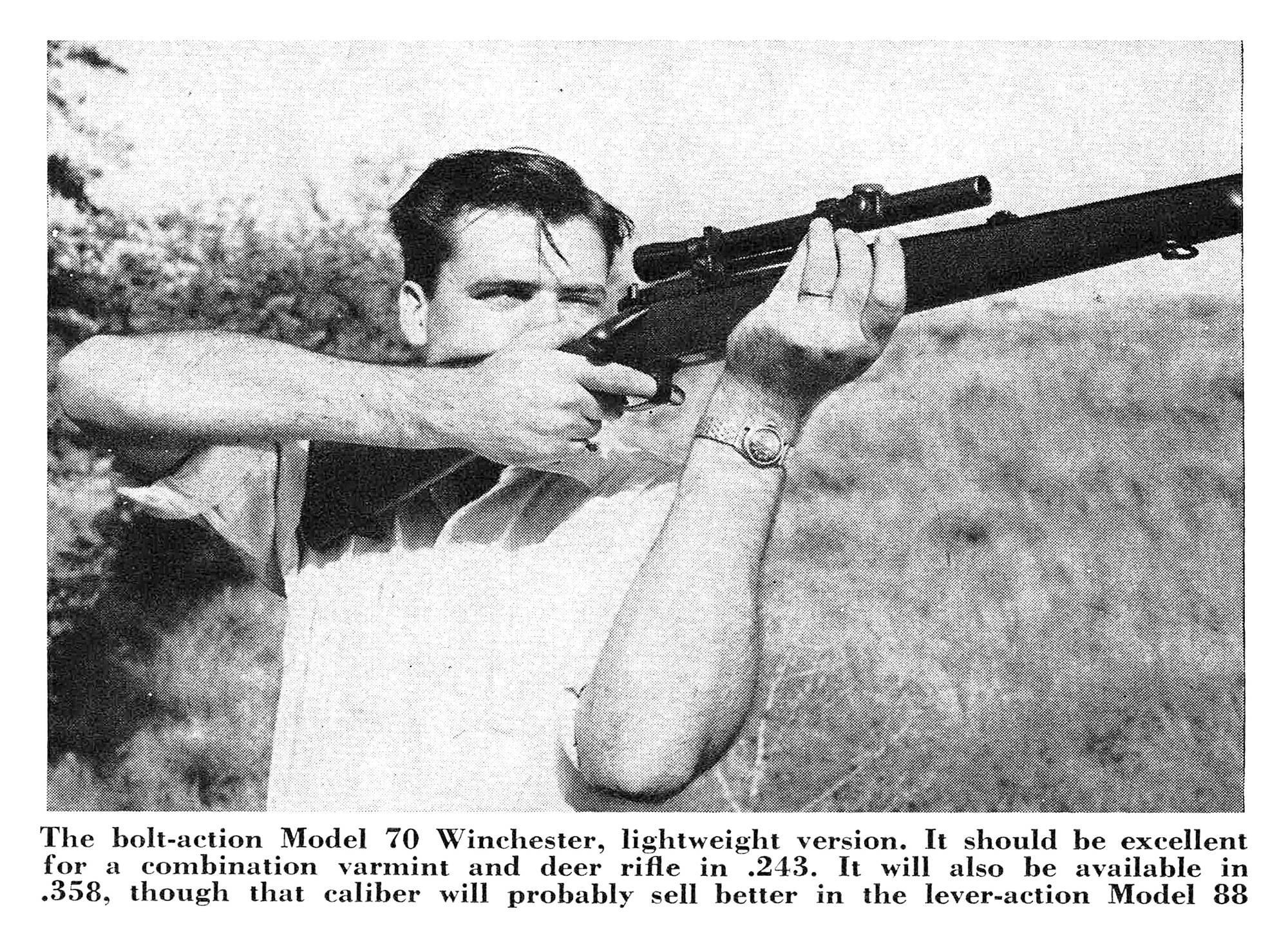
The .358 should be an almost ideal woods cartridge for any soft-skinned, non-dangerous game, and it fills a real need — for a cartridge firing heavy bullets at medium velocity from a light, handy woods rifle which can be nicely mounted with a scope. That, alas, is not true with the top-ejecting Model 71 Winchester lever action.
The .358 cartridge is like the ever-popular .35 Remington, only more so. It drives a 200-gr. bullet at 2,530 f.p.s. as compared with 2,210 in the Remington caliber, and a 250-gr. bullet at 2,250 — or only 100 f.p.s. less than the velocity turned up by a bullet of the same weight in the .348. Pressures, I’ve heard by way of the grapevine, are a good deal higher in the .243 and the .358 than in the .348 — 52,000 lb. per square inch, as compared with around 42,000. However, only rifles with strong, front-locking breech bolts or otherwise rigid actions will be chambered for the new cartridges.
Savage is almost sure to come out with the Model 99 for both cartridges — and fine combinations they will be, too.
For a lot of knock-down power under modern hunting conditions, where it’s smart to put a deer down for keeps and right now if you want to get a tag on him, the new .358 is it. Likewise you often have to shoot through brush or not shoot at all. For this, the big heavy bullet at moderate velocity in the fast-handling Model 88 Winchester or Model 99 Savage should be about right.
I have a hunch the .243 will sell best in the various Model 70 bolt action, to varmint shooters and accuracy nuts. But the .358 should move fastest in the lever.
Read Next: Why Some Rifle Cartridges Endure, and Others (Even Favorites) Die Out
In general how will the two new cartridges sell? I’d hate to make a bet. On the surface anyway, the .243 does not have the sensational ballistics of the .220 Swift, which set the world of riflemen on its collective ears some 20 years ago. Nor does it fill a big gap in the varmint-cartridge line, as did the .222 Remington when it plugged the hole between .22 Hornet–.218 Bee on one hand and .22/.250–.220 Swift on the other.
Still and all, the .24’s may be so popular that they’ll put the skids under those two excellent .25 calibers — the .257 and the .250/3000, which they so greatly resemble. If so it will be a pity.
Read the full article here

![John Fetterman Explodes at ‘Dirtbag Left’ as Socialist Victories Shake Democrats [WATCH]](https://www.rvmnews.com/wp-content/uploads/2026/06/2026.06.30-11.21-rvmnews-6a43a6b01d920.jpg "John Fetterman Explodes at ‘Dirtbag Left’ as Socialist Victories Shake Democrats [WATCH]")


![New Jersey Councilman Banished From Public Office Over Lucchese Gambling Racket [WATCH]](https://www.lifezette.com/wp-content/uploads/2026/08/2026.08.30-10.08-lifezette-6a94012b98875.jpg "New Jersey Councilman Banished From Public Office Over Lucchese Gambling Racket [WATCH]")
![L.A. County Diverts Wildfire Relief Millions to Pay Illegal Aliens’ Rent After ICE Raids [WATCH]](https://www.lifezette.com/wp-content/uploads/2026/03/2026.03.30-09.40-lifezette-69ca451035e8b.jpg "L.A. County Diverts Wildfire Relief Millions to Pay Illegal Aliens’ Rent After ICE Raids [WATCH]")

![Here Is How to Find Them [WATCH]](https://www.lifezette.com/wp-content/uploads/2026/08/2026.08.30-10.46-lifezette-6a940a14965b5.jpg "Here Is How to Find Them [WATCH]")