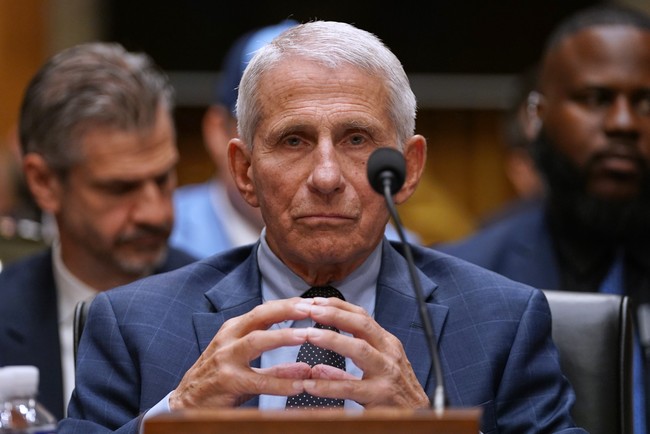

Rand Paul announced yesterday that his Senate committee will hold a vote next week to send a contempt citation against Anthony Fauci to the full Senate. But has Florida Attorney General James Uthmeier mooted that effort?
As the Senate Committee on Homeland Security and Governmental Affairs hearing-cum-public-beating wrapped up yesterday, the chair warned Fauci that his use of the Fifth Amendment was “unsupported” in light of his pre-emptive pardon. Senator Paul also noted that the former NIAID chief had effectively waived his Fifth Amendment rights by testifying with an opening statement, but the main thrust of Paul’s argument was that the pardon had already eliminated any potential criminal consequences from his testimony, except for perjury:
“He was subpoenaed here to testify, refused to answer any questions even after being directed by the chair and being advised of the law requiring him to do so,” Paul said. “He has cited a privilege that is unsupported because of his blanket pardon and because he waived the privilege by testifying at the start.” …
“Limited to the period of your pardon, at any point between Jan. 1st, 2014, and Jan. 19, 2025, did you destroy any federal record or tell anyone else to?” Paul asked Fauci.
Fauci declined to answer, citing the Fifth Amendment.
“Because you refuse to answer, citing a privilege that is unsupported because of your pardon, and after being denied to do so, this committee has scheduled a vote next week on a resolution certifying your contempt,” Paul said.
As I wrote yesterday, Paul is correct … within a particular context. Immunity in any form negates the use of the Fifth Amendment ‘privilege,’ which means a refusal to testify while immunized can be charged as obstruction or contempt. Josh Hawley even cited Supreme Court precedent in the same hearing to warn Fauci that the committee will pursue criminal prosecution for his failure to answer questions. In Brown v Walker (1896), the Supreme Court ruled that witnesses who have been immunized against criminal prosecution, whether through pardons, deals with prosecutors, or legislative action, can be compelled to testify and can be prosecuted for refusing.
But has Fauci truly been immunized against prosecution? Florida AG James Uthmeier threatened to investigate and prosecute Fauci after he refused to testify:
Florida Attorney General James Uthmeier announced a state investigation into Anthony Fauci on Wednesday amid continued GOP scrutiny in Washington.
The Trump-era Covid czar pushed for pandemic safety requirements such as face mask use and social distancing that drew criticism from Republican lawmakers — particularly in Florida, led by Gov. Ron DeSantis — and prompted dozens of appearances before congressional committees, where he was accused of misleading the public.
Fauci declined to answer questions Wednesday at a contentious Senate hearing, exercising his Fifth Amendment right against self-incrimination. Uthmeier announced the launch of a state investigation into Fauci shortly afterward.
“Fauci’s lack of candor to Congress is unbelievable,” Uthmeier said in a post on X. “It’s past time we get the truth of what happened during COVID.”
As my pal Kurt Schlichter pointed out yesterday, Uthmeier – while well-meaning – may have justified Fauci’s use of the Fifth Amendment. Joe Biden’s pardon immunized Fauci against all federal prosecution for any actions he committed between 2014 and 2024. Presidential pardons do not apply to state and local prosecutions, however. If Uthmeier finds evidence of a crime committed by Fauci that has not yet gone beyond the statute of limitations, Biden’s pardon would be meaningless for Fauci.
However, there is a caveat to the caveat: proper jurisdiction and the option of removal. Uthmeier pledged to investigate Fauci’s record for evidence of crimes committed under Florida statutes. But Fauci’s actions took place as a federal official, which means that proper jurisdiction belongs to the federal courts rather than state or local courts. We see the same issue apply to immigration agents being threatened by local DAs for actions taken as part of their enforcement activities, and the same principle applies. If Fauci did get charged in Florida, he could petition for removal to federal court, where the pardon would stop any prosecution.
The Congressional Research Service explained this in November 2024:
On the criminal side, the usual rule is that state criminal prosecutions proceed in state court. Removal statutes—such as the officer removal statute discussed below—create a narrow exception to this rule. When those statutes permit removal of state criminal prosecutions, special procedures apply. (Federal criminal prosecutions always proceed in federal courts, which have exclusive jurisdiction over federal criminal cases.)
The federal officer removal statute, codified at 28 U.S.C. § 1442, seeks to provide a neutral federal forum to preserve the supremacy of federal law and prevent federal officers and their agents from being improperly sued or punished when they attempt to perform their duties. 28 U.S.C. § 1442(a)(1) allows for removal of a civil or criminal case against the United States, a federal agency, or a person holding federal office, if the case relates to acts taken “under color of such office or on account of any right, title or authority claimed under any Act of Congress for the apprehension or punishment of criminals or the collection of the revenue.” The phrase “under color of … office” means that the defendant was acting within the scope of their official duties or with actual or apparent legal authority related to their office. Section 1442(a)(1) also allows for removal of cases against a person acting under the direction of a federal official if the directing official was acting pursuant to their official authority. Other subsections of Section 1442(a) allow for removal by certain persons holding property whose title is derived from a federal officer, officers of the courts of the United States acting under color of office or in the performance of their duties, and officers of either house of Congress acting in the discharge of their official duties under orders of the house of Congress.
Additional statutes authorize removal in specified civil or criminal cases against members of the U.S. Armed Forces, certain civil rights cases, and foreclosure actions against the United States. Another statute enumerates certain types of cases that cannot be removed from state to federal court.
If a state court case is properly removed to federal court, it will proceed in federal court even if the plaintiff prefers a state forum. However, if removal is improper—for example, because the federal courts lack jurisdiction over a case or the defendant missed the removal deadline—the federal court may remand the case to state court. The court must remand the case if at any time before final judgment it appears it lacks subject matter jurisdiction, even if the plaintiff does not move for remand. The federal court may also sever and remand specific claims over which it does not have jurisdiction. When civil claims or criminal charges arising under state law proceed in federal court following removal, federal courts apply state substantive law.
Given the nature of the NIAID and the pandemic, it would not be difficult at all for Fauci to prove subject-matter jurisdiction in a removal motion. It would be a simple recourse for Fauci if Uthmeier produces an indictment, which means that Fauci still doesn’t have any real exposure to criminal liability. If the Senate refers the contempt citation to the Department of Justice, Fauci and his attorneys had better prepare for a trial.
In the end, though, Fauci’s Fifth speaks for itself. Law professor Jonathan Turley mainly avoids the legal argument and instead cuts to the moral collapse on display at the witness table:
There is no question that it is Fauci’s right to refuse to invoke his privilege against self-incrimination and many advised him to do so. It could be taken for strategic reasons separate from any criminal culpability. After all, he was given a last-minute pardon by President Joe Biden, and any false statements he made before the Committee could be used to bring criminal charges against him.
However, Fauci is unlike many who have invoked the privilege. While many past witnesses have invoked the privilege in being called to Congress, Fauci has testified for days in countless prior hearings. He also has appeared in countless interviews on these issues. He had reason to fear this hearing after his diary revealed startling contradictions with what he was stating publicly.
The question many will ask is why Fauci could not just “stick with the science” and resolve these contradictions. The fact is that he would have had difficulty in dealing with his own “inconvenient truths.” …
Fauci stayed silent while relishing his celebrity status. Indeed, his diary shows no concerns for these scientists as he breathlessly recounted his bobbleheads and cover shoots.
Once again, Fauci has every right to invoke his constitutional rights, but the public has every right to demand answers to these questions related to the deaths of 1,238,563 Americans. That may result in a grant of immunity to compel him to answer these questions.
There was a time when no one could shut up the pandemic martinet. Lo, how the mighty have fallen.
Editor’s Note: Every single day, here at HotAir, we will stand up and FIGHT, FIGHT, FIGHT against the radical Left and deliver the conservative reporting our readers deserve.
Help us continue to tell the truth about the Trump administration and its successes. Join HotAir VIP and use promo code FIGHT to receive 60% off your membership.
Read the full article here



![Sophie Cunningham Savagely Trolls A’ja Wilson After Heated Fan Meltdown [WATCH]](https://www.boredtrashpanda.com/wp-content/uploads/2026/10/2026.10.01-10.02-boredtrashpanda-6abe2fc654afb.jpg "Sophie Cunningham Savagely Trolls A’ja Wilson After Heated Fan Meltdown [WATCH]")
![Senate Democrats Crush Bill Shielding Families From Data Center Power Costs [WATCH]](https://www.lifezette.com/wp-content/uploads/2026/10/2026.10.01-10.08-lifezette-6abe312179408.jpg "Senate Democrats Crush Bill Shielding Families From Data Center Power Costs [WATCH]")