
You might say this story began 101 years ago when Paul Mauser gave birth to a cartridge that he christened the 6.5×57 and tagged with the family name. Or the story may have begun just one year ago when I stood on the firing line of the National High Power Rifle Championships at Camp Perry, Ohio, aligned the sights of my .308 rifle on a 200-yard target, applied pressure to the trigger—and flinched! That wasn’t the first time this ugly phenomenon had presented itself. A year before, at the National Silhouette Rifle Championships, I neatly settled my crosshairs on a steel ram, then shut both eyes, hauled back on the trigger, and thoroughly disgraced myself before a throng of onlookers.
A Gentler Choice
The flinching affliction is caused by recoil. Sooner or later, if you fire enough heavily recoiling rounds, your body sends a message to the brain: “That’s it, I’ve had enough. Stop the punishment!” The brain, however, thinks you enjoy the beating, and being the bureaucratic organ that it is, gets confused and issues conflicting orders to the trigger finger and other parts of your person. So sometimes your finger works when you want it to and sometimes it doesn’t. Meanwhile your poor shoulder and cheek continue to engage in various forms of evasive action.
And that was the specter that haunted me the evening after my shameful performance last year. Having the physique and constitution of an army mule, I had considered myself recoil-proof, especially with the relatively pipsqueak .308 Winchester round that I used in competition. But what other caliber could match its accuracy and overall performance? As I analyzed other calibers, all had individual drawbacks: too much recoil, too much wind drift, unsuitable bullets, short barrel life. All, that is, but one. And that one takes us back a century to Mr. Mauser and his skinny little 6.5 millimeter—26-caliber—bullet.
The 6.5 mm bullet proved so sensational that within a decade it was used with scores of military and sporting rifles in numerous case configurations and was one of the most popular calibers in the world. Dozens of nations adopted one of the various 6.5 mm cartridges for their police forces and armies, and by the first generation of this century virtually all European makers of sporting arms offered some version of the 6.5 for hunting rifles. Before long every species of game known to man, including elephants, had been taken with some version of the 6.5; even Ernest Hemingway’s poor Francis Macomber was done in by his wife’s stylish little 6.5 Mannlicher-Schoenauer. What else? In Frank Barnes’s Cartridges of the World, I count upwards of 30 military and sporting 6.5 cartridges of different case sizes and shapes.
The 6.5 Arrives
While the 6.5 took root and blossomed in virtually every other corner of the globe, America took amazingly little notice. Charles Newton put together the .256 in 1913, a little-known round that was discontinued by about 1940. And more recently Winchester offered the .264 Magnum “Westerner,” and Remington briefly produced a .264 Remington Magnum. But Winchester and Remington failed to sell U.S. hunters on the idea of a 6.5 because the companies entirely missed the point of what had made it so popular elsewhere in the world. The successful 6.5s are relatively small, mild-kicking rounds loaded to moderate velocities with bullets that have high weight-to-diameter ratios. Driven at higher than normal rotational speeds, these slender, highly stable bullets resist being deflected by brush, penetrate deeply, and are deadly without the need for high velocity. These characteristics explain why hunters in Sweden, where more moose are killed annually than anywhere else, dote on their beloved 6.5s. This popularity extends to European target ranges where the accuracy, wind resistance, and mild recoil of the various 6.5 cartridges have long made them the caliber of choice among the athletes who compete in the demanding 300-meter international rifle events.
Casing the Cat
As I mulled over these facts that evening at Camp Perry a year ago, it was clear that any one of half a dozen classic European 6.5 rounds would be perfect for my needs and, in fact, would give me a much-needed competitive edge. There was just one big problem—the great 6.5s were all foreigners and, dammit, I wanted an American 6.5. Which, except for the Magnums, didn’t exist. So why not adapt an existing American cartridge case to 6.5? That would ensure a plentiful and inexpensive supply of brass and make the concept more agreeable to other shooters and manufacturers.
Perhaps the most obvious case to use for a wildcat cartridge is the .308 Winchester. It’s abundantly available, all-American, and short enough to function through the magazines of short and stiff (meaning accurate) rifle actions. And it has proved its adaptability by successfully fathering such cartridges as the .243 Winchester, the 7mm-08, the .358 Winchester, and, incidentally, my own .22 Cheetah. It was an instant candidate for the type of cartridge I had in mind, but still I was nagged by the fact that the .308 case has more powder capacity than necessary here. I needed a case more similar to, say, the compact 6.5×54 Mannlicher, because for my purposes less would be more. Then it hit me like thunder—the .250 Savage case! Perfect!
Also called the .250-3000 because it achieved the dazzling velocity of 3,000 feet per second back when the .30-30 was considered a reckless speedster, the .250 Savage is one of the most efficient cartridges ever designed. Yet it has been curiously overlooked by wildcatters—with one notable exception. That was when, many years ago, it was necked down to .22 caliber and became, until going legitimate in 1955, the most popular wildcat of all time—the .22-250.
Before the night ended I had sketched out specifications for two 6.5 cartridges—one on the .250 case and another on the .308—and made projections for velocities with different bullet weights. With a 120-grain bullet loaded to a modest 2,400 fps or so, recoil would be no more than that of a .243 Winchester. With 85-grain bullets, barrel wear would be negligible, but there would be plenty of punch for knocking over silhouette targets at 200 and 300 meters. And too, the almost nonexistent recoil would mean faster shot recovery in hunting situations and during the rapid-fire stages of high-power-rifle competition, thus allowing more time for aiming, a definite edge.
For the longer ranges a slick 140-grain bullet loaded to 2,650 fps would offer better wind resistance and energy for knocking over the big silhouette turkeys and rams at 385 and 500 meters. And for hitting the six-inch X-ring of the 600-yard national-match target, the same load would have virtually the same wind drift as the .308 match loads with 168-grain bullets, but with 40 percent less recoil.
Read Next: Jim Carmichel’s 6.5 Leopard and Other 6.5 Cartridges That Never Gained Popularity
A World Beater
Such cartridges would not only be outstanding on the target range, but for hunting they would be equal to or better than the great European 6.5s, especially when combined with fast-handling deer rifles like the Remington Model 7, Winchester’s short-action Model 70 Classic Featherweight, or Browning’s BLR lever action.
In the September 1993 issue of OUTDOOR LIFE I named the 6.5 Mannlicher as my first choice for whitetails. These Wildcats could be even better. Consider this: A 140-grain 6.5 hunting bullet loaded to only 2,800 fps would have a performance level very near that of the .270 Win. with a 130-grain bullet factory-loaded to 3,060 fps. Imagine, all this in a lightweight carbine … which gets to the heart of why the 6.5s have been worldwide favorites for a century.
Such heady prospects notwithstanding, I had no delusions about being the first person to consider converting the .250 Savage or .308 Winchester to 6.5 caliber. The logic of these combinations was simply too obvious for experimenters not to have tried them long before I thought of it. On the other hand, ballistics experimenters almost always proceed on the principle of goosing the last possible foot per second out of their projects (most often by expanding case walls and sharpening shoulder angles to increase powder capacity). I had no such grand pretensions, the sloping shoulders of .250 and .308 cases make feeding slick and positive, which is not always true with sharp-shouldered wildcat cartridges. And by changing nothing but the neck diameters the conversion would be the simple one-step operation of running cases into a sizing die. They would then be ready for full-power loads with no need for fire forming or any of the other aggravations normally associated with wildcats.
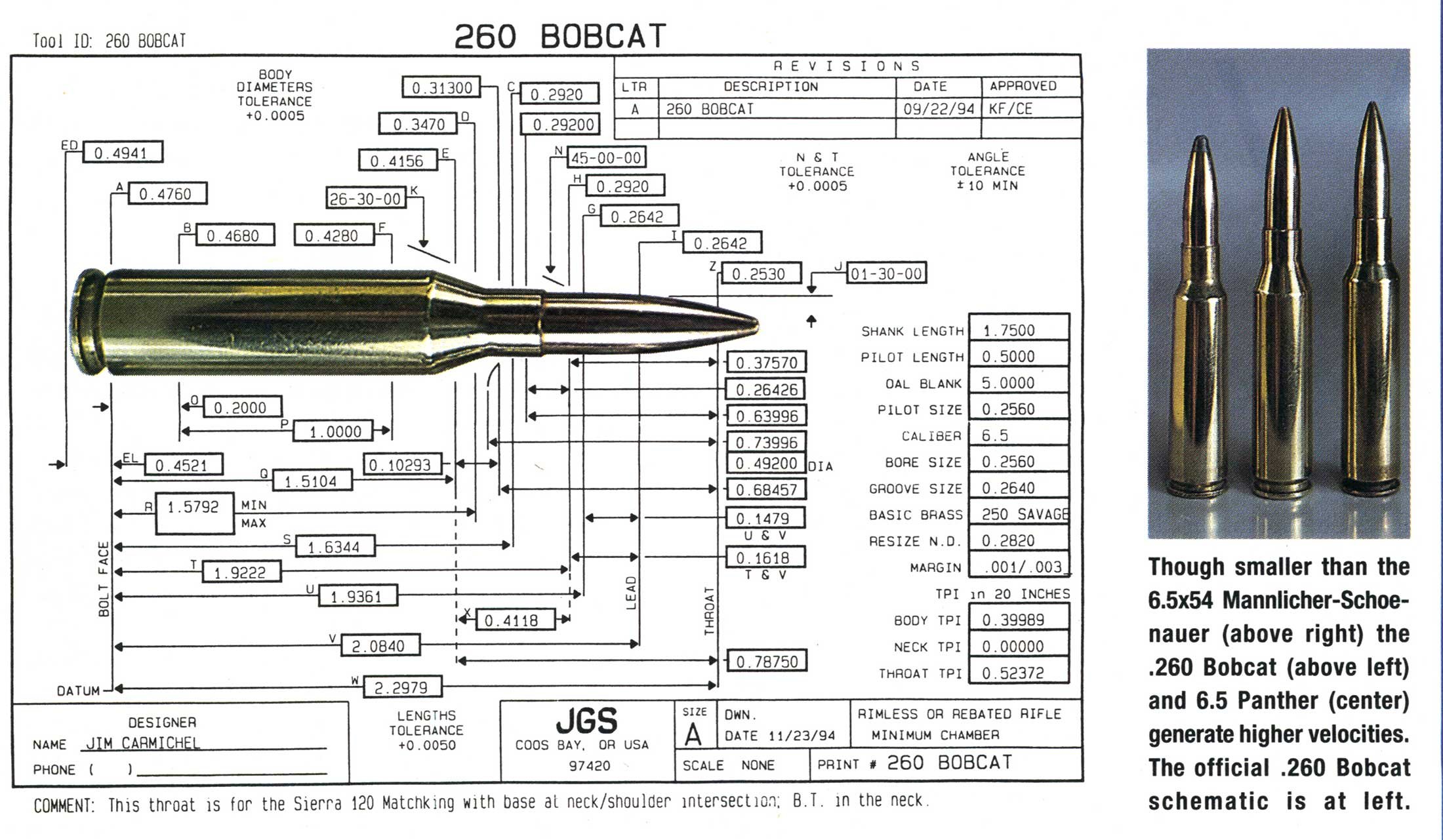
In wildcatters’ lingo the two cartridges could be called the 6.5-250 and 6.5-308, but since I’ve named my other wildcats after felines, I’d call these the .260 Bobcat and the 6.5 Panther, a pair of small but deadly cats. And so it was that a day that began in disgrace ended with dreams of ballistic ecstasy.
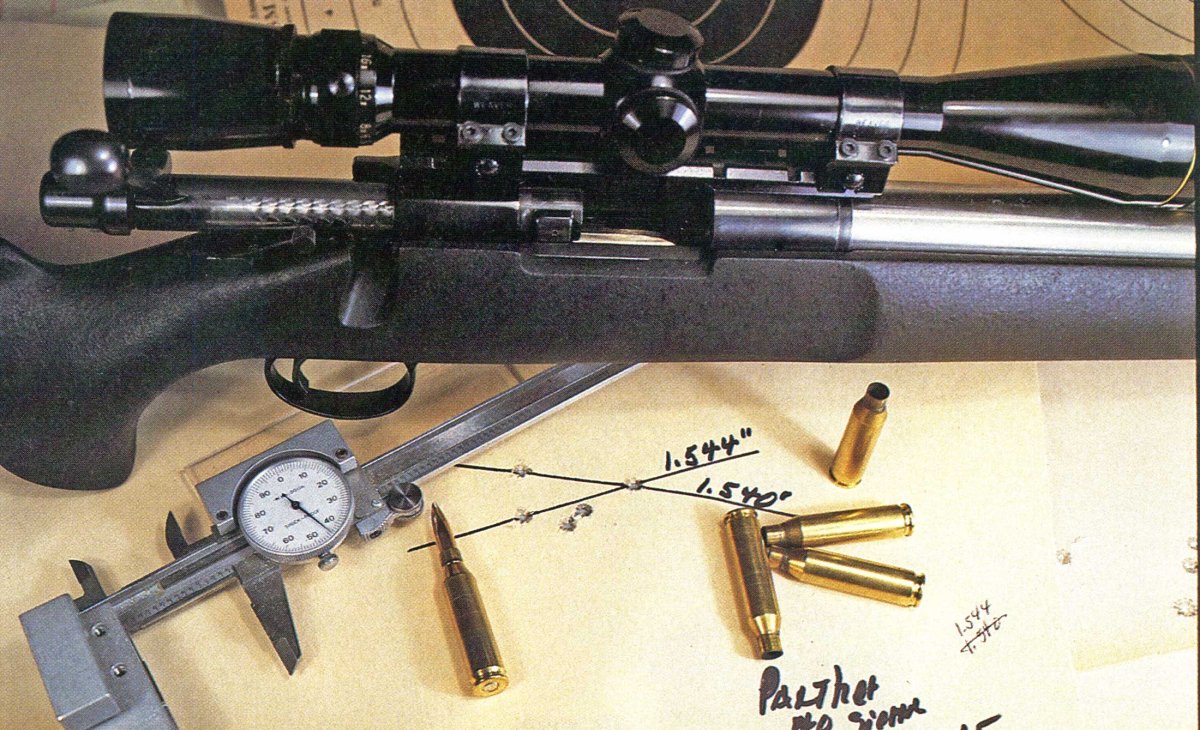
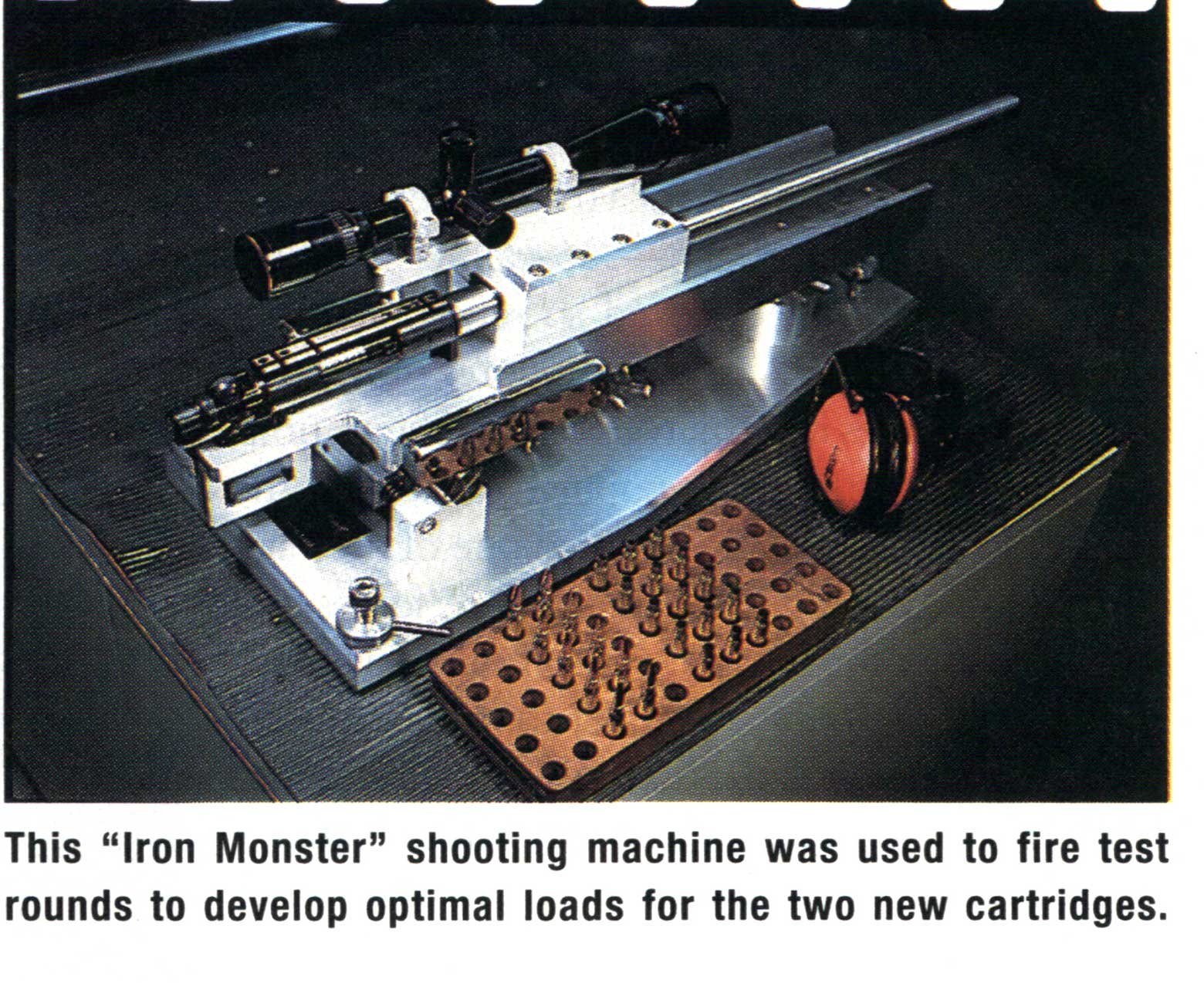
A few months later the Panther and Bobcat were realities. Jim Cuthbert, of JGS Precision Tool Manufacturing, the well-known reamer makers, had converted my ideas to toolroom drawings, and his company had made chambering reamers. Normally, the next step in cartridge development would be building test guns for collecting velocity and pressure data, but I was so convinced that the Bobcat, in particular, would be a winner that I sent my silhouette rifle and the new reamer to Shilen Rifles to have the weight-forward (for steadier offhand aiming) .308 barrel replaced with a 6.5 barrel of the same contour. The Panther reamer went to Douglas Barrels for fitting a heavy, stainless-steel barrel to a Remington M-700 action. This test unit could be fired from a rigid “slave” stock made by HS Precision or clamped in a machine rest for load and accuracy development at OUTDOOR LIFE’S test range. While the barrels were being fitted I prepared the hundreds of cases needed for a comprehensive test program. It’s worth noting that .243 rather than .308 Win. brass were used for the Panther cases. Except for neck diameter the two are identical, and the .243 neck is easily expanded by passing it over the expander button in a 6.5 Panther sizing die or, better yet, by using a Sinclair neck-expanding mandrel.
The initial testing of a newborn cartridge is always a big event, so you can imagine the excitement one cold morning last winter when we went to the range with two new rounds to test. There was also considerable apprehension—not about safety, since each rifle would be proof-fired with overloads—but for accuracy. It’s no secret that for every caliber and bullet weight there is a particular rate of rifling twist that yields optimal accuracy. Which is why hunters often discover that their .30-06 is more accurate with 180-grain bullets than with bullets weighing 150 grains or less. Since the goal for my two new cartridges was to fire both 120- and 140-grain bullets with maximum accuracy, there was the challenge of finding a compromise rate of twist that would work for both weights. Technicians at Douglas and Shilen agreed with me that a one-in-nine twist would be logical, but there was a possibility that the compromise wouldn’t work for either bullet. In that case, the whole affair would be a disaster.
That’s how the situation stood when I settled the Bobcat on target and touched off the first 120-grain bullet that chill Tennessee morning. There was a mild report, almost no recoil, and a bullet hole appeared close to point of aim on the 100-yard target. A second shot went close by on a horizontal line, and the third shot couldn’t be seen because it went through one of the other holes. Two more shots filled in the gap. It wasn’t a world beater, a bit less than three quarters of an inch, but outstanding for a new rifle and unrefined loads. The next group was almost identical.
Now came the real test. Switching to the lean and ultra-streamlined 140-grain Sierra MatchKings, the Bobcat put the first three shots almost on top of each other, and despite a rapidly changing crosswind, the final two went into a group even smaller than those made by the 120-grain bullets.
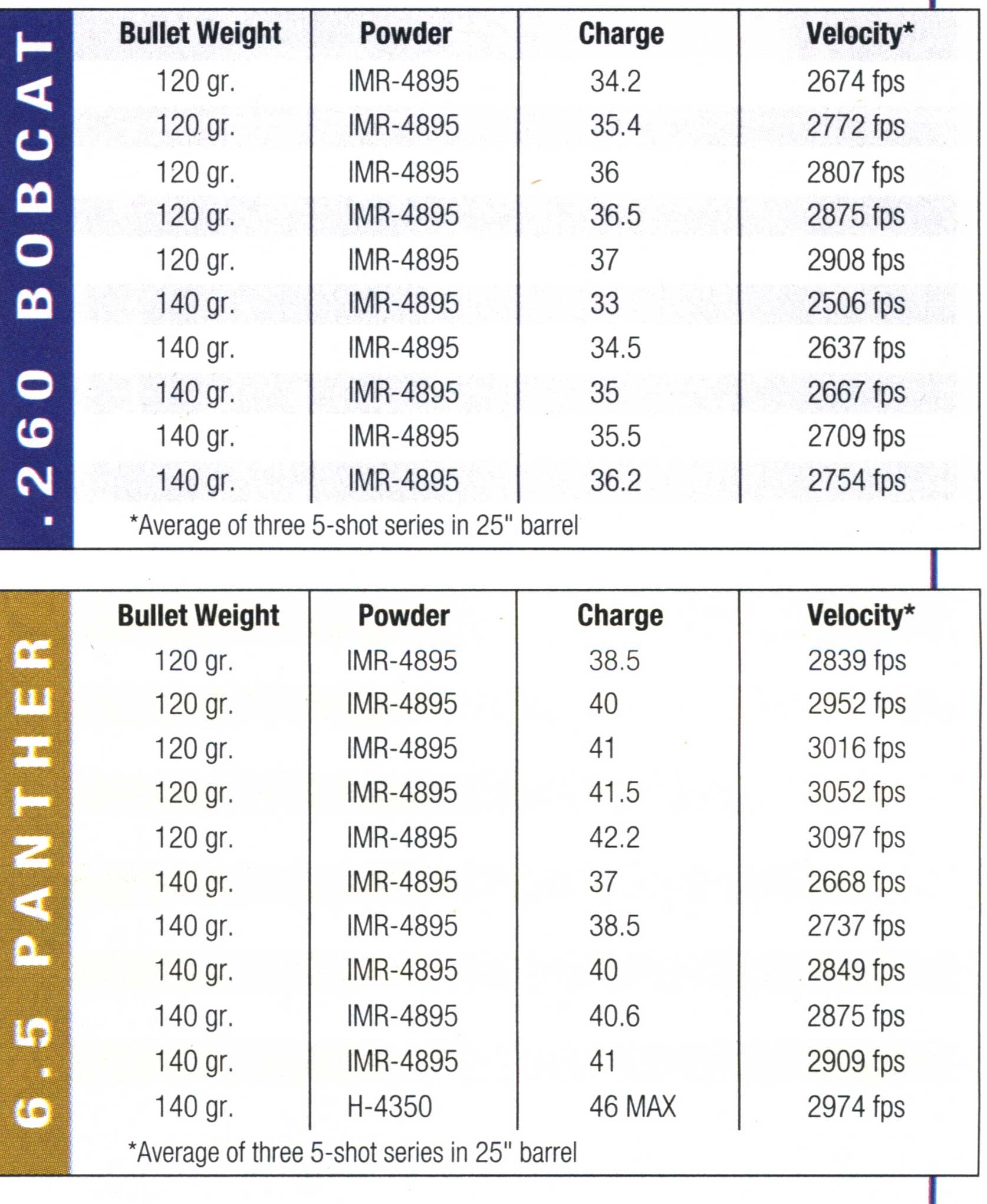
When I turned to the onlookers there were cheers and high fives. The first test indicated that the round not only did what it was supposed to do, but when we checked the printout from the chronograph, we found that the Bobcat had delivered a bonus. A mild load that had been calculated to have a velocity of about 2,500 fps with the 120-grain bullet actually averaged 2,674 fps! Likewise, the 140-grain bullets were going more than 100 fps faster than predicted. Not only was the efficiency of the .250 Savage case reaffirmed but it was proving even better than the European 6.5s.
In subsequent testing, the 6.5 Panther proved to be a very fast cat indeed, pushing the 120-grain Nosler close to 3,100 fps and the 140-grain Sierra almost to 3,000 fps.
Though the first tests yielded some gratifying groups, the fact of the matter is that accuracy testing at 100 yards can be deceiving. The only way to know for sure is to go the distance, which we did on a couple of calm mornings in early May. Firing from a bench at 500 yards, the test series included firing a five-shot group from a cold, clean barrel, followed by a 10-shot group, then cleaning the bore and repeating the process. The purpose of the 10-shot groups was to judge the effects of heat and fouling, always a consideration in long-range competition. Sparing you any further details (most of which are in the accompanying charts), the average size of the twenty 5- and 10-shot groups fired with the Bobcat at 500 yards, with all loads and bullet weights, was less than a minute of angle, 4.073 inches to be exact. The Panther, with its heavier barrel, averaged 3.88 inches, including three consecutive five-shot groups that averaged an almost unbelievable 2.318 inches. Indeed, the American 6.5 had arrived.
This story was originally published in the September 1995 Issue of Outdoor Life.
Read the full article here

![Woke WNBA Player Pummels Sophie Cunningham, Blames Ejection on ‘White Privilege’ [WATCH]](https://www.boredtrashpanda.com/wp-content/uploads/2026/08/2026.08.09-14.12-boredtrashpanda-6a788ab0422f1.jpg "Woke WNBA Player Pummels Sophie Cunningham, Blames Ejection on ‘White Privilege’ [WATCH]")