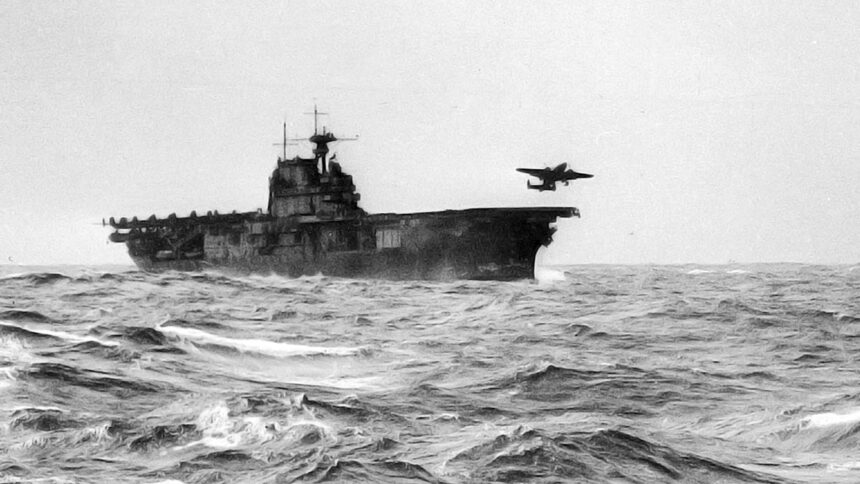

Summary and Key Points: Sixteen B-25 Mitchell bombers were lashed to the flight deck of the USS Hornet in April 1942. They were US Army aircraft — twin-engined, no arrestor hook, far too heavy and too fast to ever come back down on a carrier. The deck run was one-way by design. The plan was to launch 400 miles from Japan, bomb Tokyo and four other cities, and keep flying west to airfields in China. Then a Japanese picket boat spotted the task force, and the bombers were ordered off roughly 170 miles further out than planned, into a fuel margin that had been calculated to the gallon.
BONUS – We have included recent photos of the B-25 we took at the National Museum of the US Air Force.
The B-25 Heads to Japan
By the spring of 1942, the United States had suffered five months of nearly unbroken defeats in the Pacific.
Pearl Harbor had crippled the battleship fleet; the Philippines were falling; Wake Island, Guam, Hong Kong, and Singapore had fallen to the Japanese; and the Dutch East Indies, with its immense oil reserves, would soon follow.
B-25 at the National Museum of the US Air Force. Photo taken by Harry J. Kazianis for 19FortyFive.com
Imperial Japan controlled a perimeter stretching from the Aleutian Islands to the very doorstep of Australia, and high command in Tokyo regarded the home islands as untouchable, protected by both distance as well as a navy that no one had yet been able to challenge credibly.
American planners, left with little more than three aircraft carriers and a badly battered public mood, needed some kind of answer, even if that answer would be mostly symbolic.
The Doolittle Raid: Bombers Attacking from Aircraft Carriers
The raid, conceived that spring, was audacious mainly because it should not have worked.
Sixteen U.S. Army B-25 bombers, land-based aircraft never meant to take off, let alone land from an aircraft carrier deck, were crammed onto the USS Hornet for a one-way mission: bomb Tokyo and four other cities, then continue on to airfields in China rather than attempt a landing no carrier could accommodate.
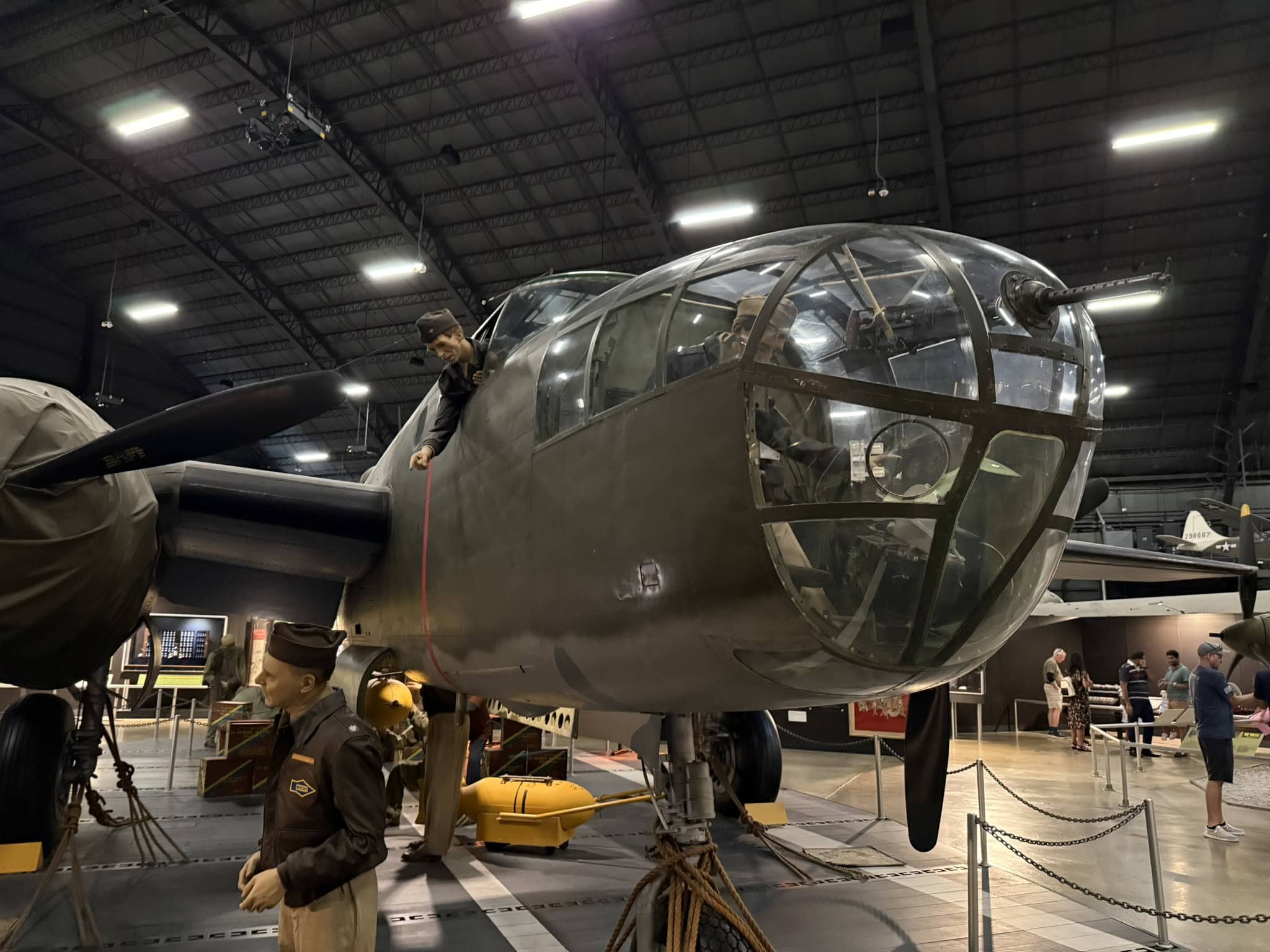
B-25 at the National Museum of the US Air Force. Photo taken by Harry J. Kazianis for 19FortyFive.com
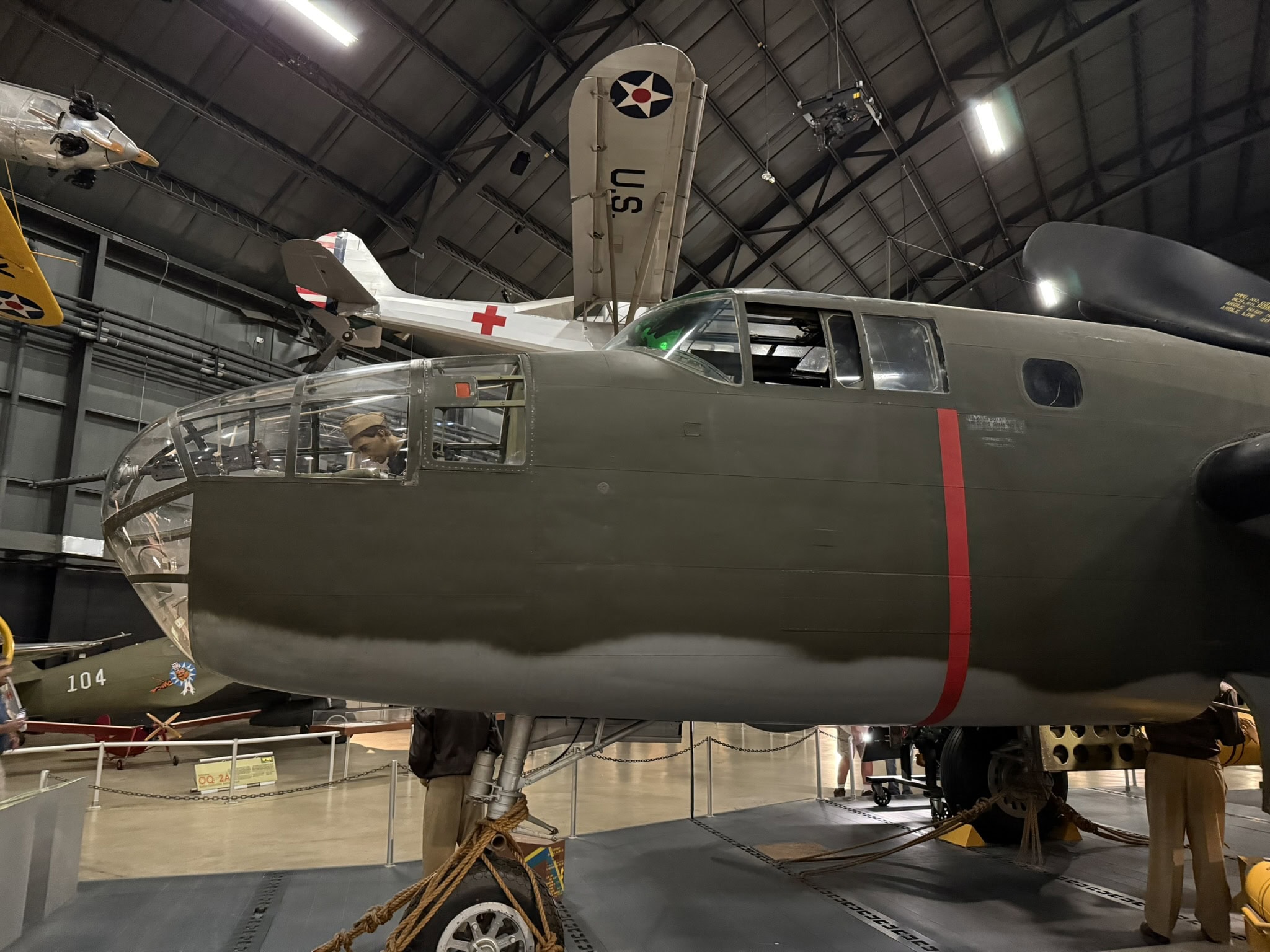
B-25 at the National Museum of the US Air Force. Photo taken by Harry J. Kazianis for 19FortyFive.com
Fuel margins were calculated to that gallon on the assumption of a launch 400 miles from Japan, but when a Japanese picket boat spotted the task force early, the bombers were ordered off about 170 miles further out than originally planned, eating into a fuel cushion that was minimal to begin with.
Several crews ran out of fuel over China and bailed out in the dark. One aircraft diverted to the Soviet Union where its crew was interned.
Eight airmen were captured by the Japanese, and three of them were executed.
The bomb loads were too light to inflict serious material damage, and every planner involved knew it before the mission launched.
What the raid offered, however, was not destruction but proof that Japan’s cities were not untouchable.
Psychological Effects
Japan’s vulnerability mattered more in Tokyo than the bombs themselves mattered.
Japanese military leaders had told their public, and to some extent themselves, that the home islands lay beyond American reach.
But Doolittle’s aircraft, however modest their payload, punctured that myth in a single afternoon.
The Imperial Navy’s leadership, and Admiral Yamamoto Isoroku in particular, treated the raid as confirmation that America’s remaining carriers had to be destroyed before they could strike again.
Yamamoto had already been pressing for an operation against Midway Atoll as a way of drawing the American fleet into a decisive battle.
But opposition within the Naval General Staff, distracted by competing plans in the south, had slowed him down.
The raid removed that resistance almost overnight, and within weeks, the Midway plan was approved and rushed forward, partly out of a genuine desire for revenge and partly out of anxiety that further raids might follow.
Separately, and much more grimly, Japanese forces occupying parts of China conducted a reprisal campaign against communities suspected of having sheltered the American airmen.
An estimated quarter of a million Chinese civilians were killed over the following several months.
A Boost to Morale
In the United States, the effect was almost the opposite of the material outcome.
After months of retreat, here was an offensive act, carried out over the enemy’s own capital — and it landed on front pages around the country.
President Roosevelt, asked where the bombers had come from, told reporters only that they had flown from Shangri-La, a piece of theatrics that aided public confidence.
War bond sales and enlistment figures both rose, and the sense that the war was shifting to the offensive deepened.
But Midway was one of the raid’s most consequential legacies.
Yamamoto’s push for a decisive engagement, hastened by the embarrassment of the Doolittle Raid, brought the Imperial Navy to Midway in June with a plan drawn up in haste and divided across far too many objectives — including a diversionary strike on the Aleutians that split off resources it could not spare.
American codebreakers, reading enough of the Japanese naval cipher to anticipate the target, were lying in wait.
The battle cost Japan four fleet carriers and the trained aircrews it could not readily replace.
It was the Pacific war’s hinge point, the moment the strategic initiative passed to the United States.
The Doolittle Raid was one of the catalysts that put Japan onto the back foot.
In terms of ordnance dropped, the Doolittle Raid was negligible. But judged by what it galvanized, in both Washington as well as Tokyo, it was among the more consequential air raids of the war.
About the Author: Caleb Larson
Caleb Larson is an American multiformat journalist based in Berlin, Germany. His work covers the intersection of conflict and society, with a focus on American foreign policy and European security. He has reported from Germany, Russia, and the United States. Most recently, he covered the war in Ukraine, reporting extensively on the war’s shifting battle lines from Donbas and writing on the war’s civilian and humanitarian toll. Previously, he worked as a Defense Reporter for POLITICO Europe. You can follow his latest work on X.



![Abdul El Sayed Could Detonate Democrats’ Entire Midterm Strategy [WATCH]](https://www.lifezette.com/wp-content/uploads/2026/08/2026.08.07-19.04-lifezette-6a762c506d3e5.jpg "Abdul El Sayed Could Detonate Democrats’ Entire Midterm Strategy [WATCH]")
![Illinois Mother Who Closely Tracked Lindsay Clancy Trial Being Called a Copycat [WATCH]](https://www.lifezette.com/wp-content/uploads/2026/09/2026.09.05-11.20-lifezette-6a9bfb187c8b6.jpg "Illinois Mother Who Closely Tracked Lindsay Clancy Trial Being Called a Copycat [WATCH]")